

American Transition
The old American order is gone. A new one hasn’t arrived. What the transition looks like—and why it still holds promise.

There’s a sense among many that America is in decline.
A better way to make sense of what we are seeing and feeling is that America is in transition. An old order, one that shaped many people’s lives, is passing away, but a stable new order has not taken its place.
We are living in a liminal period, where we can’t go back, but we aren’t sure where we are moving forward to.
A change of orders is painful. Tanner Greer documented one such transition, from the antebellum American order to America as a nationalized, industrialized colossus. But we could also think of the shift from pre- to post-World War II America.
Many mourn the passing of the old. And certainly things of value are lost in a change of order. But throughout our history, the new orders have proven on the whole to be better than what came before. Certainly few people today would actually choose to live in the previous orders if offered the chance to go back in time.
There’s no guarantee America makes it safely out on the other side into a newer and better configuration. But the was no guarantee in the past either. Previous generations of American helped build those new futures. And that’s the call on us as well.
To show the scope of what’s changing, I’ve created a framework showing the American transition in progress - the old postwar/pre-60s order we came from, where we are today in what I believe to be a transition phase, and where we might be tomorrow.
I trace this transition across three major categories: culture and formation, institutions and governance, and political economy and material conditions.
Culture and Formation
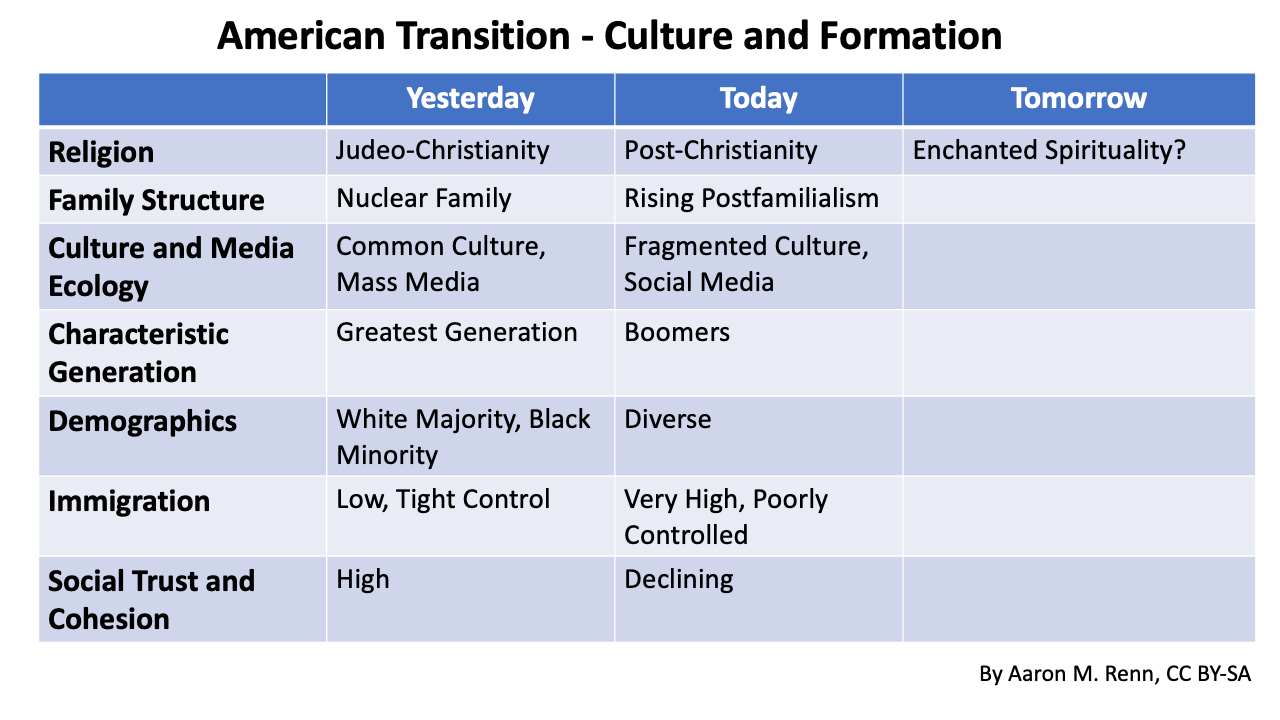
We see here the religious transition I’ve charted in my work. In the postwar order, American’s previous softly institutionalized generic Protestantism gave way to a generic Judeo-Christianity as Ellis Island era immigrants were brought into the American mainstream. Today, we are in a post-Christian culture - see my recent Wall Street Journal essay on vice as an example. We appear to be trending towards a reenchanted spirituality as a religious base.
Similarly, I’ve written a lot about the shift towards postfamilialism, with falling marriage and fertility rates. If this trend does not change, it will have profound consequences for the country - and the world. Many people are studying this topic, but few viable solutions have yet emerged.
While we read more about this in the past than we do today, the postwar order was characteristics by a national common culture (with local cultures beside it) created by mass media, starting with radio and Hollywood. This began shattering the 1990s and has continued fragmenting. Today’s social media driven landscape has a very different media ecology than mass culture America.
We’ve also seen big demographic shifts, from a largely biracial to a diverse society with high and uncontrolled immigration flows. Today’s era remains very Boomer dominated, as we have been for 35 years or so. But this will soon pass.
Unsurprisingly, we’ve seen along with this a decline in social trust and cohesion, and the kinds of dysfunctional politics that characterize our present day.
There’s a lot of white space on this chart. I don’t think the future is set in stone on any of these points.
Institutions and Governance
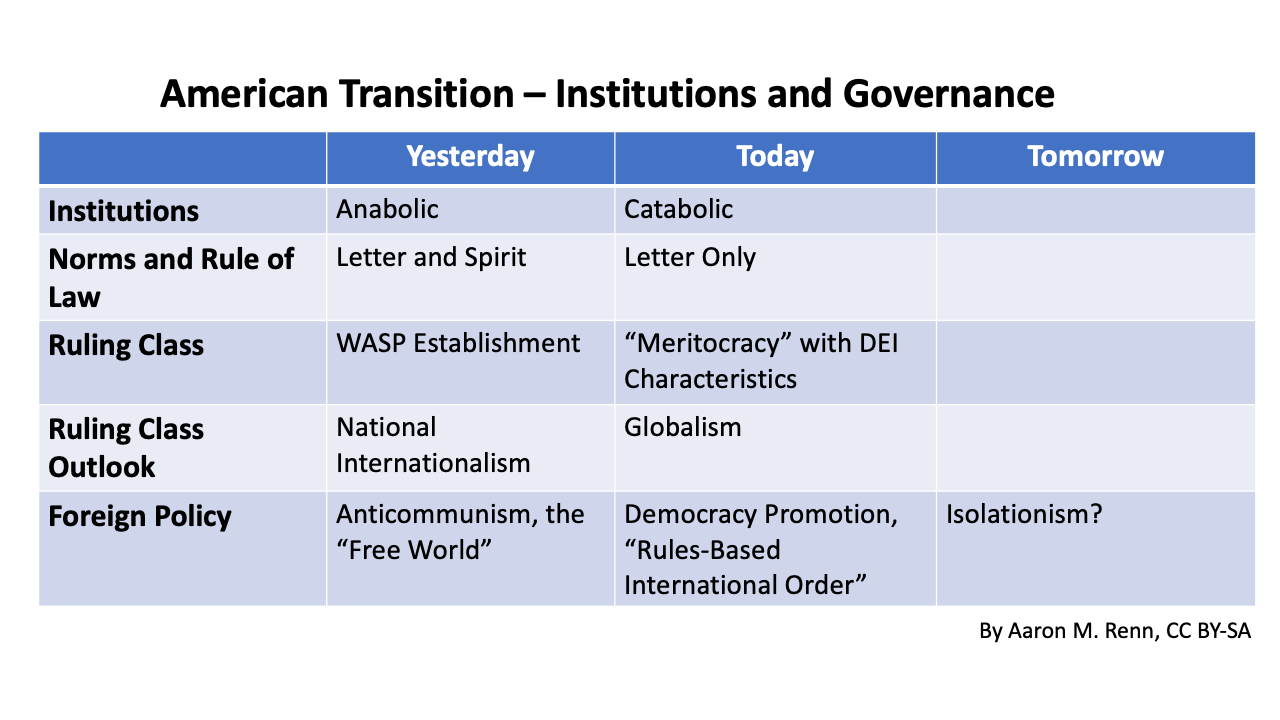
The characteristic trend we see here is a steep decline in institutional trust, something very few people seem interested stopping, much less able to stop.
Related to this is the decline of norms. Today, people only feel bound by the letter of the law (if that). Previous norms like “fair play” are despised. Hence we see large percentages of students at elite colleges claiming to be disabled to get extra time and accommodations on tests and such. The new rule is that anything that can be done should be done - if it’s personally advantageous. This ethos has come to permeate our politics, but it is much more pervasive than that.
As those of you who have read my work know, this collapse in norms is related to the collapse of the old WASP establishment, whose values defined those norms. Today’s ruling class is certainly more open, but also less effective. While it contains many good individuals, collectively it is a bankrupt enterprise. The whole is less than the sum of its parts.
In this environment, the commitments of the old order around the ruling class outlook and American engagement in the world are up for grabs. A traditional American isolationism is reasserting itself. While there’s no going back to the insular America of old - at least without some type of great national catastrophe - the idea of a purely cosmopolitan and globalist worldview, detached from the national interest, also seems to lack future viability.
Political Economy and Material Conditions
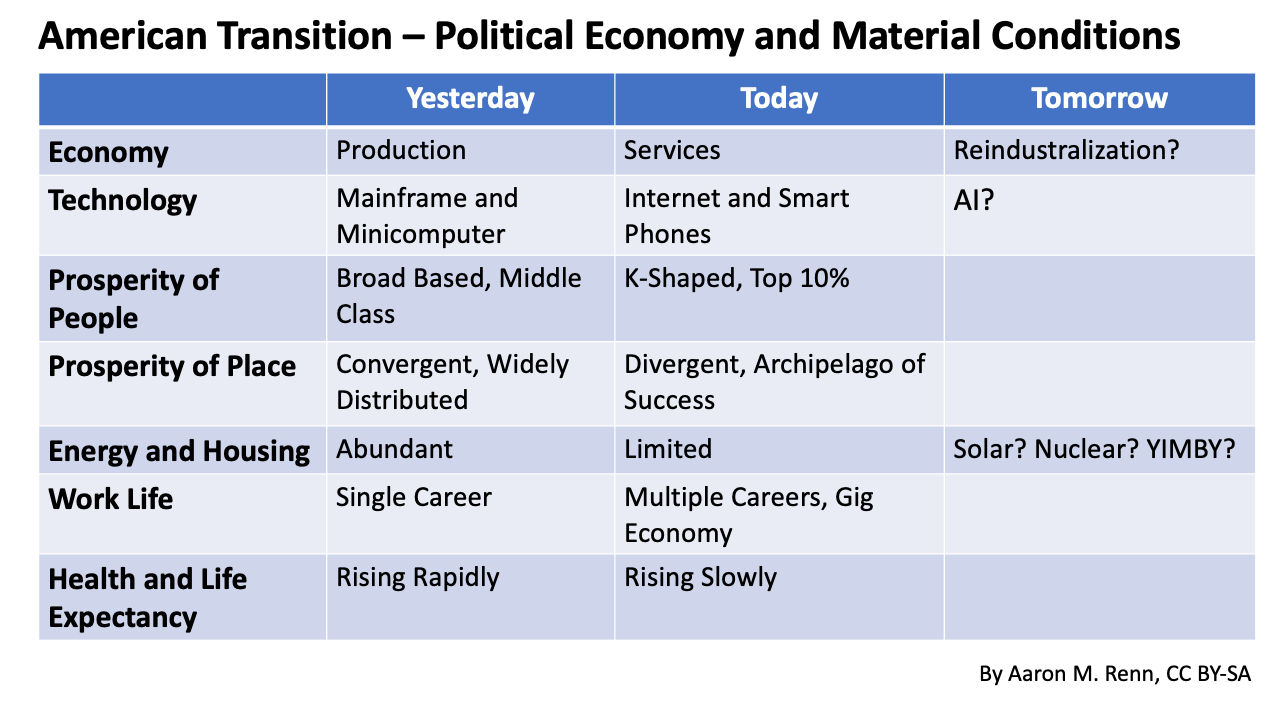
We see here the shift to a post-industrial economy. People of a variety of persuasions believe we’ve gone too far towards services, believing some measure of production capacity is necessary for defense if nothing else. We’ve seen moves towards a reindustrialization agenda, such as with the CHIPS Act, but the future is very uncertain here. AI also promises to upend our economy, and will have big implications for the future of work.
I’ll briefly note an emerging techno-pessimism in a segment of the American right, one that is skeptical of the viability of technical progress, skeptical of the implications of technical progress, and even neo-Luddite in some respects. I’ll be writing more about this in a forthcoming essay.
We also see the kinds of distributional questions that have produced a lot of discussion and political upheaval. A “K-shaped” society in which the top 10% of households by income control half of all spending is reshaping the fabric of the economy. We still experience significant geographic divergence, with many left behind cities and an entire “Old North” region that is largely moribund.
Housing and energy have gotten much more expensive. Again, there’s a lot of centrist consensus that we need more of both, and the bring down the cost of both. But the center-left “abundance agenda” is easier to talk about than to make reality. And a significant and well-funded segment of the left remains committed to de-growth.
I’ll lastly note that there’s a mixed bag on health. We are now seeing breakthrough miracle cures of diseases like cystic fibrosis. Life expectancy is now back up again. Yet our health care costs are the highest in the world, the public health establishment discredited itself during Covid, progress on many medical fronts remains stubbornly low, and techno-pessimism is very much affecting this area as well (e.g, vaccine skepticism).
These are a lot of areas that have seen major change. One could certainly add other categories as well. Not all of these changes are necessarily bad, or at least not all bad. But the net result is an uncertain environment, one subject to increasing social and political contest as the future is up for grabs.
The future is a product of many complex and interrelated forces and events, superintended by Providence. None of us as individuals can design or conjure a new order.
What we can do is feel a sense of responsibility and opportunity in getting to participate in the creation of that future. America isn’t doomed to disintegrate.
There’s not much many of us can individually do to address many of these problems. In some respects, the logical path to take is to take actions that accelerate the disintegration of the old order. Following the old norms in a country where nobody is doing so is a formula fit only for a chump, for example. And maybe the future order actually is built around a fundamentally lower trust society. (If so, this would be a return to the status quo ante in America, which was not always as high trust as it became in the postwar era). We have to protect our families from the fallout of what’s been happening.
But I do believe we can take a more realistically optimistic stance, and see that there are going to be times that some of us do have opportunities to start building something new and better, being a part of creating that new America order.
Part of my contribution will be to work hard to give you the tools and insights need to understand what is happening and help navigate this period of change, to build lives, institutions, and a society that flourish in the era ahead.
Note: I have opened comments on this post to everyone.
Cover image: Ponce City Market in Atlanta by Keizers/Wikimedia, CC BY-SA 3.0
Of all the challenges we have, the biggest is to re-establish social trust. Unfortunately, our leadership class routinely engages in behavior or enacts policies that erode trust (mass immigration, "trust the experts" when they repeatedly show themselves to be wrong or misleading), and they obviously feel quite free to ignore the expressed will of the public on many of these as well.
I am not sure our political system or courts are capable of allowing a peaceful and non-authoritarian resolution to these problems.
This is extraordinarily insightful. As a boomer religious leader, I find it strangely comforting to "see" what's happening so well-charted through various systems and structures. Faith, being the substance of things hoped for and the evidence of things not seen, allows folks like me to live imaginatively in liminal space. I need to communicate that each and every Sunday to both the faithful and the doubtful.