

The Boomer Upsize
Baby boomers are ditching the downsizing myth to claim 4-bedroom homes near their kids and grandkids, sending home prices skyward.

Here’s another trend you are probably hearing about from me first: Baby Boomer retirees are outbidding families for big houses in prime suburban areas with top schools.
As one example, the New York Times’ real estate section highlighted a Boomer couple who decided to “upsize” in their retirement.
“We spent the last 10 years in an apartment — eight years in Chicago and now two years here,” said Mrs. Harlow, 67. “And that whole time, we’ve had what I call a ‘one-butt kitchen,’ where you can’t walk past each other.”
They thought about buying a lot and building their dream home, but doing it from Chicago would have been too difficult. So in 2022, the Harlows returned to Biloxi, found an apartment, and plotted their next steps to a bigger space.
…
Biloxi is regularly hit by tropical storms and hurricanes; Mrs. Harlow’s childhood home in East Biloxi was destroyed by Hurricane Katrina in 2005. So they looked exclusively in North Biloxi, which is farther inland, nestled in the woods along the Tchoutacabouffa River. But it came with other challenges.
“The homes in North Biloxi don’t come up on the market very often, because it’s a level-five school district and so they go fast,” said Sallie Lawson of Fidelis Realty, who worked with the Harlows. “Most houses do 10 days at max on the market and they’re gone.” [emphasis added]
They ended up buying a four bedroom house, a decision they described as a “no-brainer.”
To put some more statistical meat on this trend, St. Louis University Demographer Ness Sándoval posted about St. Charles County in his region. St. Charles County is another example of prime suburbia.
The most important county to watch right now is Saint Charles. What looks like growth on the surface is, in reality, a demographic paradox unfolding in slow motion. It is the fastest-growing county in the St. Louis region, yet much of that growth is driven by senior citizens relocating there for retirement.
Population growth alone does not guarantee demographic vitality. When the red line in the month-to-month mortality trend continues to edge upward, it signals something deeper than expansion—it signals aging that is accelerating.
The official 2024 death numbers are now in, and Saint Charles has moved another step closer to crossing the demographic Rubicon. In 2018, the gap between births and deaths stood at 1,159 (4,306 births to 3,147 deaths). By last year, that gap had narrowed to 518. In 2024, it fell again—to just 431 (4,107 births to 3,676 deaths). The margin that once provided demographic momentum is shrinking each year.
At this pace, Saint Charles may even surpass Saint Louis City in entering the first phase of demographic winter, when births approach or fall below deaths.
Four years ago, the county might have bought time by urgently expanding housing options tailored for families with children. Instead, the current trajectory suggests a slow demographic transition that will be increasingly difficult to reverse. Growth without generational renewal is not long-term growth. It is a shift in age structure and age structure ultimately determines destiny. [emphasis added']
He attached this chart of births vs. deaths in St. Charles County.
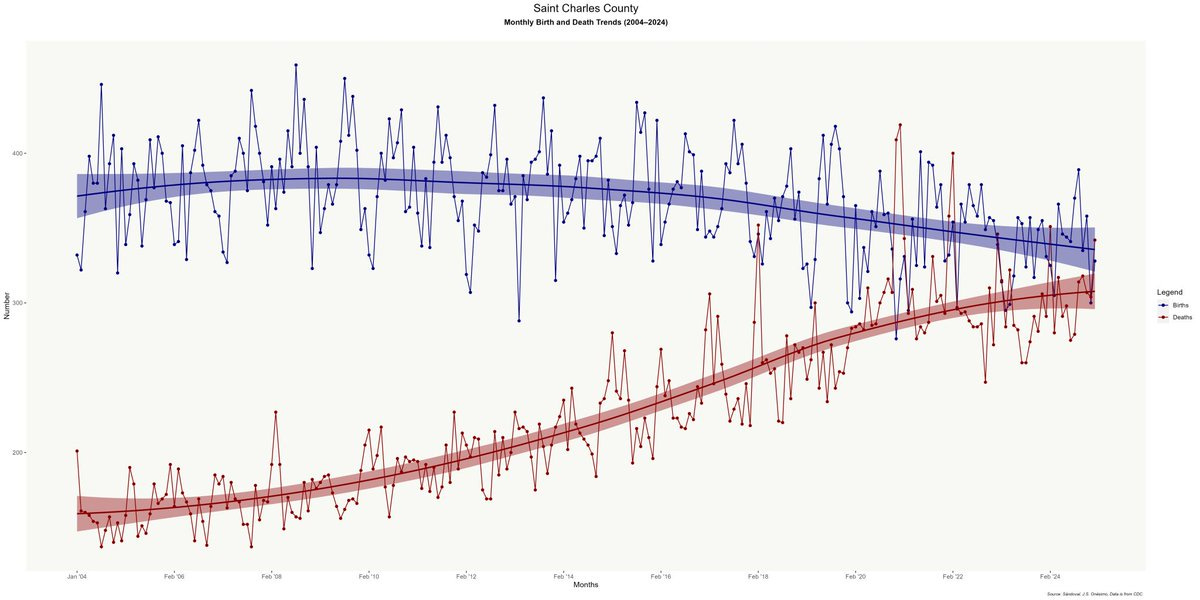
Births, though falling, are not down that much as of yet, but keep in mind this county is booming in total population. Some of the rise in death rates is also surely from generational cohort factors. We are an aging society in general, and the large Boomer generation is starting to die at higher rates. St. Charles is a growth area, but also long established. So a number of the older people dying are those who raised families there and aged in place.
Still, Sándoval notes the influx of retirees.
What’s going on here?
I don’t have good data on this as of yet, but my impression is that many of these prime suburbia retirees are relocating to be closer to children and grandchildren. We personally know quite a number of people like this where we live in suburban Indianapolis.
When I lived in Chicago in the 1990s, a common story went something like this: kids went to college at Iowa or some other Big Ten school, moved to Chicago, lived there a few years, got married, had a kid, then moved back to the wife’s hometown (or sometimes the husband’s).
In the 2000s, I started noticing a change. Rather than the children relocating to be closer to their parents and extended family, the parents started relocating to be closer to their adult children and grandchildren.
The wife of one couple I knew in Chicago was originally from Pittsburgh. Her siblings had moved south to the Charlotte area, and after retirement, her parents moved there.
As has been well-documented, upper-middle-class people are now more concentrated in upscale communities, not spread throughout the country or its urban regions. There’s also been great divergence between metropolitan areas in terms of growth and economic opportunities.
In this environment, a place like Charlotte is just going to look more attractive than moving back to a place like Pittsburgh. Pittsburgh is a great city with opportunity in select high end industries like AI and robotics, but in general the clear trend has been towards boomtown Sunbelt destinations.
In this kind of environment, it often makes more sense for parents to move rather than the children.
I’m sure that there are also cases in which people simply choose to retire to these prime suburban areas. These cities have become much more amenity rich and are now fantastic places to live based on the product they offer. It isn’t just the old “good schools and low taxes” model of eras past.
But while I don’t want to discount straight up retirement moves, I did want to highlight these family ones. Again, while I haven’t been able to find data on this, I did reach out to Sándoval. He confirmed that he’s heard from sources in St. Charles County that a lot of people are retiring there for proximity to children. (I hope he does some quantitative research on this).
I would say in general that proximity to extended family is generally a good thing. So there are lots of reasons it’s a positive development that parents are moving closer to children and grandchildren.
But this also has big implications for these suburbs.
A lot of people have a vision of multigenerational living in a single household. One of the big urbanist ideas right now is legalizing so-called “accessory dwelling units,” sometimes called “granny flats.” Part of the idea is that aging parents can live there, allowing easy caregiving, etc.
I’m sure there’s some of this, but I don’t personally know anyone doing it. But we do know many people where the retired couple owns a house.
These Boomer retirees are often still healthy and active, have plenty of money, and don’t need to economize on space. They want the big space, to live in for themselves, and to host family gatherings.
Rather than the multigenerational household, what we see is the multi-household extended family.
While the couple in North Biloxi moved to their hometown to be near their parents, not their children, they did want to host their children and other family gatherings, hence their desire for a large house.
After seven years up north, the couple felt ready to get back to their roots. They wanted to be closer to Mrs. Harlow’s parents in Biloxi, and they wanted their two adult daughters — one lives in Omaha, the other in Italy — to be able to come and see family….“The whole idea was to have enough room so that if on the off chance everyone came at the same time, they could all have their own bedrooms and baths,” said Mr. Harlow, 65.
If you’ve got the money - and the Boomers do - why not?
Boomer retirees are putting upward pressure on prime suburban home prices - and making it difficult for families to be able to buy into these communities with top schools. In effect, families are starting to get squeezed out of these communities.
A few people posted reactions to this topic when I discussed it on Twitter. Ashley Weber said, “The last two large ranch style homes for sale on my street have been purchased by Boomer retirees. They are ideal family homes with large yards, safe neighborhood in a good school district. Would love to have had playmates for my children.”
Sullivan Nolan wrote, “I’ve been in the market for awhile and see this all the time. At open houses I’m usually one of the youngest people there. It feels incredibly strange to be competing with retirees for 4 bed / 3 bath homes in top tier school districts.”
What this trend means in practice is that in a growing number of cases, in order to provide housing for families, you actually need to provide two houses - one for the actual family and another for at least one set of their parents.
Boomer retirees buying up homes in prime suburban areas has to be a factor in why prices are going up there. When the towns with good school districts become unaffordable to many families, this can’t be a positive for our fertility rates.
Again, while there are good things about parents moving to be closer to children, it does have this downside. Combine the price increases with increasingly militant demands by Boomers that they shouldn’t have to pay property taxes because they are retired, and the general NIMBYism and willingness to show up to public meetings to complain that Boomers/seniors also have. This is a recipe for public policy negatives that undermine schools and the community in the long term as they get fiscally squeezed and become less dynamic.
Public policy in these suburbs has tended towards actually exacerbating these problems. This is because they enormously privilege development for seniors.
My own city of Carmel, Indiana has recently adopted a de facto policy of becoming a retirement community. Any development that’s age restricted to seniors gets waived through the city council almost automatically, while developments for anyone else get subjected to an ordeal. In one particularly egregious case, the city council expressed skepticism of a development because it included apartments. The developer simply converted them to age-restricted apartments and the council approved without further objection.
As one person on Twitter observed about her community, some towns are actually putting age-restricted retirement communities directly next to their public schools, “The top performing school district in our area has an amazing public middle school for kids gifted in the arts and a top rated elementary school. They just built a 55+ gated community the on the property adjacent to the schools. This should be illegal.”
These kinds of decisions, if compounded over the years into the future, pose a long-term risk to these towns’ futures.
It’s good to have people of all ages in your community - including Boomer retirees. We should welcome all. But you don’t want to become a retirement community.
Whether or not that happens, the trend of Boomers retirees buying up big houses in prime suburbs with great school districts seemed primed to continue.
1968: the oldest boomers turn 22 and move out on their own. The Civil Rights act is enacted and bans housing discrimination.
1995: the oldest boomers turn 49 and start to plan for retirement. Our first boomer president signs the Housing for Older Persons Act, legalizing housing discrimination for 55+ communities.
You can't make this stuff up.
Both the "better school district" and the "age restricted" designations are ALSO non-racist, non-judgmental-sounding labels for "people who behave better/will be better neighbors." It is just a fact that the Boomers grew up in a more cohesive, more religious, (and whiter) America and thus have far more prosocial habits than later generations.
Compared to first-and second-generation immigrants/lower classes/later generations, Boomers generally keep their yards well-manicured, do not smoke cigarettes or weed (and let the smell billow outside where the kids play), do not fill public airspace with demonic, filthy, irritating music about raping women, and volunteer for local activities. I as a mom of school-age children would love more neighbors like this and less neighbors like the increasingly antisocial younger generations they are displacing, even though it would drive up property taxes.
Property taxes and home values are a proxy for "non-shit neighbors." I think one of the factors driving both up that nobody wants to talk about is the increase in foreign-born people who don't share basic American habits like not dumping trash into the street (now the norm in Chicago and elsewhere) and younger generations who were not parented by the boomers now using their purchasing power to escape the societal results of their collectively absent parenting.