


Steven Pinker once noted that online radicalization is often a product of people discovering critical, important truths that mainstream society refuses to mention or acknowledge. He said:
A way in which I do agree with my fellow panelist that political correctness has done an enormous amount of harm in the sliver of the population whose affiliation might be up for grabs comes from the often highly literate, highly intelligent people that gravitate to the alt-right – internet savvy, media savvy – who often are radicalized in that way – who “swallow the red pill” as the saying goes from the Matrix – when they are exposed for the first time to true statements that have never been voiced in college campuses or in the New York Times or in respectable media. It’s almost like a bacillus to which they have no immunity, and they are immediately infected with both an outrage that these truths are unsayable, and no defense against taking them to what we might consider rather repellent conclusions.
One of those truths is that men, and especially white men, are actively and explicitly discriminated against by the institutions of our society in the name of diversity.
Jacob Savage just wrote what may be the most viral article of the entire year. Called “The Lost Generation,” it is about the way that Millennial white men have been discriminated against in prestige institutions.
While I don’t have access to Compact’s traffic statistics, just one tweet of this article by Matthew Schmitz has gotten over 25 million views so far, and racked up another five million just while I was writing this piece. This should give you a sense of the scale of this readership of this piece. It’s the talk of the Internet and has already been the subject of a Ross Douthat column in the Times.
Savage provides a powerful mix of story and eye-popping data that really illuminates this reality. In essence, the strong turn towards DEI in the post-Great Awokening world kneecapped the careers of many aspiring Millennial male creatives.
It starts with his own personal attempts to become a script writer in Hollywood:
The showrunner emailed us back apologetically. “I had initially thought I might be able to bring you guys on,” he wrote, “but in the end it wasn’t possible.”
We met with the executive anyway—a Gen-X white guy—who told us how much he loved our pilot. But the writers room was small, he explained apologetically, and the higher-level writers were all white men. They couldn’t have an all-white-male room. Maybe, if the show got another season, they’d be able to bring us on.
They never did.
The doors seemed to close everywhere and all at once. In 2011, the year I moved to Los Angeles, white men were 48 percent of lower-level TV writers; by 2024, they accounted for just 11.9 percent. The Atlantic’s editorial staff went from 53 percent male and 89 percent white in 2013 to 36 percent male and 66 percent white in 2024. White men fell from 39 percent of tenure-track positions in the humanities at Harvard in 2014 to 18 percent in 2023.
When you think of the number of very talented white male script writers over the years, the fact that only 11.9% of lower level TV writers are white men is extraordinary.
He notes that, “In retrospect, 2014 was the hinge, the year DEI became institutionalized across American life.” This is also, of course, the year that I selected for the start of the Negative World. However you slice it, there was clearly a major cultural break in America sometime during President Obama’s second term.
He continues:
The truth is, after years of concerted effort, most news outlets had already reached and quietly surpassed gender parity. By 2019, the newsrooms of ProPublica, The Washington Post, and The New York Times were majority female, as were New Media upstarts Vice, Vox, Buzzfeed, and The Huffington Post.
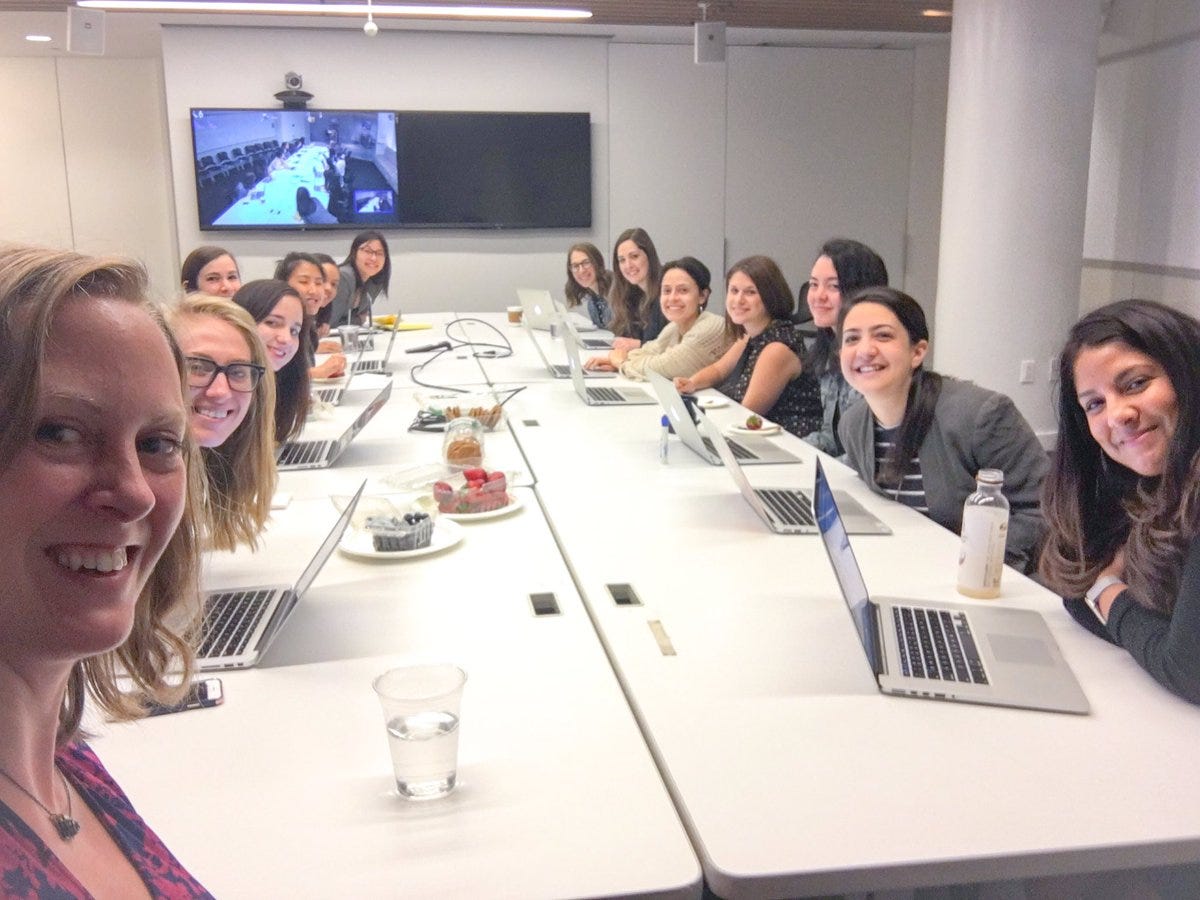
A number of creative fields and institutions have become majority, even overwhelmingly female. White women have arguably been the single biggest beneficiary group of DEI. I’m reminded of this famous photo of a Huffington Post editorial meeting from a while back.
The same has happened to various civic organizations I track. I looked at some local major civic groups here to quickly see the gender composition of their staff and they ranged from two-thirds to 80 percent female. Even our local tech booster group has a 75% female staff.
Savage goes on to track 2021 post-George Floyd hiring at major news organizations, and again we see an enormous female skew.
These weren’t empty slogans, either. In 2021, new hires at Condé Nast were just 25 percent male and 49 percent white; at the California Times, parent company of The Los Angeles Times and The San Diego Union-Tribune, they were just 39 percent male and 31 percent white. That year ProPublica hired 66 percent women and 58 percent people of color; at NPR, 78 percent of new hires were people of color.
“For a typical job we’d get a couple hundred applications, probably at least 80 from white guys,” the hiring editor recalled. “It was a given that we weren’t gonna hire the best person… It was jarring how we would talk about excluding white guys.”
With or without quotas, The Atlantic succeeded in hiring fewer of these white males. Since 2020, nearly two-thirds of The Atlantic’s hires have been women, along with nearly 50 percent people of color. In 2024, The Atlantic announced that three-quarters of editorial hires in the past year had been women and 69 percent people of color.
Other pipelines dried up as well. The alt-weeklies that gave misfit young men their start have shed them entirely. There are no white men on the editorial staff of the Seattle Stranger or on the staff of Indy Week. As late as 2017, there were six white men atop the masthead for the Portland Mercury. By 2024, there was just one: the Boomer editor-in-chief.
Of the white men who did get hired, one also can’t help but wonder what percentage of them were LGBT identifying.
It’s worth noting that Scott Galloway, whose book on manhood I looked at last week, actually boasts in it about how few straight men he hires into executive positions, saying, “Nearly 80 percent of my senior management has been women or gay men.”
Savage also highlights how the same trend affects other prestige occupations like academia:
White men may still be 55 percent of Harvard’s Arts & Sciences faculty (down from 63 percent a decade ago), but this is a legacy of Boomer and Gen-X employment patterns. For tenure-track positions—the pipeline for future faculty—white men have gone from 49 percent in 2014 to 27 percent in 2024 (in the humanities, they’ve gone from 39 percent to 21 percent)…Since 2018, only 14.6 percent of tenure-track assistant professors hired at Yale have been white American men. In the humanities, that number was just six out of 76 (7.9 percent).
…
At Berkeley, as recently as 2015, white male hires were 52.7 percent of new tenure-track faculty; in 2023, they were 21.5 percent. UC Irvine has hired 64 tenure-track assistant professors in the humanities and social sciences since 2020. Just three (4.7 percent) are white men. Of the 59 Assistant Professors in Arts, Humanities and Social Science appointed at UC Santa Cruz between 2020-2024, only two were white men (3 percent).
He notes that this is virtually universal in prestigious domains:
Over the course of the 2010s, nearly every mechanism liberal America used to confer prestige was reweighted along identitarian lines. Seven white male Gen Xers won the MacArthur “Genius” Fellowship in 2013 alone—the same as the total number of white male millennials who’ve won since.
In 2014, two white male millennials were National Book Award finalists, including one winner; that year nine white male American artists under 40 appeared at the Whitney Biennial. But of the 70 millennial writers nominated for National Book Awards in the decade that followed, just three were white men. The “Big 4” galleries represent 47 millennial artists; just three are white men. At the 2024 Whitney Biennial, which featured 45 millennial artists, zero were white American men.
We might also, for example, think of the way that media outlets decided to start capitalizing Black but not white.
Boomers Over All
Savage does a good job of honing in on how the impact of this has varied by cohort. Boomer, and to some extent Gen-X white men were already established in their careers when dial really got turned on this. Boomers were already tenured professors by that time. They were the senior leaders of these organizations while this was happening, and in some cases still are. For example, despite the huge shift towards hiring women and minorities at the Atlantic, the older Gen X white male Jeffrey Goldberg remains the editor-in-chief.
Thus the brunt of the diversity push fell largely on the Millennials. This was compounded by the fact that the Boomers won’t retire. Every old white male professor or executive means, roughly speaking, one less younger white man who will be able to get a job in these organizations.
There have actually been moves to make it easier for white male Boomers to stick around. Savage notes how mandatory retirement ages were abolished in universities:
“A big part of why it’s hard to diversify is the turnover is really slow,” a tenured millennial professor explained. “And that’s become worse now, because Boomers live a long time.” Many elite universities once had mandatory retirement at 70. But in 1994, Congress sunsetted the academic exemption for age discrimination, locking in the demographics of the largely white male professoriate for a generation.
The results:
Yale’s history department, with 10 white male professors over the age of 70, provides a striking illustration of the generational divide in hiring. Since 2018, they’ve hired four older white men as full professors—but among sixteen tenured or tenure-track millennials, just one is a white man. At 84, the Cold War historian John Gaddis isn’t even the oldest in the department. “The Yale history department at the time I arrived in 1997 was overwhelmingly white and male, if not yet millennial,” he told me in an email. “Some remedial action was long overdue.”
We’ve seen similar dynamics in evangelicalism, where the white male, largely Boomer “Big Eva” elites retained their power and prestige while becoming endorsers of DEI type approaches whose cost fell on younger generations of white men.
We can also think of Galloway here, the white male Boomer making millions of dollars a year while openly talking about how few straight men he hires.
Savage doesn’t go into detail on this point, but does hint at how mass immigration has interacted with DEI in pernicious ways. In effect, every single immigrant is privileged in this system above native born white men. In many cases their descendants will enjoy the same priority in perpetuity. (For Asians, it is a mixed bag. Undoubtedly, native born Asians face discrimination in things like college admittance, but foreign Asian students are loved by universities because they pay full freight, and largely Indian H-1B visa holders are strongly preferred over native born people as employees).
The white men who do get hired are often older and more established—or foreign. Several people I spoke with noticed that European white men don’t seem to face these barriers. The reason, one professor suggested, is they exist slightly outside the American culture wars. Another is an administrative sleight of hand: Federal education statistics (IPEDS) classify foreign nationals outside racial categories. In other words, a white European on a work visa doesn’t register as “white” in diversity metrics. Among new Ph.Ds with definite academic employment plans, white temporary-visa holders are nearly twice as likely as white U.S. citizens or permanent residents to secure tenure-track positions (61.0 percent versus 33.1 percent in 2023).
Confronting the Truth
I’ve seen any number of people pushing back on this.
One pushback is that Millennials were hardly the only victims of this. I’m sure many Gen X or even Boomers had some experiences with this. I have personally been told explicitly that I was not getting work because I was a white male, for example. But it’s important not to overly center ourselves. It really has been much worse for Millennials.
Believe it or not, there are also people out there still denying this is real or a major problem. An editorial writer for the Washington Post, for example, suggested this is limited to a very narrow set of prestige institutions, saying, “This is not an economy-wide problem.”
But actually, it is. Vast swaths of our corporate and institutional landscape brag about their diversity efforts and statistics. I suspect that, like me, large numbers of white men have been directly told they aren’t getting a job or position because of their race and gender. As as the troves of documents discovered by Chris Rufo and others show, people haven’t been shy about putting in writing that they discriminate against white men or create a hostile work environment for white men.
I’m sure people will pore over Savage’s stats with a microscope, too, looking for any way to discredit them. He previously wrote another widely read piece saying that no white man born after 1984 has ever had a piece of literary fiction published in the New Yorker. Somebody then found that one such person had been published. But does this change the underlying reality?
But beyond simple denial is the much larger phenomenon of people who simply refuse to acknowledge one of the fundamental experiences younger men have today.
Yuval Levin, writing a tribute to the recently deceased Norman Podhoretz, said that in today’s world, “Everyone runs from the seriousness and importance of living by the truth.”
I adopted as my first guiding principle for my newsletter the Aleksandr Solzhenitsyn admonition to “live not by lies.”
It’s a lot easier to say than to do it though, because speaking the truth is often costly.
I’ve talked before about how roughly 70% of divorces are initiated by women. While the exact percentage varies by study, this is one of the best attested statistics in social science. But I’ve never seen this statistic mentioned in sermon or book on marriage by a major evangelical pastor.
Similarly, have you ever heard one of them talk about discrimination against white men today? I haven’t seen it.
My observation from over a decade ago, from before I even started this newsletter, is that the average evangelical pastor is terrified of offending women. You can almost smell the fear on them.
Similarly, when it comes to things like what Savage discussed in his article, we see a lot of what looks like the fear of man.
Everybody has to pick their battles. I don’t think we are obligated to go around giving our take on every single subject, or even every nuance of every subject.
But when you talk frequently, and often loudly, about topics like marriage and racial justice, and never mention much less address very core and relevant facts, you are not being honest.
You also forfeit the moral standing to critique the people who are mentioning them. It’s easy for these people to criticize the manosphere, for example. There’s a lot to criticize. But there’s no reason to take many of those critics seriously when they refuse to confront the unpopular truths that the mansophere people, whatever their faults, are addressing.
It’s similar with race. If you are shrieking about the dissident right but not talking about the dynamics Savage exposes, you don’t deserve to be taken seriously.
I’m happy to denounce people like Andrew Tate and Nick Fuentes. In fact, I’ve done it. I’m happy to highlight the bad things in the manosphere and such. Again, I’ve done it.
But I also try to make a point of explicitly talking about these elephants in the room. For example, I mentioned discrimination against white men in my Galloway review last week, before the Savage piece was published.
I don’t like to belabor these points or talk about them too frequently. This isn’t my main beat. But these points around race and gender are core to the experience of many young men today. And if we really want to put forth a more compelling message to disaffected young men, they have to be addressed.
They are also related to substantive problems people wring their hands about today. For example, under conditions of hypergamy/assortative mating and anti-male discrimination in high status employment, no surprise we see many college educated young women complaining about a lack of marriageable men. But the Boomers just want to yell at these younger guys to “Man up!”
Putting Things in Perspective
It’s important to acknowledge these realities, but also to put them in perspective and not allow them to cause a root of bitterness to spring up in your life.
In my time in consulting, my tenure overlapped with that of the first woman to ever be promoted to partner at my firm. The corporate world was still very male dominated at that time. I lived through the era where the few female executives there were tended to be ultra-masculine “Iron Lady” types - because they had to work hard to convince male bosses that they were as good and tough as the men. There was long, of course, large scale explicit discrimination against blacks and other minorities - far worse discrimination than anything white men face today.
Some of today’s discrimination against men and especially white men is just Nassim Taleb’s “ergodicity,” namely things evening out over a long enough time horizon.
You don’t have to ignore injustices being done against you. But try to put them in perspective and avoid wallowing in self-pity. Fortune’s wheel spins around, and sometimes your number just comes up.
We also have agency. There’s a lot I’m not going to be able to achieve in life. There are a lot of doors that are closed to me. Some of them perhaps unfairly. But I can still build a life and have successes.
As I noted in a previous piece, the attacks against the very high agency A. M. Hickman reveal that a lot of young men don’t want someone proving it’s possible to build a life in today’s world. Because then they might have to try doing the same thing themselves instead of posting complaints all day.
Picking yourself up, dusting yourself off, getting back in the game, and never ever quitting or giving up even in the face of unfairness or injustice is part of what it means to be a man.
Ultimately, God is sovereign. We cannot guarantee success for ourselves by our own efforts. But that also means there are possibilities for the future that can arise from outside of ourselves, doors we didn’t even know existed that might open for us. God is not constrained to save by many or by few. So “blackpilling” is rarely warranted.
One thing you should do is resist being propagandized by manipulators. Much of our society, and the church, is trying to convince you that it’s imperative to focus on the particular issues of concern to them, often ones about very specific, favored demographic groups that they care about.
You can’t focus exclusively on yourself, but you have the freedom to decide for yourself what causes you care about the most. You also have just as much right to object to injustices committed against you as anyone else does.
You don’t have to passively accept a system that is putting you and people like you at a disadvantage.
Another thing to put into perspective is that in a diverse society, it is actually important that there’s some level of representation in our prestige institutions of the various groups that compose it. “Merit” as promoted today is not the only criterion of selection for positions.
In some cases, especially in creative fields like writing or music, positions are vastly oversubscribed because they are intrinsically desirable. In many cases such as when hiring for, to pick an example, a violin position in an orchestra, there are a huge number of extraordinarily excellent musicians to choose from. Some positions have an incredible number of very qualified people applying for them. That’s not everything to be clear, but it is some of them. In these cases, some extremely talented and qualified people are going to lose out. It’s inevitable.
Also, it’s hard to discern what “merit” means in many of these cases because there are no objective performance criteria. I would put humanities professors into this category. Unlike, say, chemical engineering, what is considered valuable in the humanities has a large subjective component. It’s similar for things like foundation boards or “genius” grants.
As I’ve written previously, having symbolic representation for the various groups that make up a society is an important civic good. That doesn’t mean we need quotas in proportion to our demographic makeup, or that qualifications should be ignored (particularly in safety critical roles or those with objective performance metrics like sales). But it is a legitimate consideration.
We have massively overcorrected on this point. It’s one of the factors that accounts for the civic malaise in all too many of our cities, another reality people won’t admit or talk about. But that doesn’t mean there isn’t something important here.
Maybe you don’t like how diverse our society is, but it’s an actually existing empirical reality. We have to operate in the real world, not a fantasy one.
The Savage piece is superb, and hopefully opens a door to more honestly addressing this reality. If you are an authority in a mainstream or traditional institution, I hope you will have the courage to start talking about some of these difficult and risky truths.
When that pic of the HuffPost writer’s room first came out, it was attacked not because it had no men, but because it had no black women.
Anecdotally, this is one of the push factors that drove surprising numbers of gen Z men to the right in the most recent election. I'm core millennial in age myself, and have multiple centrist-type acquaintances (all living in some of the bluest places in the USA, politically) who either voted for Trump or didn't vote at all for president on this basis. It wasn't policies in general, it was because they felt that the Democratic party tolerates bigotry against men.