

Most of America Is Pittsburgh Now
Deaths now outnumber births across most of the country — and the effects are just beginning to arrive.

Demographics may be destiny, but fate takes a long time to show up. People have been discussing falling birth rates as a problem for at least two decades, but we are only now starting to see the tangible impact of that.
The Baby Boomers, a huge and overwhelmingly white generation, are starting to reach the later stages of life, while at the same time the number of children has been being born has fallen significantly. We’ve known these facts for some time, but their tangible impact on society is just starting to show up in the data and social trends.
For example, it was once so normal for births to outnumber deaths that demographers referred to this as “natural increase.” A place like Pittsburgh, with more deaths than births, was so unusual it attracted attention as an oddity.
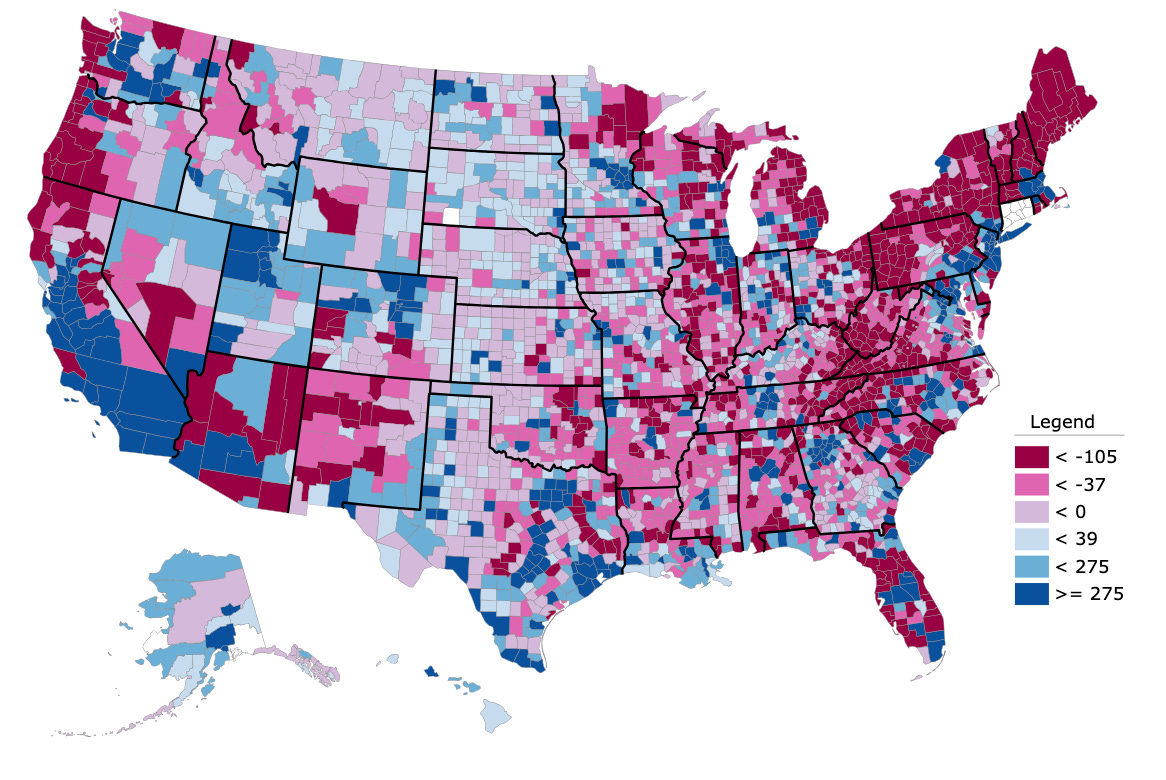
Now most of America is Pittsburgh. Two-thirds of America’s counties, over 2,000 of them, had more deaths than births this year. A few years ago the Census Bureau renamed its “Natural Increase” data field to “Natural Change.” Here’s a map of those declining counties in red.1 The legend is total number of people.
The Decline of White America
Because the Boomer generation was so white, this demographic inversion is starting to show up in the overall white (non-Hispanic) American population, which is now actually declining in much of the country. Here’s a percentage change map of white population by county last year. (Multiply legend values by 100).
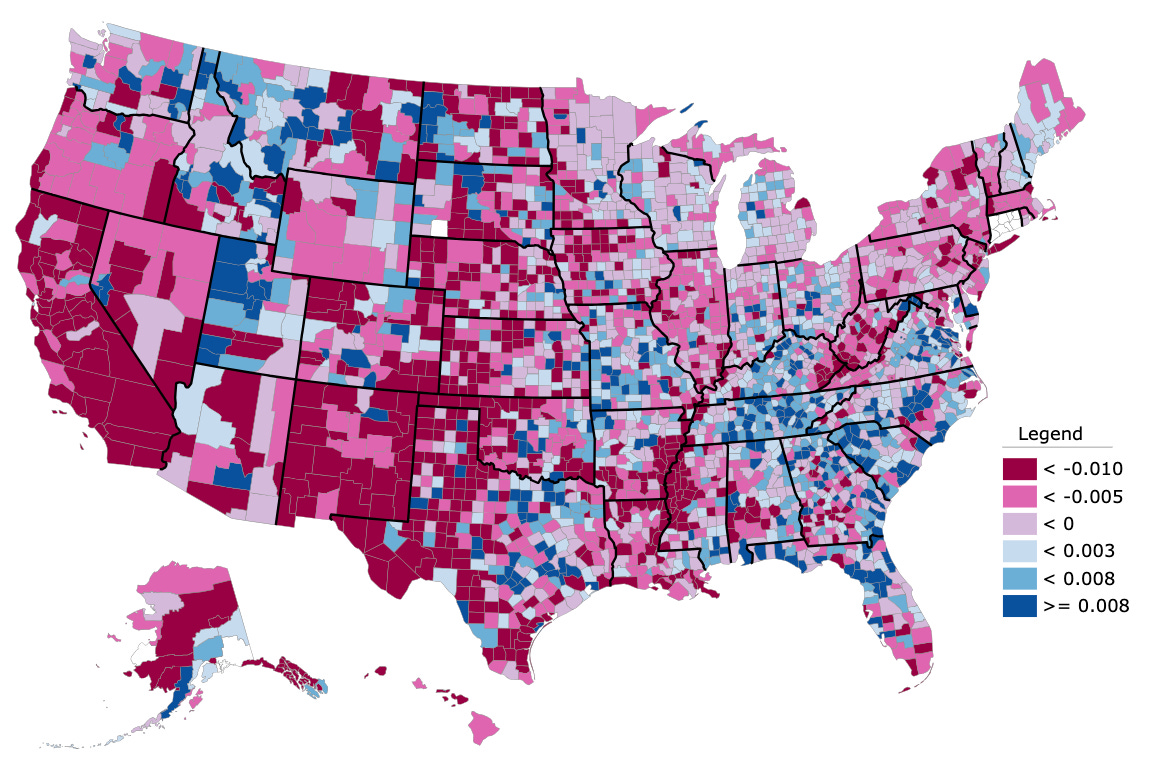
This is also about two-thirds of all counties. It is present not just in rural areas, but also in big cities. There are 56 major metropolitan areas with a population greater than one million people. Only 14 of them added white population last year, and most of those had very little white growth. The top percentage gainer was Greenville, South Carolina at 1.1%. Only two metros in the entire country added more than 10,000 new white residents last year, Nashville and Charlotte.
Dallas-Fort Worth, Houston, Atlanta, and Phoenix are all big growth regions that are frequently discussed in the media as boomtowns. All of them have falling white populations - on a regional basis, not just in the central city. This is the rule, not the exception for growth cities.
This is not the image most people have in mind of what’s happening there. They probably think Dallas is booming with white middle-class families fleeing high tax New Jersey or Illinois. That may have been true 25 years ago. But while there might still be some of that today, it’s more likely a second or third generation middle class Mexican family fleeing California’s high housing prices, or new immigrants from India.
The steepest white population decline has been in large coastal elite metros like the Bay Area, Los Angeles, and Miami.
While immigration is undoubtedly the necessary factor in America’s rising diversity, the white population is not getting “great replaced” - it’s dying off. It is self-liquidating, at least to some extent. This is increasingly the norm around the world, so there’s likely no reason unique this is happening to white Americans. But it is still happening.
Ryan Burge, the scholar of American religion, notes that further decline of Christianity in America is baked into the cake. The Boomers represent such a high percentage of church attenders that even if there were a true Gen Z religious revival, simple generational turnover is still going to produce large scale declines.
This applies more broadly as well. America will be much more diverse in the future. Even if immigration went to zero, simple generational turnover in light of falling birth rates means far fewer white people in many places in the future. The idea that a large share of post-1965 immigrants and their descendants will be deported is a delusional fantasy. It’s unlikely even a third of people here illegally will ever leave.
Our immigration regime has many serious problems, and mass immigration poses many challenges to our country. America is going to change significantly in the future to address those and accommodate itself to a more diverse population. Almost nobody really likes change, so that will be very uncomfortable for many people. It also won’t be without its legitimate problems or losses to our society.
But it’s nothing to fear either. America has gone through this in the past, and we all like being on the other side of it. Nobody really wants to go back to living in 1870 or 1790. That America would be a completely alien and unpleasant country to us socially, quite apart from the technology gap. As a modern American, I much prefer our own time and country.
There’s no guarantee we’ll successfully navigate this transition, but there are ample resources within the American experience to pull it off. I’m optimistic we can do it, and that our future can be great. Reform of our immigration system, including ending its many abuses and significantly reducing immigration levels for a period of time, would be a start. But real work lies in building a more cohesive society with our new more diverse, post-Boomer demographics. We need much more focus on how to create that.
Disappearing Children
Dealing with diversity isn’t the only reality of the birth dearth. We are also experiencing a significant decline in the number of children that’s hitting many places. Here, the figures are also stark.
