

Insurgent Media Changes Sides
The rise of the new online left, seminary sorting, demoralized men and more in this week's digest.

The standard view since Trump’s 2016 election win is that while the left dominated in traditional media, the right dominated in online and social media. A significant number of people on the right seemed to believe that the left was not even capable of succeeding online, as summarized in the idea of “the left can’t meme.”
Well, today the online right media ecosystem is in increasing disarray. It’s suffering from major problems with audience declines (gift link), internal conflict, and many of its core personalities going completely off the rails.
Meanwhile a new online left media ecosystem is rising, one that’s more successful than the right in important ways.
Substack was once seen as a right wing platform, with all the associated demands that the platform start censoring people that you’d expect to come with that. To their great credit, Substack didn’t censor. But the left has now become dominant on the platform. Virtually all the largest political Substacks are on the left, though the Free Press remains number one. This is a legitimate free market outcome.
Inc. just profiled the incredible success of the Bulwark, originally started as a Never Trump site by Bill Kristol, but which has become a politically left “resistance lit” empire. The Bulwark has 140,000 paying subscribers, has a large Youtube presence, and is profitable and on track to do $30 million in revenue this year. Even if they received algorithmic help we aren’t aware of, getting 140,000 people to pay money is a big accomplishment. And they appear to have done it without the huge marketing spend that built up the Free Press.
It’s particularly notable that the Bulwark appears to be pulling away from the Dispatch, also founded as an anti-Trump outlet, but which is still a conservative publication. They’ve executed very well, but the their last confirmed paid subscriber number was 45,000 - excellent, but far behind the Bulwark, and with a comparatively tiny Youtube presence. (To be fair, the paid subscriber number was from a year and a half ago, but I’m skeptical that they grew by 3X in that time).
Many on the right think these kinds of left wing people and publications only exist because they are propped up by donors or media conglomerates. People used to believe this about Jennifer Rubin at the WaPo, for example. But when she left for Substack, she racked up 350,000 free tier subscribers in two weeks. Clearly, she actually did have a following. And with tens of thousands of paying subscribers, she’s doing very well for herself.
The fact that so many people are willing to pay money for these sites not only makes them sustainable, but gives them independence from the Democratic establishment and donor networks. This is causing big headaches for the party, as the AP documents.
“The ground has been made fertile for an anti-establishment media politics, where it just wasn’t quite there with the voter base in those previous cycles,” Peck said. Even older, moderate liberals, he said, have started to ″throw their hands in the air and look for alternatives.”
YouTube accounts like ”Secular Talk” and “Breaking Points,” streamers like Hasan Piker and new digital journalism organizations like More Perfect Union and The Lever are among those that have seen their audiences multiply. Grim said Drop Site has amassed 800,000 free and 60,000 paid subscribers since launching two years ago — more than he’d anticipated.
The left too is losing trust in mainstream media institutions, and turning to influencers and these new media outlets. This independent left wing media played a big role in boosting the insurgent progressive Senate candidate Abdul El-Sayed in Michigan, who just won his primary. It will likely continue turbocharging insurgent candidates.
The rise of a powerful alternative left media infrastructure is in some ways a reversion to the status quo ante. A collection of bloggers known as the “Netroots” played a big political role in the early 2000s and through Obama’s 2008 victory, though largely faded away with the decline of the Blogosphere 1.0. I personally remember how getting a link from one of these bloggers like Atrios would explode my traffic. They were bigtime.
What’s different today is that subscription infrastructure and revenue sharing on platforms like Youtube create a large monetization engine for these kinds of sites.
In a sense, this reversal is normal and to be expected. Opposition media thrives, well, when in opposition. The Netroots emerged during the Bush era, the new left online media sites during the Trump one. With Trump in power, we’d expect online right media to decline.
Still, this shift in audience and financial firepower in online media from right to left is going to play a major role in coming election cycles, both within the Democratic party, and with interparty competition. And a key is that on both sides, we’ve seen the growth of a powerful, independent online media that’s not beholden to traditional party institutions or funders.
Seminary Sorting
The great decline of our institutions is affecting more than just the legacy media. It’s rippling through every corner of our society. One domain it is also upending is Protestant ministerial training.
First Things magazine’s Protestant Mind newsletter had a very interesting piece on trends in seminary education. Traditional residential seminary programs are in big decline, particularly in mainline seminaries, but also evangelical ones. Mainline seminaries have also largely dried up a source of serious scholarship. However, total seminary enrollment has held up as people shift to online programs and other “non-conformist” schools that seem to be offering a kind of trade school model of education.
These trends are the result of responses to three broad shifts that occurred over the past two decades: a generational shift, an ecclesial shift, and an educational shift. Most of the scholars who defined the late twentieth century have either retired or passed away, resulting in a generational shift. Closely related is an ecclesial shift away from mainline dominance and toward non-conformist approaches. Finally, the blending of digital and physical spaces coupled with the rise of Learning Management Systems (LMS) has resulted in an educational shift. This educational shift hit older, freestanding seminaries with a large physical campus the hardest. None of these trends in isolation explain the current moment, but together they offer a narrative as to why some seminaries have declined while others are growing.
The rise of these non-conformist seminaries parallels the rise of non-denominational churches as the new demographic center of American Protestantism. Again, this is similar to the shift of political commentary from institutionalized to deinstitutionalized voices, even as the overall supply of it remains high.
It’s a fascinating piece for those who are interested.
Religious Leaders as Gateway to the Community
I recently interviewed Mark Barbash for the podcast. He’s a long time economic development person who has worked for mayors of Columbus, Ohio, and also for a previous governor of the state. My essay on how local civic leadership shifted from titans to technocrats was inspired by his writing, so I wanted to interview him about it.
I’m posting the episode Monday, but here’s a clip where Barbash talks about how, when he worked for a former mayor of Columbus, their first stop in any community when they planned something that would affect it was to visit religious leaders there.
The decline of religious commitment and institutions has implications for how political leaders are able to engage with urban communities. It’s also well known that in low-income neighborhoods, pastors and such have long served as key community leaders as well.
And the substitution of non-denominational or non-conformist churches and ministers for traditional denominationally embedded ones will also change the relationship of churches to their communities. It likely presages churches that, even to the extent they are still around, are much less connected institutionally to the rest of the community.
Demoralized Men
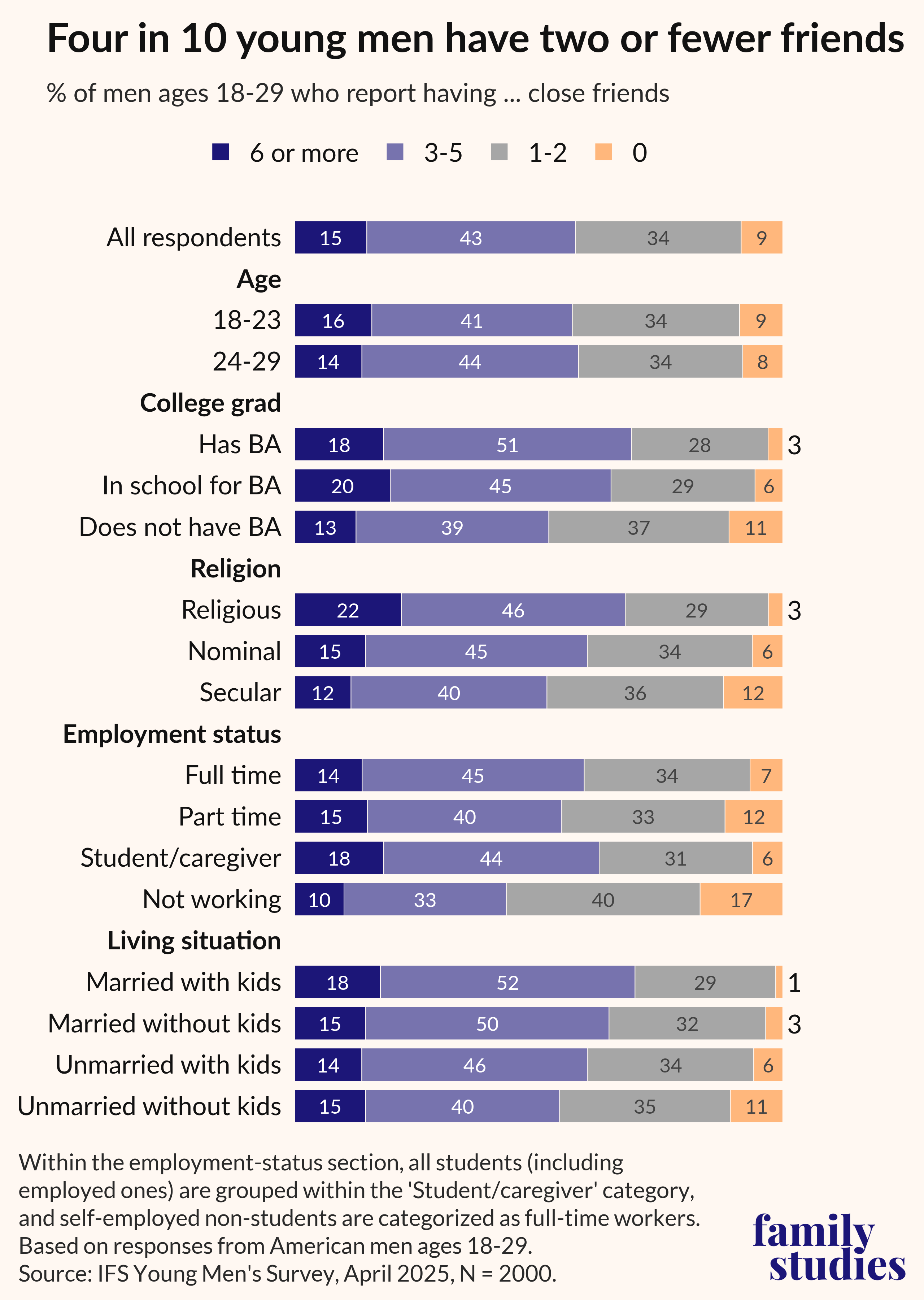
The Institute for Family Studies released the second installment of their “America’s Demoralized Men” report. It includes chapters on social connection, and alienation and distress. Here again, we see evidence of weak connectivity to institutions, and much else besides.
One thing that struck me was how few friends even young men ages 18-29 have. Almost 10% of them are completely friendless, which is not a good place to be. No surprise, a large share of that group, 43%, feels lonely all or most of the time. And another 34% of young men have just two or fewer friends. I might have expected this to be more characteristic of men later in life.
In terms of alienation, a significant share of young men have negative views about their future prospects. About half do not think they will be able to achieve the American dream, and the vast majority believe ability and hard work are not the most important factor in how you get ahead in America.
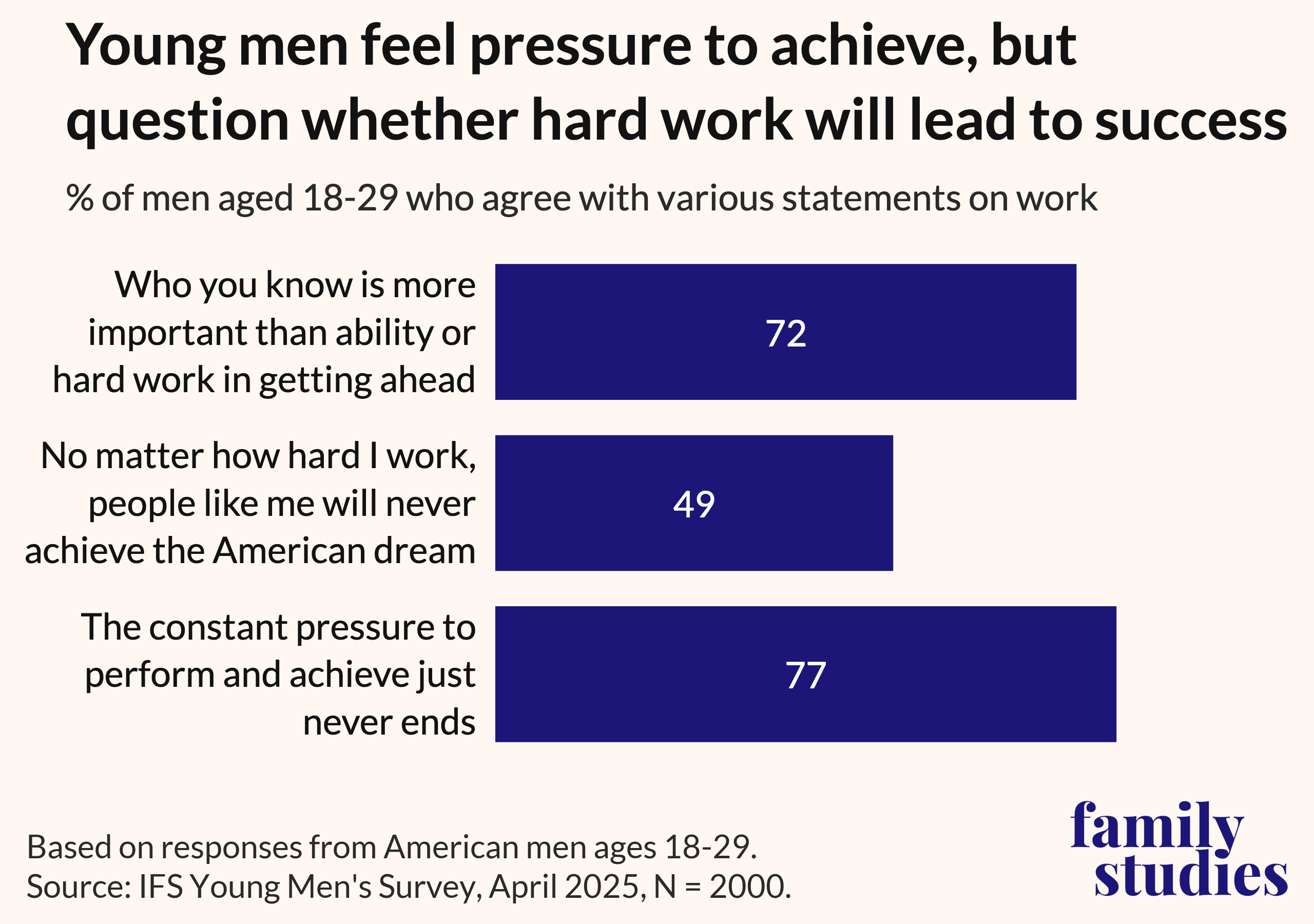
But on the plus side, most young men feel ambitious and have a lot of confidence in themselves. Put these together and it’s easy to see the formula for the “hustle bro” lifestyle that I see so many young men turning to. If you believe the system is rigged or the deck is stacked against you, but have high ambition and self-confidence, turning to some kind of hustle, say crypto, is a somewhat logical choice to make. It’s aligned with the recent WSJ reporting on how people are looking to find some kind of passive income scheme.
Click over to read the whole report.
Best of the Web
WSJ: Pastors Using AI to Help Write Sermons Grapple With Where to Draw the Line (gift link)- A divide is growing over AI-assisted preaching in American churches; ‘Martin Luther is rolling over in his grave.’ - I have a forthcoming essay on this topic.
WSJ: Helicopter Parents Are Co-Piloting Their Adult Children’s Careers (gift link) - Mom and dad are calling up hiring managers, applying for jobs on their kid’s behalf, and even lurking just off-screen on Zoom calls
The Atlantic: The Great Romance Slump (gift link) - Why are so few young people finding love?
If you missed it, check out my essay from earlier this week on the curse of the right.
FYI: Sometimes WSJ gift links will not bypass the paywall for you. Unfortunately, there’s nothing I can do about this.