

Sex Positive Conservatism
Evie's "Sex" issue, cozy girls, creationism, and more in this week's digest.

For those of you here in Indianapolis, Ryan Burge, who posts amazing quantitative analysis about religion in America that I regularly share here, will be appearing at two events this Sunday, March 1. He’ll be speaking at Second Presbyterian Church at 11:30am. And he’ll be speaking at Tabernacle Presbyterian Church at 4pm.
Locals should also mark their calendar for March 26th, when traditional church architect Duncan Stroik - he designed Hillsdale College’s chapel - will be giving a lecture on sacred architecture at Indiana Landmarks.
Sex Positive Conservatism
The Wall Street Journal ran a profile of Evie magazine (gift link), an online women’s journal known as the “conservative Cosmopolitan.”
Founded in 2019 and named for a modern take on the Bible’s original woman, Evie has struck a cultural nerve, animating young conservatives eager to make the movement feel fashionable and drawing detractors who believe its anti-feminist messaging is regressive. (Brittany Hugoboom, the face of the brand, holds that the magazine is “feminine, not feminist.”) After Donald Trump’s re-election, conservative values have been expressed more openly in liberal-leaning cities like New York. For this cohort, dressing well, hosting social events and embracing criticism has become a way to seize ground in a shifting media landscape.
“Evie started for women who didn’t feel represented by the mainstream media, for women who love beauty, romance, aspiration,” said Hugoboom, 34. “I didn’t have another outlet to get it from at the time.”
Shortly after this article, the magazine posted an announcement of a new themed issue called “the Sex issue,” one that features highly sexualized photos and other sexually explicit material.
On Sunday night at evie's EROS party, we unveiled the cover of our next print edition in front of the press and hundreds of guests. It's the first of many themed issues, and it's the most ambitious thing we've ever produced. For years, a recurring plea has shown up in our DMs, emails, and survey responses. Young married women asking us for real, honest, detailed guidance about sex….
Many young women, especially from traditional or religious families, have come into womanhood without learning anything about sex. They saved themselves for marriage and then realized the culture that told them to wait had absolutely nothing to say about what comes after the altar. They grew up with negative associations to intimacy, but were expected to become uninhibited the moment they said "I do." We believe sex is one of the most important foundations of a thriving marriage. You cannot call something sacred and then refuse to take it seriously. We talked to doctors, experts, and women who've been married for decades. This issue is specific on purpose, because vague advice is the same as no advice. There are beautiful hand-drawn illustrations for the explicit content and tasteful photography for the implicit content.
Some of you will read this and be surprised. In truth, this is the most Evie thing we've ever done. We've always said we want to celebrate femininity and help marriages thrive by giving women real advice that actually makes their lives better. Your sex life with your husband is arguably the most important part of your marriage. You asked for guidance, and we listened.
This spawned quite a bit of debate in conservative circles. Some said it was inappropriate. Others defended it as being a positive portray of sex within marriage only - one that rejected extramarital sex.
To me, there are a few ways to look at this. One is as another example of the old quip that, “Conservatism is just liberalism with a twenty year lag.”
Another is that it’s another example of the shifts in right wing politics in the Negative World. Traditionally, conservative politics would have rejected the idea of publishing sexually explicit content, regardless of whether or not it was aimed at married people. In country that’s culturally post-Christian, and with an increasingly post-Christian right, a more sexually expressive right wing politics emerging is not necessarily surprising.
Another option is that this is a manifestation of the increasing Catholic cultural domination of conservatism, particularly among the young and politically active. The main woman behind Evie magazine is apparently Catholic. While not all Catholics would approve the Evie issue by any means, I think it’s fair to say that such a thing would be much less acceptable in the evangelical world.
Whatever the case, this sort of thing is certainly a new development in the conservative landscape.
I can’t help but compare the reactions to this to those of a pinup calendar aimed at conservative dads. This spawned major blowback. It would be interesting to track those who rejected this calendar vs. those who rejected Evie. I checked one of the bigger names quoted in the anti-calendar article, and she did not say anything about the Evie issue that I could find.
Cozy Girl Life
Freddie deBoer posted some interesting observations on the “cozy girl” lifestyle, and what it says about our society.
You’ve heard this song from me before many times: we live in an era in which the range of lives publicly regarded as worthy of living has contracted almost to nothing. Our culture confers esteem on a vanishingly small number of roles, and those roles are largely defined by being visible - that is to say, by attracting public attention, of which there is a necessarily finite supply. Success, as it is marketed to young people, means being a pop star on the order of a Sabrina Carpenter, a director with the cultural cachet of a Greta Gerwig, or at minimum a micro-celebrity “creator” whose daily routines are packaged for the algorithm. A contented life requires building a brand, cultivating a following, being legible to the feed. Everything else - teacher! paralegal! office manager! dental hygienist! retail supervisor! random white collar office email job that’s basically fine! - is flattened into an undifferentiated gray. These are necessary roles, some of them pay well, but they certainly aren’t glamorous ones, and young Americans seem increasingly convinced that a life that doesn’t inspire envy among others - when broadcast online, naturally - isn’t one worth living.
…
For Gen Z, this has all combined with a frankly pathological embrace of high-risk, high-variance speculation into something I find very scary; it’s a generation that seems to view all ordinary jobs as sucker deals for “NPCs,” pushing them towards more and more risky efforts to make money and escape the life of drudgery they mostly haven’t lived but have been taught to disdain. “Gen Z” is the empty, meaningless signifier that we’ve chosen for them, but it would be more apt to call them Generation Roulette Wheel. They never stop looking for a get-rich-quick hustle. Cryptocurrency manias rise and fall with the chaos of a fever dream; meme stocks explode and crater in a matter of days; sports gambling apps turn every game into a financial instrument, every friendship into a wagering pool. When your ambient culture tells you that the only meaningful victories are stratospheric and rare, it makes a certain perverse sense to chase stratospheric and rare outcomes. If stability isn’t honored, what’s left other than volatility?
…
The genius of the cozy aesthetic is that it identifies sources of pleasure that are widely accessible and modest and treats them as inherently worthy of serious cultivation: a soft sweater, a well-made cup of tea, a public library card, a crockpot recipe that reliably produces something warm and nourishing, a Saturday morning with nowhere to be. You may find any one or all of these more or less attractive based on your own preferences, but whatever they are, they’re not signifiers of elite achievement, they’re all available in low-cost forms, and they’re all reliable and attainable. They’re not blue-check credentials, they don’t require venture capital or viral reach, and you don’t need to chew your fingernails waiting for the wheel to spin to see if you’ve won them. These simple pleasures are, instead, elements of an ordinary life lived with intention.
Click over to read the whole thing.
The Decline of Creationism
Speaking of Ryan Burge, he had a recent interesting post looking at views on creationism. There are some limits in the survey he’s analyzing. It only deals with the development of human beings, so the view he assigns as creationist says, “Humans have existed in their present form since the beginning of time.” This doesn’t talk about creation more broadly.
Also, what Burge calls “intelligent design” I believe would more accurately be labeled “theistic evolution,” or evolution directed by God. My impression is that the people who label themselves as believers in intelligent design to do not believe evolution can account for the development of life as we know it, even with divine guidance.
With those caveats, here’s the chart:
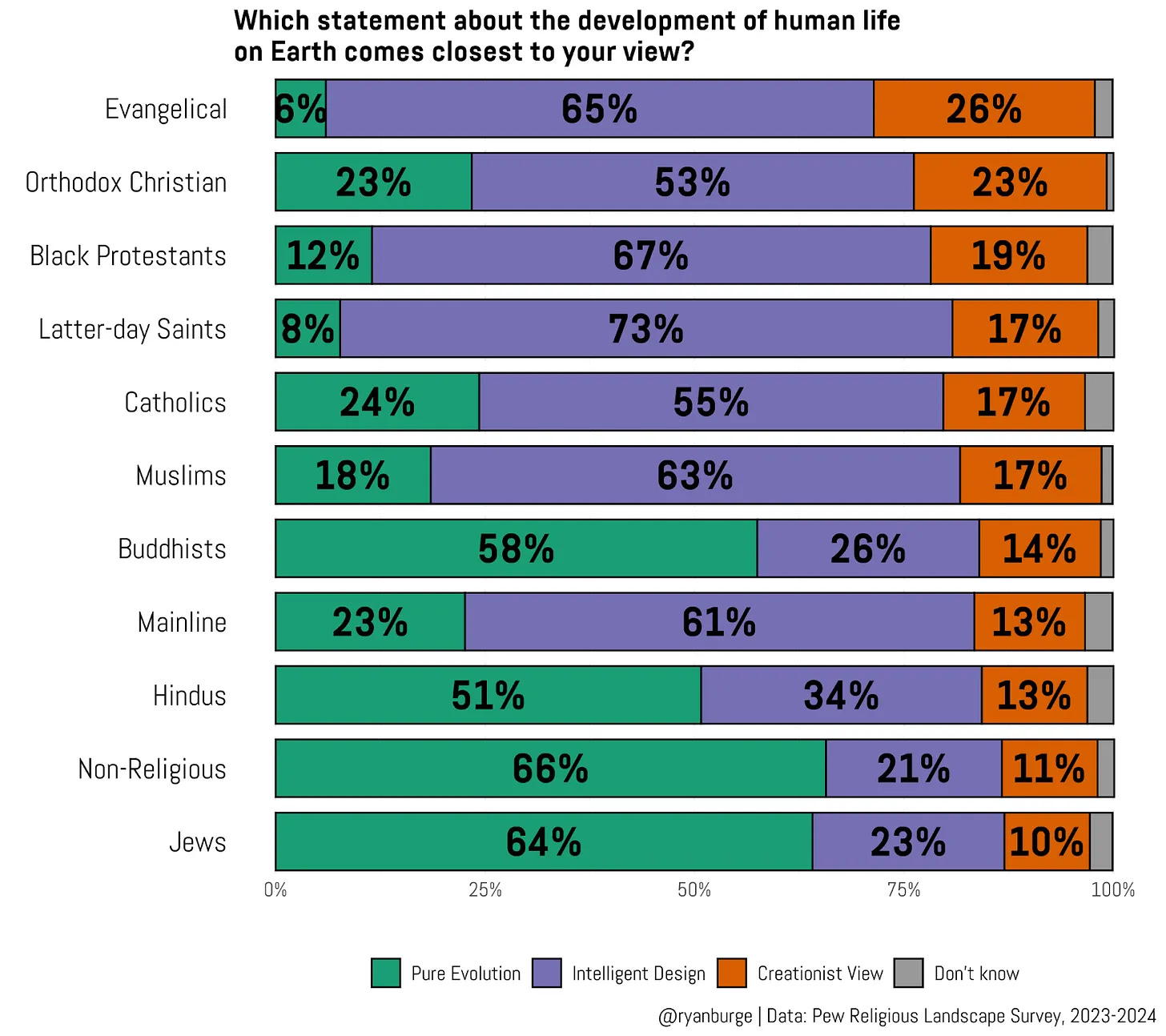
Remarkably few people of any religious stripe believe in creationism as defined here.
Click over to read Burge’s entire post.
Best of the Web
NYT: The Birthrate Is Plunging. Why Some Say That’s a Good Thing (gift link) - The political class is worried about the historic drop. But the biggest change is among the youngest women, who are the least ready to have children.
About half of all 30 year old women in America are childless. With women aged 30 without children having only about a 50% of ever having kids, that means a quarter of today’s 30 year old women will never have children - if demographic trends stay the same.
I actually agree in part with some of this birth rate decline being good. It’s good that there’s been a big decline in unwed teen mothers having kids, for example, given the big negative associations between single parenthood and a variety of negative life outcomes.
Scott Greer: The Conservative Golden Age Of… 2007? - Yet another example of conservatism being liberalism with a 20 year lag.
Block, formerly known as Square, is laying off 40% of its workforce, citing AI. Most corporate announcements of layoffs citing AI are probably just trying to portray their firm as successful adopters of emerging technology. In reality, they were probably just downsizing. That’s probably in part the case here as well, given that like many tech firms, Block’s payroll mushroomed during Covid. But AI actually is probably playing some role here as it is already ready for primetime when it comes to software development type tasks. I’ll have more to say about that in a future essay.
Harper’s: The Plot to Save America - Inside the movement to reindustrialize—and rearm—the country
Ryan Burge: The People Streaming Church Aren’t Who You Think - Education, income, and the hidden class pattern in religious attendance
Mere Fidelity: The Great Evangelical Hand-Off That Never Happened - This podcast discusses the lack of successful generational succession in evangelical institutions. In my view one of the biggest factors is that Boomer leaders never wanted to surround themselves with or invest in younger people who could ever plausibly match or upstage the boss one day - or who had their own ideas about the world. This was actually the subject of our Member Zoom this month. To learn more about my Member program for my closest supporters, see my Support page.
New Content and Media Mentions
I got mentions this week from the Niskanen Center, Noah Smith, Joel Kotkin, I was also pleased to see that I got a mention in one of the presbytery reports at last years general assembly of the Evangelical Presbyterian Church.
New this week:
Old Orderists vs. New Orderists - Legacy vs. outsider institutions, restoration vs. reinvention: The fault line running through today’s politics.
It’s Almost a Sin for an Evangelical to Be an Elite (paid only) - From “Radical” to “Seashells”: How evangelical rhetoric downgrades “secular” vocations to second-class—or worse
This week’s podcast is on the Boomer paradox with Jeff Giesea.
Why Boomers Never Produced a Next Generation of Leaders - The recording of this month’s Member Zoom discussion. Also includes thoughts on why conservatives aren’t creating art and culture.
Subscribe to my podcast on Apple Podcasts, Youtube, or Spotify.
Off-topic, saw a couple of things on X that may be of interest to folks here:
1. A couple of writers for glossy magazines (GQ, Rolling Stone) reflecting on how thoroughly that segment of the culture has "lost" young men. Even the coastal chattering classes are starting to notice:
https://x.com/mcdermott/status/2027068302212931988
2. The problem of getting trees into new subdivisions. Seems to implicate political economy, short-term vs. long-term thinking, tragedy of the commons, skin in the game, etc. etc. etc.
https://x.com/lymanstoneky/status/2027048811504324701
Basically trees are beautiful but they cause a lot of problems and nobody has an incentive to plant new ones at this point. Thus, much of the new housing in the Sun Belt is really ugly. But this seems like something where an enlightened political leadership could figure out a way to get more trees in the ground (e.g. a Carmel, Indiana-type leadership). It goes back to Mr. Renn's earlier American Affairs article about Indiana, pointing out that bare-bones "GOP standard" policy, i.e. low taxes and low services, is not necessarily ideal in all cases (even if preferable to parasitic Dem governance e.g. Chicago). In this case, "the market" sans intervention yields many miles of treeless, ugly Sun Belt suburbs.
Just as a heads up, it's probably a good idea to be careful with Burge's numbers, since he can be reckless in his rush to push out content.
For example, when he ran the article on Exvangelicals a while back, I dug into his data because his results looked sketchy compared to other scholars. His methodology (raw survey responses) has been rejected by every major sociologist of religion that I've read because they skew the results toward sensationalist claims. I understand why he does it; doing this research correctly is expensive and difficult, while straw polls are cheap and easy to interpret. He's probably heavily constrained in what he can actually accomplish due to his budget.
In short, I'm not saying that he's a bad guy or a fraud, but don't take his surveys as anything other than an interesting point to ponder. They're not scientifically valid and possess substantial error. I wish he was clearer about this point, but I understand why he wouldn't want to suppress his own click-stream.