

The End of the Cool City
What a trip to Seattle and Portland taught me about commodified cities, collapsing downtowns, and why conservatives keep losing the culture they refuse to build.

Today I have a piece inspired by our family vacation. This was the first time we’ve taken a week long vacation since probably 2018. Usually our trips have involved my family coming along with me to some work event I’m doing, or a long weekend somewhere. So I appreciate you all allowing us a proper vacation this year.
We flew out to Seattle, where we spent a bit of time before taking the train to Portland. After a bit of time there we rented a car and drove down to enjoy the natural beauty of southern Oregon and northern California, and to visit some of my family in Humboldt County. We flew back out of San Francisco, though didn’t really spend any time there - just enough to give my wife and son their first driverless Waymo ride to dinner.
Seattle and Portland are known as two of America’s most progressive cities. Both have built extensive transit systems. The sheer quantity of buses in Seattle is incredible. And Portland is famous for having built one of America’s first light rail systems.
I made a comment on X that there are seven Amtrak trains each way daily between Seattle and Portland, while there isn’t a single daily train between Chicago and Indianapolis, even though they are about the same distance apart.
This prompted the expected chorus of contempt from conservatives about how trains are a financial loser, are heavily subsidized, etc. This is of course correct as a financial matter. I’ve criticized any number of small city rail projects myself.
But the casual, contemptuous way conservatives dismiss trains and other left-coded ideas is an example of what James Patterson called the right’s “car dealer” mindset. It’s one that sees the world almost entirely through the lens of short term financial ROI, rather than long term goals, cultural influence, economic or institutional power, etc. It’s the worldview that underlies the evangelical business mindset. Many on the Trumpist right decry the focus on GDP as the sole measure of the economy, but what is the car dealer mindset but an expression of the selfsame principle? To a great extent, car dealers believe that man lives by bread alone.
While the exact merit of passenger trains is a legitimate topic of debate, the right’s car dealer mindset is why it is destined to be ruled over by people on the left from coastal cities. I obviously can’t prove this, but I don’t believe it’s a coincidence that Seattle both has good transit and was the place where world shaping companies like Microsoft and Amazon were founded. Or that it was Portland that reshaped so much of urban America - America generally in fact - in its image when it comes to things like farm-to-table restaurants, coffee microroasters, microbreweries, etc. By contrast, the economic success of many red states has not translated into much broader power or influence.
That’s not to say that leftism alone is any way to run a city or a nation. There are always multiple forces that need to be held in balance, yin and yang, chaos and order. While the best balance is always situation dependent, overly collapsing into just one dimension usually produces bad results.
We see that also in both Seattle and Portland. These two cities have some of the worst homeless problems of any cities in the country. Portland in particular had an overwhelming presence of homelessness. My wife noted that this inverted the feel of public spaces in downtown. They have been so taken over by the homeless that it’s ordinary citizens who are made to feel like intruders there.
Both cities have also seen a stunning collapse in their downtown economies. Downtown Seattle’s office space is 36% vacant, and the Seattle Times paints a grim portrait of its future. I took this picture from the Space Needle. In the background you can see a second skyline starting to rise. This is Bellevue, a suburban municipality that is where business in the region is increasingly concentrated. It’s effectively an emerging second downtown for the region.
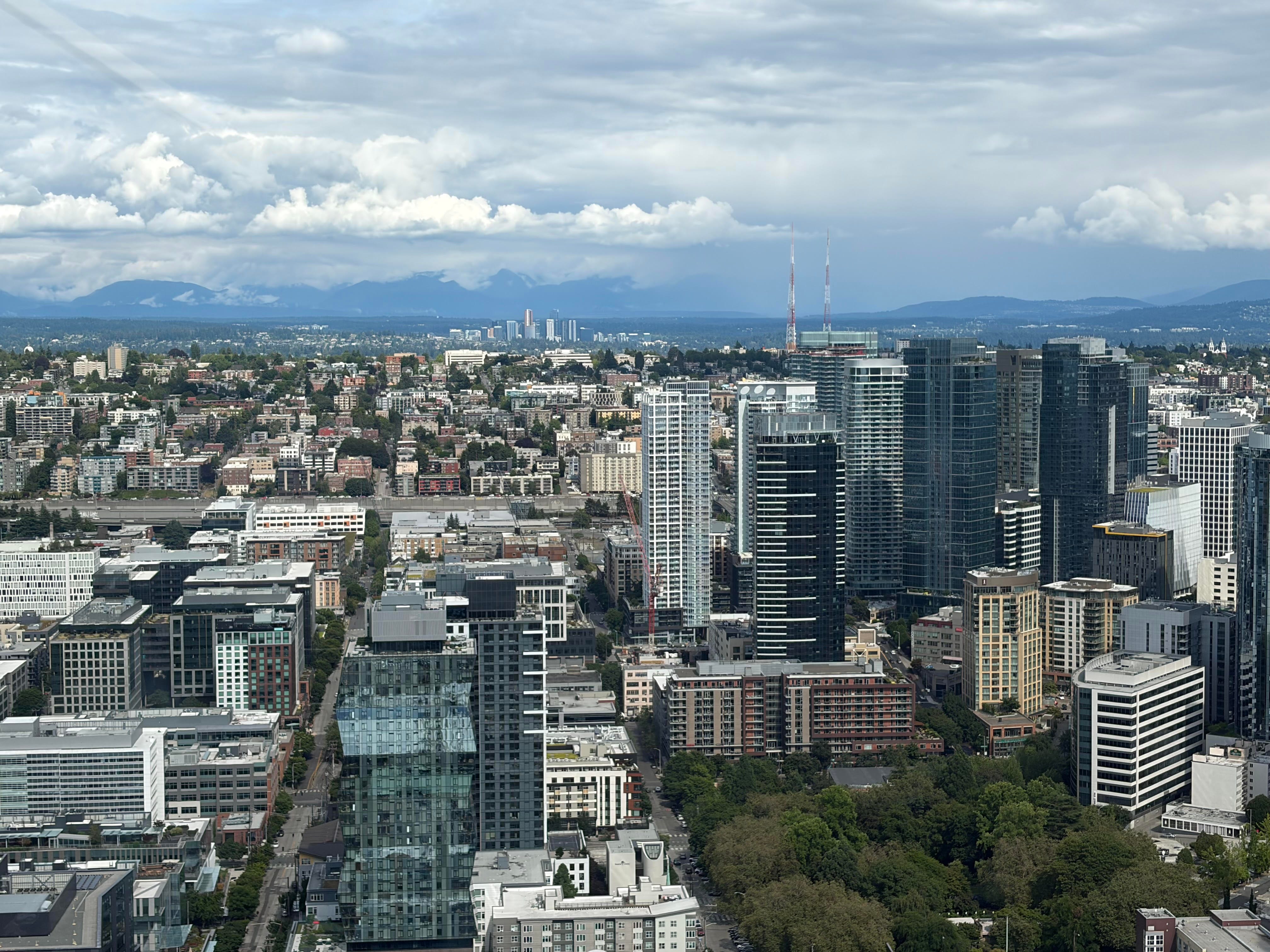
Portland was always a far less commercial city than Seattle, and its downtown has been similarly hammered. I saw little evidence of office workers in downtown Portland, and the city’s famed light rail system had few riders even at evening rush hour on a Tuesday.
These are cities that could use a much greater degree of business sense and focus on ROI. To be clear: they are not going down the tubes. Many parts of these cities are thriving and delightful to spend time in. The city of Seattle is at an all time record population high. But they have serious problems.
My friend Carl has two sayings that, while in tension with each other, each contain profound truth about the way the world works:
“The market doesn’t care what I think.”
“Government makes markets.”
The market is a real, powerful thing that renders judgments we can’t ignore. At the same time, we have agency to reshape the world and society as well.
Too many liberals think they can ignore the market. Too many conservatives think the market is all that matters, which is why they live in a world created and defined by others.
The Commodification of Urban America
This was my first proper visit to Seattle since the mid-90s. Back then, I flew out to visit a college roommate who had rented a U-Haul and moved to the city sight unseen.
I was blown away by the city on that first trip. I couldn’t believe how cheap it was compared to Chicago, for one thing. You could get amazing vegetarian food there for $7. My friend lived in the U-District. At a used bookstore there I found a science fiction book I’d been searching for since high school, maybe even junior high. There was an incredible video store called Scarecrow Video. They stocked rare import videotapes that you had to rent a special VCR from them to be able to play back on American TVs. Seattle was still known for its music scene, and I got to see one of my favorite Seattle bands, the Fastbacks, in concert at a small club when I was there. I was tempted to move there myself.
Similarly, I made my first trip to Portland in 2014, when the city was still considered an avatar of urban policy, and the TV show Portlandia was still in its prime. I was very impressed. I’m a very tough grader, and used to being disappointed when checking out places recommended by others. But Portland was the rare city that exceeded the hype.
Today, there’s nothing nearly as unique about either city. Certainly both have better consumer amenities than Indianapolis, but the gap is much, much smaller than it was in the past. Back in the mid-90s, moving to a tertiary city like Indianapolis would have been like getting sent to Siberia. Today, even in the Indy suburbs where I live, there are several establishments that would hold their own in Portland. You can get good coffee, food, trails, etc. basically everywhere now.
Also, the Internet made it super easy to buy basically any music you want, see basically any film you want, order any product you want. I don’t need to go into every random used book store I come across looking for a book I really want to read. I can just open my laptop and order it.
Yes, there are still some unique aspects to cities. I believe Seattle’s Scarecrow is still around, and will still rent you a playback device to watch a foreign videotape or DVD of films that have never been released in the US. But this sort of thing is much thinner on the ground than it used to be. There’s been an incredible commodification of the urban lifestyle experience in America in the past decade or so.
As a result, lifestyle is less of a draw to living in places than it used to be. We are back to more basic matters like cost, economic opportunity, and natural amenities - or state political climate. The places that still do have a very unique culture or amenities - think New York, Los Angeles, or San Francisco - remain the ones that have a perennial intrinsic lifestyle draw.
Perhaps this indicates a sort of cultural exhaustion, or Douthatian decadence, on the left. If that continues, then perhaps it means the left isn’t as destined to culturally rule as I indicated above. If true, this commodification would represent an opportunity for the right to transcend the car dealer mindset and start positively reimagining the kind of country and the kinds of communities it wants to live in.
Thanks again for letting me take a week away with the family. Up on Thursday, I’ll have a look at the latest Census demographic data dump showing the decline of children and more.
Thanks for visiting!
Portland is still funky and laid back, while Seattle, its economically successful sister, is full of educated, elitist, type A personalities. The Seattle culture is like the careerist/hustle of NYC combined with the outdoorsy/fitness of Denver. The ratio of men to women is also so high that it's impossible not to notice.
Sounds like you had a great time off and I hope it won't be so many years before you take a full week again.