

The Half Life of the American Church
The coming denominational decline, looksmaxxing, and more in this week's digest.

Ryan Burge is out with another fantastic data driven post looking at how long before American church denominations lose half their members.
He thinks many people are complacent about decline, thinking things will continue on with a slow bleed indefinitely. But highlighting Hemmingway’s line about going bankrupt two ways, gradually, then suddenly, he thinks in coming years there will be a very steep decline in many of these denoms.
He writes:
I cannot emphasize this point enough — we are in a lull right now. While most major denominations have been experiencing decline for a while, their ship has remained seaworthy. Yeah, some water will lap over the sides every once in a while, but there are still enough buckets and enough laborers to toss it back into the ocean.
That won’t be the case in a very short time horizon, and I don’t think many people realize just how quickly the buckets and the workers are going to disappear.
He’s got a number of great charts, but here’s one of the share of various denominations that are Baby Boomers:
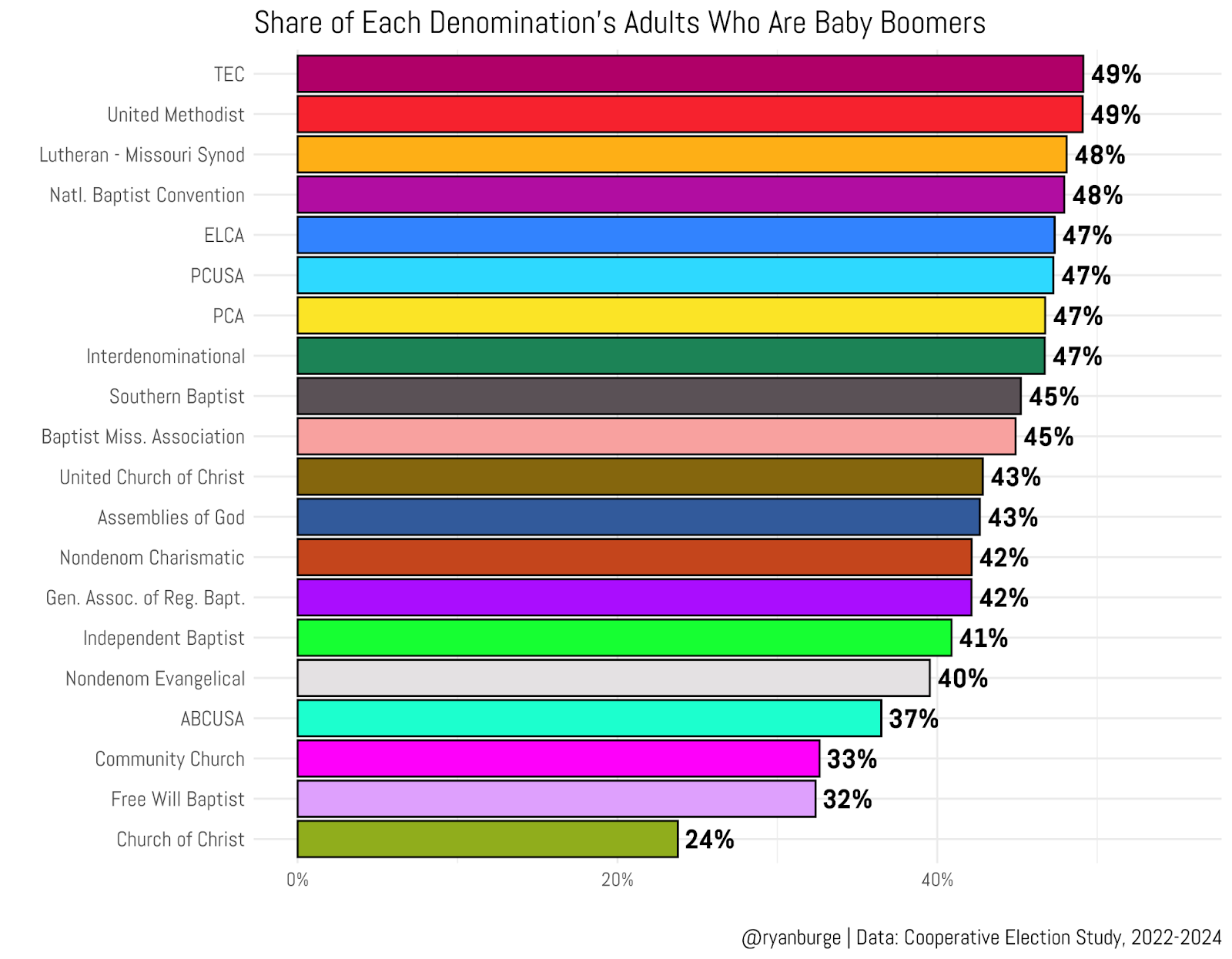
One thing that surprised me about his data is that there often isn’t a huge gap between the mainline and evangelical denominations. Both the PCUSA (mainline) and PCA (evangelical) Presbyterian denoms are 47% Boomer.
He also provides the population pyramids of these denominations.
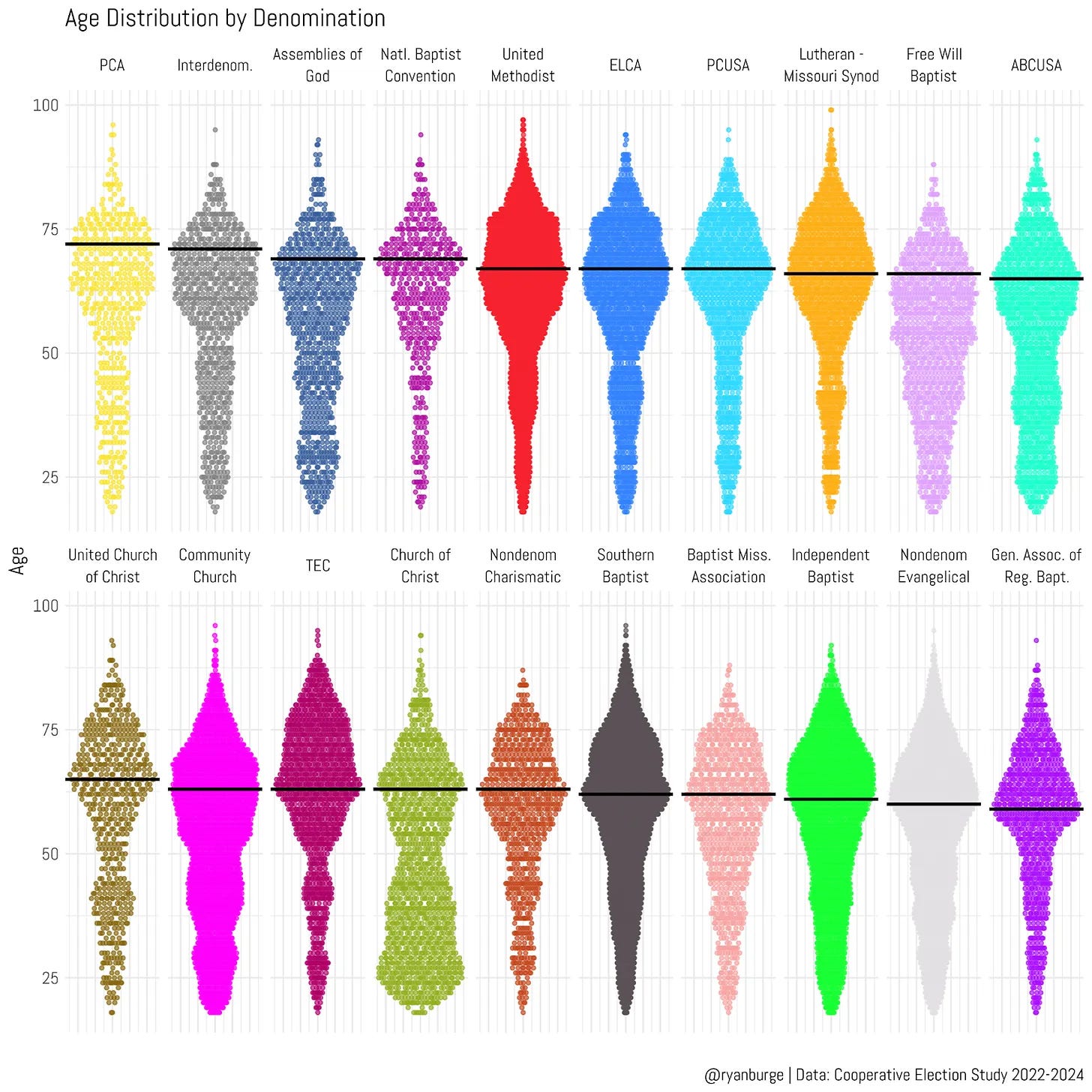
One of Burge’s conclusions that is sure to be talked about is that the future of the Southern Baptist Convention is not at bright as many might think.
This is why I’m much more optimistic about the future of the Church of Christ than I am about the Southern Baptists. Look how skinny the SBC distribution is at the bottom of the plot. When that huge bulge begins to age into their eighties, the membership of the Convention will begin to decline incredibly rapidly. There are just not nearly enough young people to offset those losses.
It’s a must read piece. Click over to read the whole thing.
Burge was recently a guest on Ross Douthat’s podcast (gift). It’s an interesting discussion so be sure to check it out.
Looksmaxxing
One of the Internet trends among younger men in recent years is called “looksmaxxing,” which is basically about, well, trying to maximize your looks. There are a number of varieties of this, including “softmaxxing”, which involves things like getting in shape, and “hardmaxxing”, which can involve drugs or surgeries.
A 20 year old looksmaxxing influencer who goes by the name Clavicular has exploded in the last year.
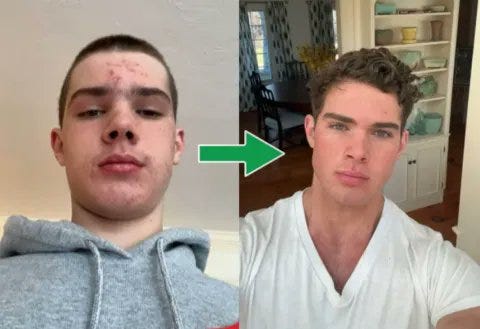
His hardmaxxing protocol is intense to say the least.
Starting testosterone at 14. Current steroid stack: anavar, test
Starting HGH at 16, and is still taking it after his last meal.
Starting Masterone at 17, unclear if still uses.
Weightlifting, but no cardio.
Bonesmashing.
Supplements: meldonium (neuroprotection), glutathion, NAC, melatonin (300-500mg megadose), hCG (250 units, twice per week, for fertility), pregabalin (anxiety), alprazilam, minoxidil, dutasteride, melanotan II (tanning, sexual function), retatrudide (appetite suppression), BPC-157 (cardioprotection, recovery), carotenoid blend (undertone, antioxidant), ketamine, isotretinoin (collagen production), noopept, alpha gbc, cerebralin, mexidol, semax (nasal), and adderall
It’s wild that teenage boys are now supplementing testosterone and growth hormone.
The X user Meta_trav noted that there’s a perverse logic to this, arguing that looksmaxxing is coming for us all.
Looksmaxxing is coming for us all. The game theory is clear. We've hit a nash equilibrium with male looks. The same competitive escalation women have navigated, the race that started with shaved armpits and arrived at botox, is now targeting men.
Instagram, TikTok, and dating apps are funneling everything into this reality.
…
In my city you can't be out of shape or unstylish. Zero results. That same escalation is coming for faces. Golden era bodybuilders created the fitness paradigm where being unfit makes you a loser. Looksmaxxers are doing the exact same thing for facial aesthetics.
If you haven't adapted to the fitness paradigm yet, you're getting steamrolled. The distribution keeps skewing toward fewer males capturing female desire. Late 30s? You might generationally dodge this. Under 35? The game is cooked.
Welcome to the global male-male contest.
Obviously there’s some “engagement farming” at work here, but the core point has some validity. In a difficult dating market that’s producing lots of “incels,” with partnering now mediated heavily by swipe apps in which looks are the dominant factor, being good looking is incredibly important to dating success for a lot of young people today.
Giving Early
In response to Justin Powell’s article and podcast about parents giving money to their children as young adults, a reader emailed me to say:
When Covid hit, my parents let me move back in with them without any shame, gave me a car to use, and took care of me like a spoiled teenager (no cooking!) so that I had time to work two jobs (one remote, one in person). That one year of no rent and two jobs got me financially ready for marriage and one year after I moved out, I was married. For my wife, after college she spent a few years working abroad in a very expensive city in Asia, but as a Christian she was able to rent a spare room in a local Christian’s apartment for way below what all her colleagues paid for expat housing. When we met we each had a car and around 100k in the bank, which meant we could marry right away, have a kid right away, my wife could be a stay-at-home-mom, and we could even save for retirement. If we had each had to live on our own and rent studios after college like most people and if I didn’t have the family support needed for my second job, we would have been in a completely different position.
A young person fresh out of a good college can often get a high-paying job, but it will be in an expensive area with crazy rent. So if your family can cover that housing cost, or let you stay in their basement, or connect you with Christians who can house you, that will make a huge difference in accelerating the jump from single to married.
It’s worth noting that in some cities like New York, a significant number of young people are getting financial assistance to pay rent from their parents. Children who don’t get that are often put at a disadvantage.
Best of the Web
Sahil Bloom: 22 Pieces of Career Advice They Don’t Teach You in School - This is a pretty good list, though I might quibble with or nuance a few.
NYT: Her Gilded Marriage Imploded. Now, She’s Ready to Tell All. (gift link) - Another female divorce memoir. But in this one the husband is the one who wanted out of the marriage, and didn’t want any custodial time with his children. That was his response to her busting him having an affair. You can also read the original NYT essay she wrote that led to the memoir (gift link).
Mere Orthodoxy: Why and How to Give Up Your Smartphone - There’s plenty to be wary of when it comes to smart phones, especially for young people, but this piece is a good example of how evangelicals are becoming enamored of Catholic anti-technology thought. (The author teaches at a Catholic school and is presumably Catholic, while MereO is an evangelical journal).
New Content and Media Mentions
I got mentions this week from American Reformer, and Mere Orthodoxy.
New this week:
Ownership vs. Elite - The tradeoff evangelicals face: Prioritize owned institutions for cultural survival, or invest in elite pathways for broader societal impact?
Jewish Sovereignty - In an age of institutional decay and transactional politics, could a Jewish sovereign wealth fund offer a path to autonomy and security?
My podcast this week was with Justin Powell discussing his article on why parents should give money to their children now, not when they die.
Subscribe to my podcast on Apple Podcasts, Youtube, or Spotify.
I'll second the recommend for Douthat's Burge interview. Douthat's podcast is one of the best out there, mainly because he's very good about pressing people and not letting them get away with punting or deflecting.
My $0.02 on the SBC, as someone who has lived a lot of his life in and around it: there are a lot of SBC churches with relatively good demographics. Though one difference relative to the non-denom world: every SBC church has a solid contingent of old people. In many, but not all cases, they still have plenty of families.
Non-denoms are the opposite: they basically always have families or single young people. They may or may not have anyone over the age of 65, but even if they have some, they will never have as many as even a family-oriented SBC church.
I would think the SBC could recover to some degree if it produced incentives for churches to join it. For example, it could invest more resources in church planting, or invest them more wisely. Summit Church -- part of the SBC! -- has its own Summit Network of church plants, which seem to be mostly, if not exclusively, non-denoms. I don't have the exact stats, but I wonder if Summit on its own has had more success at church planting than the SBC itself. My own non-denom received a crucial loan from a Baptist organization to finance the purchase of a new building.
But the problem -- and this is shared to some degree by all denominations -- is the brand has negative value. Some of the most successful SBC churches don't have "Baptist" in their name.
Though there's a particular irony in the case of Baptists: the trajectory of American Christianity is non-denominational, and your standard non-denom would qualify as some form of Baptist (though some are more on the Charismatic side). I would go so far as to say that the Baptist approach has become the dominant religious expression in America, and most of the market share lost by the Mainlines was taken up by churches that are Baptist in essence. Yet fewer and fewer Christians want to call themselves "Baptists". I wonder if to some degree Baptists are victims of their own success.
With respect to looksmaxing: part of the problem here is that there's a grain of truth underlying it. For young guys who want dates, looking good helps. A LOT. This has always been true to an extent, and sure the pressure nowadays is even more intense; but being overweight, unhygienic, unkempt has never been a positive in the dating market (obviously). I suspect there's a connection here between the overall decline in dress and self-care in American culture and the rise of this movement. Americans dress much more casually than they used to, and when you're out in public it's hard not to miss that outright sloppy appearance is everywhere. I'm not talking about young men not having model looks, but rather about them clearly not investing in basic hygiene and maintenance. Also, despite the pressure on both young men and women to look fit, the reality is that Americans young and old alike continue to get increasingly overweight as a population. The disparity between reality and desire grows so fast it feels unbridgeable to many. Perhaps this leads to feelings of hopelessness and giving up? Hard to say. But in any event, while looksmaxing as described in your post is outright dangerous (talk about hormones and drugs like that in teenagers: it's insane), I wonder if part of this movement's popularity is a reaction to a culture where so many clearly care so little about how they present themselves in public.
With respect to giving early: parental support for rent in high cost cities is very common in high end professional circles. Or even other, more subtle levels of parental financial support (paying for cell phone bills, paying all education expenses so no loans, keeping kid on health insurance first few years out of college). It is an absolutely massive differentiator. I'm in medicine, and when one combines the cost of med school and associated debt, the extremely low salaries during multi-year training courses after med school, and the concentration of many of the strongest residency programs in high cost cities, the reality of a kid without any form of parental support making a go of it these days in a medical career is bleak. It's not like it's impossible, but America is making it harder and harder for ambitious poor and working class kids to have a shot at a medical career in so many ways. That's a loss to those communities as well, because those are precisely the people we need MORE of in medicine if we're going to stand a chance of increasing healthcare availability in rural and poor areas.