

The State of America's Downtowns
Field notes from four downtowns, where schlubby workers, empty storefronts, and shrunken corporate footprints tell a complicated recovery story

I’ve been traveling a lot this year, and recently visited the downtowns of New York (twice), San Francisco, Chicago and Washington (twice).
America’s cities have rebounded somewhat from their Covid-era lows, but still remain challenged. While it’s important to look at statistics, there’s also no substitute for taking a first hand look.
As someone who has spent two decades studying urban America, I’ll share my impressions from these visits.
One general observation: the change in the way people dress for work is noticeable and shocking. The people who appeared to be office workers that I saw were all dressed very casually and had a schlubby look. They were far from the level of even pre-pandemic “business casual.”
At the risk of sounding like a curmudgeon, I think this is a bearish sign for the economic future of those downtowns. When the workers at ordinary, non-tech corporations don’t look like they take their job seriously - certainly a lot less seriously than the architecture of the costly, sometimes extravagant buildings they work in - this suggests a certain lack of seriousness in the entire downtown corporate enterprise.
It’s also not a good sign for the workers themselves. In a weak hiring market, when corporate employees don’t want to go to the office at all, dress like slobs when they do go in, and then head home promptly at five o’clock sharp, these are people primed to lose their jobs to AI, offshoring, an H-1B, or even a plain old reduction in force.
San Francisco
I stayed near the now-shuttered San Francisco Centre, which was an upscale mall anchored by Nordstrom and Bloomingdales. It’s weird to see an entire mall on Market Street essentially boarded up.
This is right by Union Square, the city’s premier shopping district. The actual Union Square plaza itself was quite nice, with people enjoying the space. But there was a lot of visible retail vacancy, including of major spaces like the former Barneys, whose sign is strangely still up. There were still a number of luxury brand boutiques in business, but most of them didn’t appear to have any shoppers, and the people on the streets didn’t look like a high end shopping crowd. The whole area felt much more challenged than Chicago’s Michigan Ave.
When I tweeted about this, someone said Union Square was better than two years ago. This seems to be the general view of the city. But if this is better, I’d hate to have seen it at its worst.
It might only be a small percentage chance at this point, but it’s certainly possible the Union Square shopping area could suffer a complete collapse that essentially eliminates it as a high end retail zone.
I also visited the Financial District. The area north of Market is the historic office core. This is where the city’s remaining non-tech legacy employers tend to be based. I was there at 5:15p on a Monday, and there was a stream of people leaving the offices and heading to the transit.
It was good that there were a number of workers in the office on a Monday. But I really noticed that they were basically all dressed ultra-casually and didn’t look impressive. It was quite a contrast with the often opulent office buildings from a bygone era.
San Francisco gives off the feeling that it was built by a lost civilization and is now inhabited by a completely different group of people. This is unlike NYC, where today feels very connected to the deep history and even the historic buildings of the city.
San Francisco was once the West Coast’s financial, business, and cultural hub. But the old Financial District world seems strangely shriveled. Data show that companies like Wells Fargo have shrunk a lot, going from 2.1 million square feet of office space in the region in 2019 to 750,000 today. The bank is technically still based in SF, but the CEO works in NYC and it has a huge presence in Charlotte.
The feeling south of Market Street around the Salesforce Tower is quite different. There’s a new cluster of modern high rises around the new Transbay Terminal bus station. I believe these buildings are mostly occupied by tech and tech adjacent firms like professional services.
The top of the Transbay Terminal is the gorgeous Salesforce Park. This is a public park, but homeless people were strangely absent. It would be interesting to know how the city encourages them to not linger there. The park was well patronized with even children enjoying the playground. A couple of the buildings are directly connected to this elevated park, and are some of the hottest offices around.
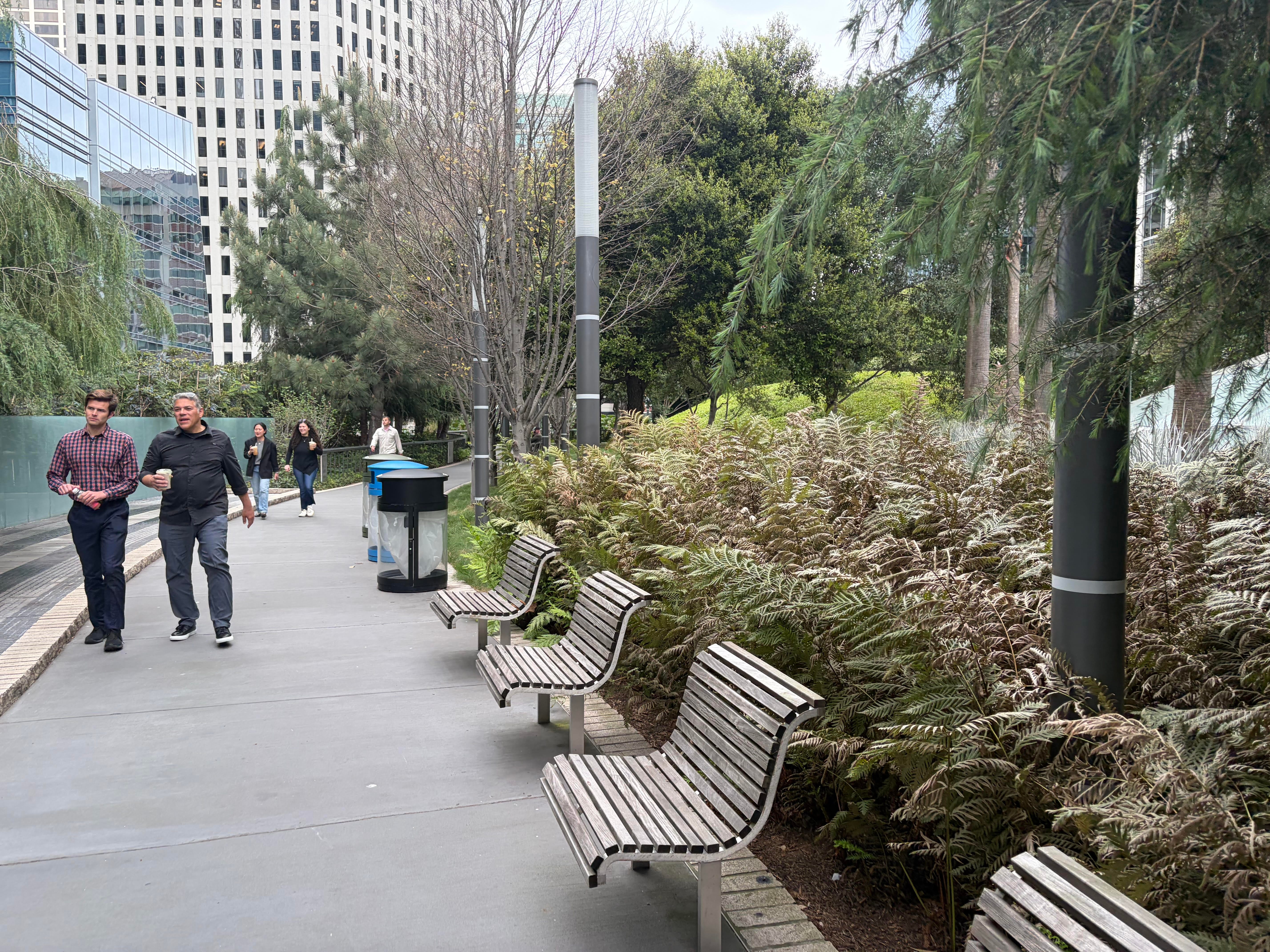
Tech has long had a casual dress code, but typically the people are quite stylish and in good shape. I found it interesting that the workers in this part of town were far better dressed and had a much better appearance than in the old Financial District. Tech now looks better dressed than corporate. This district seems much more vibrant and alive - and the people there more serious about what they are doing. The new buildings, park, and bus terminal go with the people you see. If the city ever brings the Caltrain station into here as planned, that could really turbocharge things here.
Still, the city’s economy appears very dependent on one industry, tech, whereas it used to have a much more diversified economy.
In general, the downtown of San Francisco didn’t have the crowds I remember. But it did have tons of homeless people. Frankly, it seemed quite sketchy and I would not want to bring my son here. Nor would I want my wife walking around by herself in the evening.
On the plus side, the neighborhoods outside of downtown that I saw looked basically fine. I rode BART and Caltrain, and they were likewise perfectly fine, if not especially well-patronized. And the driverless Waymo cars were like a visit to the future. I enjoyed using them, and they were super-convenient. Better than Uber in my view. Driverless ride hailing is going to dominate the market I suspect.
Chicago
Chicago had a much better feel than San Francisco, but also has a lot of struggles with downtown office occupancy and especially street level retail vacancies.
