


I was pleased to see that Daniel Stid at AEI liked my “New Trustees” framework for public intellectuals, including finding it useful for self-assessment. My essay really seemed to resonate with people.
And Tim Challies also mentioned my piece on Christians and AI. His essay on AI and the democratization of competence is well worth reading in its own right.
Their Pandemic Lockdown Never Ended
The great data journalist John Burn-Murdoch at the Financial Times has a sobering article about how the pandemic lockdowns never ended for some people. He uses the American Time Use Survey to look at the social lives of young people. For most people, their level of social interaction rebounded from the Covid-era restrictions. But for those with the least social interaction, the lockdowns not only took away what little social interaction they had, but they never recovered from that loss.
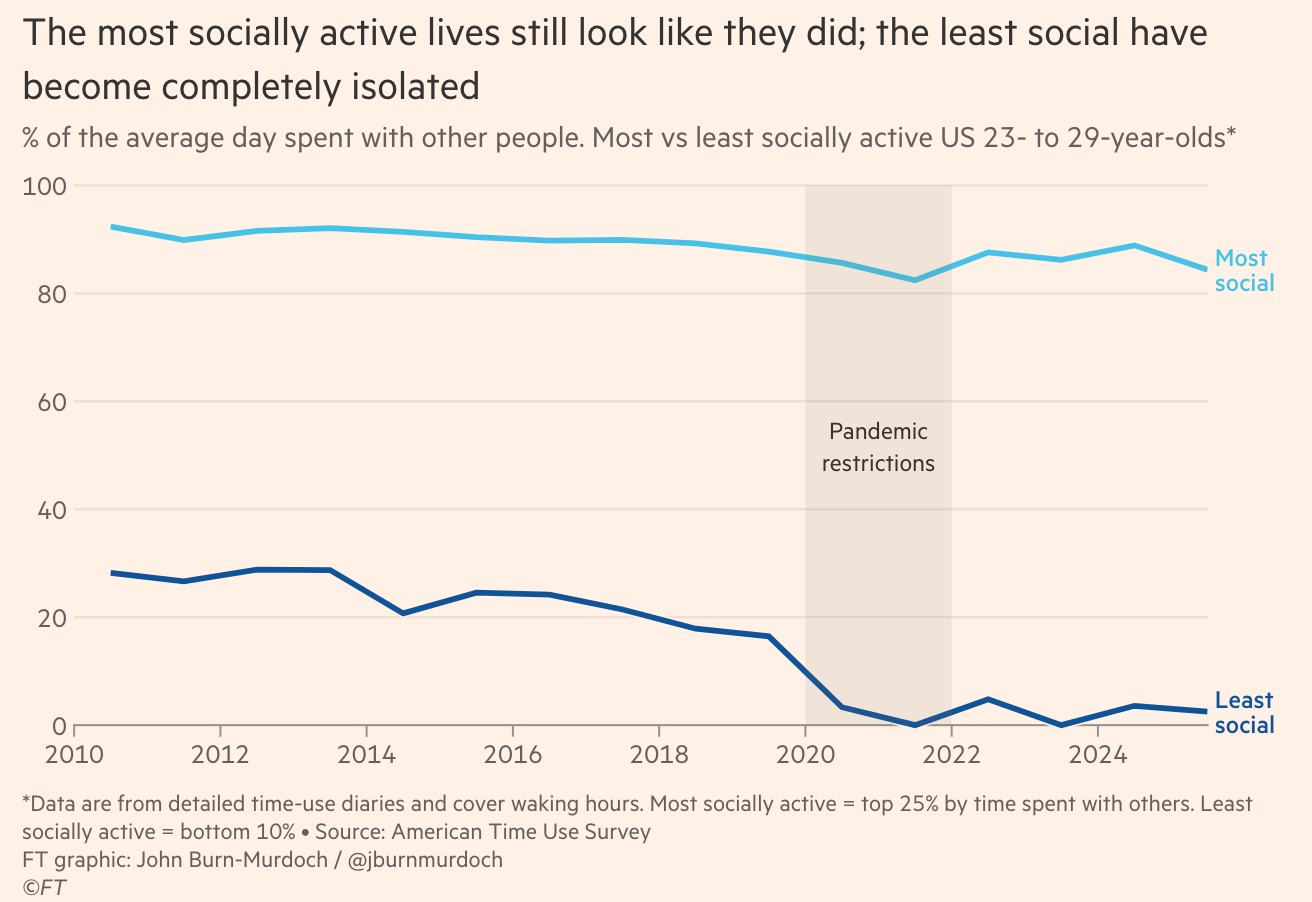
That’s an astonishing drop, from over 20% of the day spent with others to almost zero. Now, this isn’t a longitudinal study, so this isn’t the same group of people tracked over time. Also, we can see that the trend was declining prior to Covid.
But it still shows something very bad going on. Burn-Murdoch writes, “On an average day in 2023, one in 10 young Americans aged between 23 and 29 did not spend a single minute interacting face to face with another person.”
He goes on to describe the highly unequal effects of the general decline in socializing among young people, saying, “Anti-socialising forces have had radically different effects on different young people. Many teens and young adults have lives that are just as socially rich today as they were a decade ago while others have become completely cut off.”
In my observation, Gen Z has a very strong divergence in the trajectories of its members. The best of Gen Z is the best generation of Americans in my lifetime. But part of Gen Z is deeply troubled.
Some people might think this group of socially disconnected people will become a base for ever more radical politics. I think it’s more likely they become another lost generation, spending their days in porn, pot, and sports betting.
In a related piece, Christine Emba wrote in the New York Times about how friendship has become a luxury good (gift link). She writes about the “Nobody to Call” study about completely socially disconnected men. It’s important context about what’s happening to the people in Burn-Murdoch’s graphs.
Also, a Sam Sifton newsletter (gift link) in the Times talks about pot use, especially by young people. He writes, “It’s highest, unsurprisingly, among those ages 21 to 34 — 37 percent of those men and nearly 34 percent of the women report using marijuana in 2024.” He also notes the growth in the number of Americans suffering from cannabis use disorders.
The Economics of a Shrinking World
Jesús Fernández-Villaverde and Patrick Norrick published an interesting study about falling fertility. Much of it is very easy to read for the layman.
Part of the difficulty is that the bar any explanation has to clear is lower than it looks, because children come in integers. A cohort in which 15 women in 100 remain childless, most have two children, and one mother in six has three or four delivers a completed fertility of 1.8. Raise childlessness from 15 to 26, move 13 more women to a single child, and empty out the four-child families, and the same cohort delivers 1.3, the conventional threshold for lowest-low fertility despite three-quarters of women behaving exactly as before. Small changes in relative prices or opportunity costs, applied at the margin, are enough.
This math is one of the more important things to take away from the paper. It makes two key points. First, fertility happens in integers. No woman ever gives birth to 1.6 children. Second, overall fertility can drop significantly even the vast majority of women - three-quarters of them in their example - have no change in their personal fertility. Later they note an implication of this, “To reach [a replacement level fertility rate of] 2.1, a population needs many families with three or more children. Families stopping at two do not deliver replacement.”
Three popular candidates to account for the fall in fertility are shifts in preferences and social norms, smartphones and their effect on in-person interaction, and rising housing prices. It is too early to adjudicate among these. But, in our reading, smartphones accelerate the change in the TFR more than they cause it, and housing prices have an ambiguous effect because they make owners richer and renters poorer. We are left with shifts in preferences and social norms more by elimination than by conviction.
Thus, we will conjecture a more speculative possibility: modernity itself. We live in a society built around large organizations and formal credentials, which makes a third child expensive and childlessness cheap, and that circumstance has created a mismatch between women’s position outside the home and men’s inside it. As modernity has spread everywhere, even to countries with low income per capita, fertility has also fallen everywhere.
If the modernity thesis is correct, it suggests that our techno-industrial development has exceeded or is mismatched with our human-social. We have not yet created a cultural or institutional environment that enables the levels of reproduction needed to populate the future.
Click over to read the whole thing.
Best of the Web
After the paywall, 40 first dates, “Sunbeltism,” a Catholic convert’s experience, and more. Note again that my “Best of the Web” link roundup will be paywalled going forward.
