


I have a couple of urbanism/policy related pieces that came out this week.
In City Journal, I have a short take on how Californication caught up with Colorado. Colorado was the Texas or Tennessee of its day, but has seen a remarkable reversal in its fortunes.
Migration from California has helped change Colorado from a libertarian-inflected reddish state into a solid-blue one. And now blue Colorado is starting to turn into California.
The state’s remarkable demographic reversal provides the clearest evidence of this transformation. Recent Census numbers show Colorado losing more than 12,000 residents to other states last year, while its total population growth is anemic. The metro area of Denver, once a city with buzz as hot as Austin or Nashville, is now growing more slowly than Midwestern cities like Indianapolis and Columbus. The state’s labor force has also started shrinking—something the Denver Post notes has “never happened outside a severe recession or economic shock like the COVID-19 pandemic.”
Not so long ago, Colorado was one of America’s booming destinations. During the 1990s, its population grew by over 30 percent, adding more than 1 million residents. Between just 1990 and 1997, Colorado attracted nearly 110,000 migrants from California, about six times the number from any other state. The state also grew in the 2000s and 2010s.
Click over to read the whole thing.
I also have a longer essay in American Affairs Journal on how we should think about transportation policy in an age of disruption. This one is a bit wonkier, but I call for, among other things, devolution of responsibility of most transportation funding from the federal to the state level, as well as increasing the discount rate used when assessing the benefits of proposed highway projects in light of the uncertainty introduced by the possibility of autonomous vehicles.
Waymo, the autonomous driving spin-off of Google, is fast at work turning driverless ride-hailing from a science fiction concept into a realistic transportation option for the public. In San Francisco, it has already captured as much as 27 percent of the rideshare market. In addition to the Bay Area, Waymo offers service in parts of the Los Angeles and Phoenix areas; its driverless cars can also be hailed through Uber in Austin and Atlanta. Amid this success and momentum, the firm is now looking to expand its operations throughout the United States, with Miami, Dallas, Houston, San Antonio, and Orlando next on the list.
Not to be outdone, Tesla is now promising what it calls “full self-driving” to its customers, though its vehicles still require a driver to be ready to take control; it has begun offering driverless “Robotaxi” service in Austin and San Francisco, with more cities to come. The company is nearly at the production stage for its Cybercab, a car designed explicitly for robotaxi service.
While one segment of the U.S. auto industry is focused on going all in on driverless cars, another is looking at the threat of competition from Chinese EVs. Ford CEO Jim Farley has been driving electric vehicles from China, such as the Xiaomi SU7. Xiaomi is a Chinese conglomerate known especially for its mobile phones. He said of the SU7, “It’s fantastic. I don’t want to give it up.” He considers these low-cost, high-quality electric vehicles from China as the real challenge to Ford, and a genuinely existential one at that. He said, “We are in a global competition with China. And if we lose this, we do not have a future at Ford.”
The popular YouTube tech reviewer Marques Brownlee was also impressed with the Xiaomi SU7. After driving it for several weeks, he said, “This feels like a preview of what Apple might have done if they’d made an Apple car.” Brownlee touted its high-quality build and materials, software, quiet ride, and more. He summed it up by saying, “Are we cooked? Not yet, clearly. This car is not available here in the US. But you can see how we could be soon. . . . There’s basically no question in my mind that if a car like this was available in the US for $42,000, that it would crush.”
Click over to read the whole thing.
A Very Protestant Catholic Critique
While reading renowned sociologist Christian Smith’s lament about why he left Notre Dame, I couldn’t help but think that complaining that Notre Dame isn’t fully living up to its Catholic intellectual ideals is such a Protestant critique. Smith converted to Catholicism in 2010, and I think it’s a testament to him that he recognizes his essay may be a reflection of his Protestant enculturation.
Much of this is on me. I have never done well with institutions whose performances fall far short of their stated principles. It’s probably some residue of Protestant Reformation sensibilities in me. I also have difficulty not naming things frankly what they are. That’s my Philadelphia upbringing, no doubt. I own it. But at some point the personal costs became intolerable. [emphasis added]
It’s a generalization to be sure, but it seems like being Catholic has never come with the expectation that every person or institution fully embody all of Catholic thought, teaching and practice to the same extent that this is expected in Protestantism. We see this, for example, in surveys of Catholic laity, in which their views on a range of subjects align closer to mainline Protestantism than to the teachings of the Catholic church. The culture of Notre Dame probably is relatively close to what it means to be Catholic in actual practice.
The South and the SEC as Spectacle
Christopher Sandbatch is an interesting and provocative online writer, even though sometimes it can be difficult to understand exactly what he’s trying to say. He recently put up an interesting piece about the growth of SEC colleges as prestige destinations. It hits at some points related to topics I discuss here.
Elite schools of the Northeastern corridor have begun shedding their aspirant prestigees directly onto the Southern public colleges, and these institutions built to hold the region together (and, admittedly, to shield its inhabitants from the radiative effects of the Empire’s hegemonic culture) are being reimagined as destinations for people whose own regions have long served as the country’s default importers of credentialed youth.
…
The SEC school is increasingly constructed in national discourse as a cultural “elsewhere”: a place of spectacle, excess, ritualized sociability, and stylized gender performance; a place whose public meaning is carried less by laboratories and clinics than by tailgates, stadium light, and choreographed pageantry. It becomes legible as “The South” in quotation marks, a set of signs that can be consumed at a distance. One does not have to believe that the students themselves consciously think in these terms to see the structure. A region that is still treated as backward, parochial, or morally compromised is now (again) also alluring because it is imagined as unburdened by the neurotic disciplines of the Northeastern meritocracy. The difference is that the older contempt and the newer fascination share a common mechanism: both reduce an institutional world to an aesthetic object.
…
The tension between these frames, the SEC as aesthetic object on one hand and the SEC as functional institution [producing professional and technical graduates to staff the institutions of their states] on the other, produces many of the aggravations that now surround the “coolness” narrative. Observers who approach the South as a cultural novelty often speak as though these universities were newly invented as entertainment complexes; resorts that happen to have classrooms. Observers who approach prestige as a Northeastern monopoly often speak as though any influx of Northeastern students must be an error or a fad, because they cannot imagine legitimacy moving in that direction. Both positions miss what is actually taking place. The institutions are not becoming Northeastern; the Northeast is, in a limited but real sense, becoming institutionally dependent on the South for an increasingly large share of its own middle- and upper-middle-class reproduction.
In the previous regime, Northeastern schools produced prestige while SEC/land grant schools had a functional purpose to educate skilled technical graduates largely for their own states. He argues that what’s happened with the SEC is not just a transfer of the prestige function from the Northeast, but a hybridization of prestige + functionality as a response to a collapse in credibility of our elite.
To see this clearly is to return to the original purpose of the land-grant and flagship system, and to notice what has changed around it. The older American regime could tolerate regional specialization because it assumed the stability of the national core: prestige flowed from a small set of recognized centers, and the periphery sought recognition from them. But in a period when the centers increasingly appear as engines of moral and bureaucratic dysfunction, and when the costs of the credentialing path have become grotesque, the appeal of institutions grounded in visible competence and coherent social life grows. This does not mean that the SEC school is a new Harvard, nor does it mean that it produces the same kind of national elite. It means that the old prestige grammar no longer exhausts the ways Americans are now seeking legitimacy, security, and a workable adulthood. ….The SEC flagship, once an organ of regional self-maintenance, is becoming — by recruitment strategy and by the failures of other institutional ecologies — a site where legitimacy is redistributed. The observers who continue to read this through inherited prestige frameworks will keep mistaking it for spectacle. The more accurate reading is structural: an old apparatus of competence is being asked to absorb not only its own region, but a portion of the country that it once presumed it would never need to.
…
If the SEC flagship is becoming a site where legitimacy is redistributed, it is not because it offers a more pleasing youth culture. It is because the prestige regime that once monopolized legitimacy has grown detached from visible function. Its institutions still confer status, but the connection between certification and competence has become increasingly abstract. By contrast, the Southern flagship remains legible. It is still visibly tied to the reproduction of engineers, nurses, administrators, and the professional classes required to keep a society operational.
This distinction is difficult to state within the language of credentialism, because credentialism recognizes recognition, not function. Yet function is precisely what these institutions were built to preserve. Their authority was never meant to rest on symbolic superiority, but on their ability to reproduce competence for civic ends. [bold emphasis added]
Click over to read the whole thing.
I do believe at some level people are looking for credibility and competence today, and they haven’t been finding it in our prestige institutions.
Best of the Web
The Atlantic has a great major profile of Rod Dreher (gift link) in its March issue.
Joel Kotkin has a new report out asking if there is a new religious revival.
Related in Comment: Not So Secular Sweden - One of the most irreligious countries on earth is getting religion. What’s going on?
In 2025, memberships saw their largest rise in decades. Between 2005 and 2010, five to six thousand people applied for membership in the Church of Sweden annually. In the early 2020s, that number surpassed ten thousand. In 2024, fourteen thousand new members joined—the highest figure in decades. And 2025 will top even that: By November, nearly eighteen thousand had already entered the church.
Kyle Smith/WSJ: No Boyz Aloud on BookTok (gift link) - The literary world has zero interest in publishing novels for heterosexual men
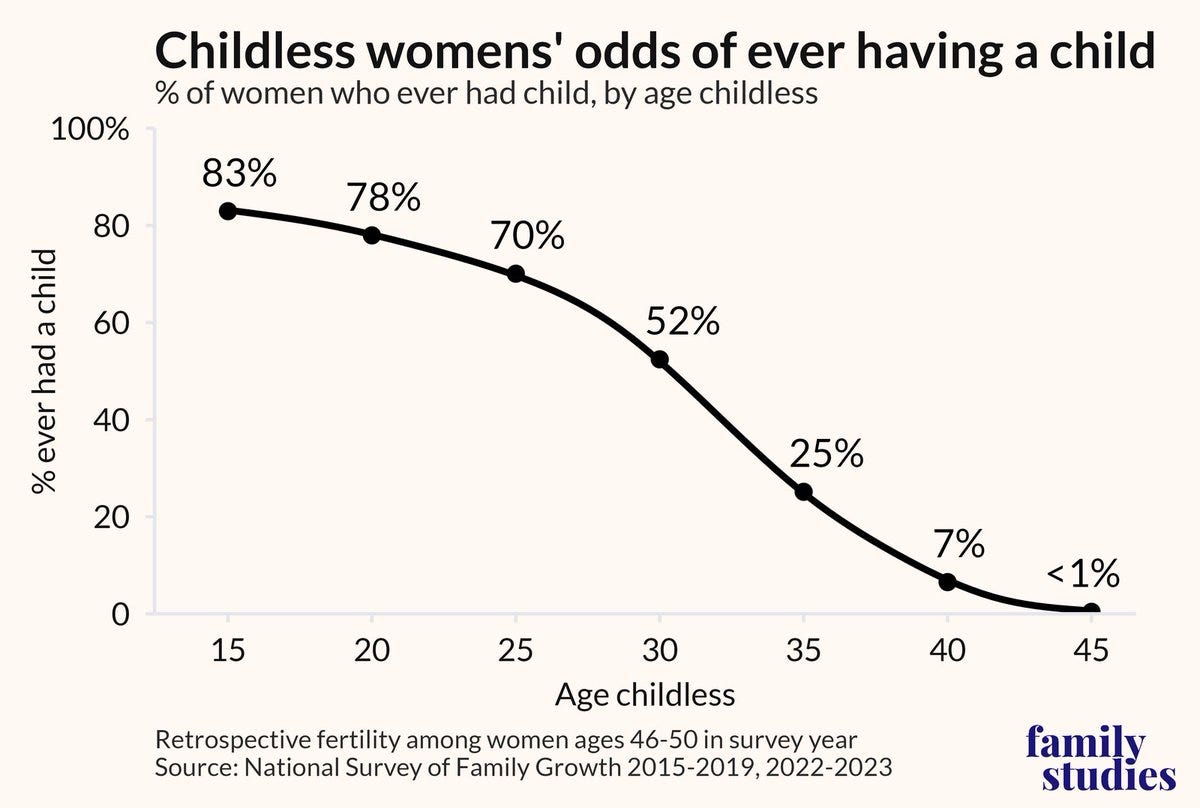
I mentioned the Brad Wilcox stat that if a woman doesn’t have a child by the time she reaches age 30, she has a roughly 50% chance of being permanently childless. Here’s a chart from IFS showing how those odds change with age.
The New Yorker: Silicon Valley’s Favorite Doomsayer Philosopher - Nick Land
Land’s writings from the nineties have a seductive danger, envisioning a sci-fi future of synthetic drugs, black-market brain implants, gene editing, and cyborgs. At that time, a world of true digital immersion was still decades away; like William Gibson, who wrote the eighties cyberpunk classic “Neuromancer” on a typewriter, Land, in his C.C.R.U. heyday, had a green-screen Amstrad computer, and was barely connected to the internet. But now a version of Land’s midnight future has arrived. While real-world infrastructure is left to rot, A.I. build-out floats the economy, accounting, as of 2025, for almost forty per cent of U.S. G.D.P. growth. And many of the fantasies that powered the online right during the mid-twenty-tens have become official policy under the second Trump Administration. The President hired the world’s wealthiest tech mogul to dismantle the government. The Department of Homeland Security posts deportation videos on TikTok that resemble the “fashwave” fan edits once spread on meme accounts inspired by Land and Yarvin. Out-of-control A.I. is not a fiction imagined by novelists but a reality financed by venture capitalists and sovereign wealth funds. And you no longer have to go to the deepest crypts of the web to find Land: in October, on an episode of Tucker Carlson’s show seen by millions, Carlson and the self-described amateur theologian Conrad Flynn discussed Land’s ideas about A.I. for close to half an hour. “We are building the demons from the Book of Revelation with A.I.,” Flynn explained, summarizing Land. “That’s Nick’s Land’s position?” Carlson asked. “It’s the position of a lot of these guys,” Flynn replied.
New Content and Media Mentions
I got a mention in the American Conservative and Breakpoint. And I was a guest on Razib Khan’s podcast.
New this week:
How We Engineer the American Transition - The playbook from America’s post-Civil War great reinvention—techno-nationalist acceleration paired with human-social formation
Evangelical Cultural Cringe - Building the quiet confidence cultural engagement evangelicals need to critique the mainstream and create real influence
Subscribe to my podcast on Apple Podcasts, Youtube, or Spotify.
Re: Colorado
Trump’s 2024 election win overshadowed Colorado voting on par with Illinois and New York. Colorado is the heavily white college educated town with no opposing coalition to it on a statewide level. It will be interesting to see how that experiment continues to play out.
Re: SEC
In the 1960’s, there was a group of Southern Ivies that looked to start the Magnolia Conference. It included schools like Vanderbilt, Tulane, SMU, Rice, Georgia Tech, and Duke. If it came to fruition, they probably add a school like Miami, Virginia, or TCU. It would have been interesting to see the result in a world of Ivy League elite schools in the northeast versus Southern Ivies situated in booming Sun Belt cities and states with SEC aesthetics.
Re: "Californication." It's mostly about cost of living. The fact is that you can sell a house in an expensive region (like coastal california, NYC tri-state area, etc), move somewhere cheaper, buy a new house and invest the difference. This is the single biggest driver of migration, especially among the older set (retirement age). Colorado, like California, has stunning natural amenities, and was cheaper until recently (it's still cheaper than CA, but the difference is much smaller than it used to be). People usually want to move to states that still have opportunities and activity going on, so they go to places like TX or FL as opposed to truly cheap places like MS or WV, at least in aggregate.
More broadly, state lines actually obscure the trends. If you look at a large state with a still growing population, such as TX, you see that what's happening is that rural parts of TX continue to slowly depopulate while the metros drive the lion's share of the population growth. (https://demographics.texas.gov/Visualizations/2024/Estimates2024/ slightly old but gives the idea). What people in working age groups are doing, by and large, is sorting into two separate subsets. Most, by the numbers, are moving to metros with decent economies (job opportunities) where cost of living is still attainable. TX, as a state, does well here because it has 4 such metros. Another subset pursues high paying careers in expensive cities that have good job markets but very high cost of living (your NYC, SF, etc). California has several of these types of cities (SF, SJ, LA, SD). The absolute number of working age people who can afford to get started in these markets is smaller, so that combined with the retirement cash-out effect described above drives the migration pattern of wealth concentration but population flatlining.
Most new housing in the US these days is being built in suburban and exurban counties, as opposed to downtown cores. There are many reasons for this, that vary from region to region, but that's the trend. Examples:
GA (https://www.axios.com/local/atlanta/2023/04/11/georgia-population-changes-pandemic)
NC (https://www.axios.com/local/raleigh/2025/01/07/north-carolina-population-growth-cities-wake-chatham-census)
Notice the "donut" surrounding Atlanta, and see how few counties in NC are really driving most of that state's population growth.
The pattern is similar even in "blue" states:
MN (https://www.axios.com/local/twin-cities/2021/08/17/minnesota-county-population-growth-map-census)
CA (https://www.axios.com/local/san-diego/2025/01/02/population-counties-california-shift-trends),
Note the migration to lower cost inland counties in CA, for example.
Other states mirror this pattern. Rural areas with no jobs are depopulating, people are migrating to counties that have affordable real estate + job market access. The sunbelt is where most of these counties in the US are nowadays.