

Evangelicals Missing from the Halls of Power
The lack of evangelical elites, politicized parenting, seniority-driven government and more in this week's digest.

For those of you in New York City, I’ll be speaking about evangelical elites next week on March 11th at Hephzibah House on the Upper West Side. Here’s the link to register.
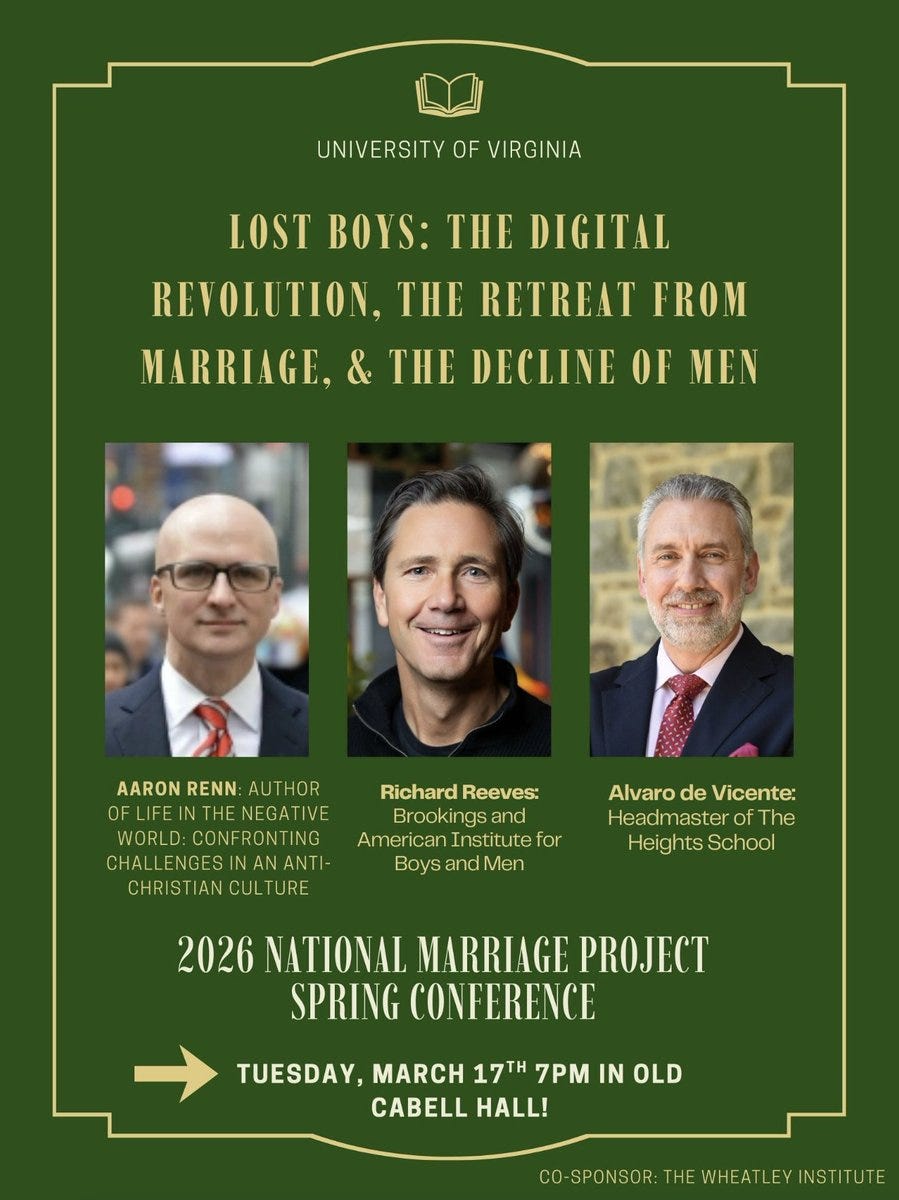
And if you are near Charlottesville, Virginia, I have an exciting event at UVa on March 17th at 7pm called “Lost Boys: The Digital Revolution, the Retreat from Marriage, and the Decline of Men.” I’m going to be part of a great panel discussion on this topic with Richard Reeves and Alvaro de Vicente.
There’s been a lot of recent press for James Talarico, a liberal Christian who won the Democratic nomination for Senate in Texas this week. But if you’ve been a reader of mine, then you already know about Talarico as I wrote about him and his own variety of Christian nationalist vision back in 2023.
Evangelicals Missing from the Halls of Power
I have an op-ed in today’s Washington Post on the lack of evangelicals in the halls of power (gift link). It’s another entry in the theme of the lack of an evangelical elite that I’ve been exploring.
Evangelicals are 23 percent of U.S. adults and one of the most loyal Republican voting blocs, with 81 percent backing Donald Trump in 2024. Yet despite six of the nine Supreme Court justices being appointed by Republican presidents, there are no evangelicals on the Supreme Court.
This is just one of the many elite institutions in which evangelicals are absent or underrepresented. Evangelicals have excelled in politics, producing figures such as Sen. Josh Hawley (R-Missouri) and House Speaker Mike Johnson (R-Louisiana). They are also prominent in well-run and profitable businesses with relatively low cultural impact, such as food processing (Tyson Foods) and retail (Hobby Lobby). But they are all but absent from the leadership of prestigious universities, major foundations, Big Tech companies, leading financial firms and large media companies.
One response to this situation might be: Who cares?
Click over to read the whole thing.
My piece is slated to run in Sunday’s print edition as well.
In my view the lack of an evangelical elite is not primarily the result of anti-evangelical bias in institutions - though there’s some of that - but from evangelicalism’s own internal dyanmics.
Please see my longform essay on this in the First Things.
Boomer Upsizing and Other Follow-Ups
I got a number of emails and replies to my article about the Boomer upsizing, that is, Boomer retirees buying large, multi-bedroom homes in prime suburban communities with top school districts.
I said one driver of this trend is Boomer parents moving to be closer to children and grandchildren. One woman wrote to say:
My parents (62) moved from DC to Winston-Salem, to live on my street and help with my kids. We moved my grandmother (81) from DC to her own home in a retirement community in Winston. My parents and grandmother now go to our church, where my sister and her family also attend. In our church, we have *multiple* examples of grandparents relocating to be close to grandchildren in a relatively low cost area, in a state experiencing a mini population boom. The downside is that our nuclear family can’t afford to move into a home the size we need - 4K sq ft- because they are filled with all-cash offer Boomers (like my parents, who own two homes). My extended family is part of the problem! What’s the solution? The boomers will age in place and not leave those big homes anytime soon.
Another woman told me:
We moved to Tennessee from the NYC area during the pandemic. When they retired, my parents took the proceeds from their home sale and bought the house next door. It’s been amazing for us. We are not the only family in the neighborhood in that situation. And every time here is a three or four bedroom. But I see my parents every single day, which wouldn’t happen if they were even five minutes away in a townhouse…
I suggested that Boomers retirees driving up housing prices in these prime suburban areas might negatively affect fertility. But she suggest the opposite, saying her parents move, “will likely give my parents a couple more grandchildren on the margin as well.”
And a retired male Boomer said:
We have met the enemy, and he is me! My wife and I wanted to retire to a walkable neighborhood in a town. The market was hot so we ended up snatching a house that, compared to the house we raised our kids in, added 1 bedroom and 400 sq. feet of space. I love it, it’s great for entertaining ... but I feel a bit guilty a family didn’t get it. We would have been happy downsizing but previously for a smaller house we were outbid by $40k.
In my piece from yesterday on the manosphere hitting the mainstream, commenter Sprouting Thomas posted this in response to my observation that the mansophere now trashes virtually every woman as too ugly to date.
Yes. I too have noticed this shift: every woman is “mid” at best. If a man online says out loud that a woman is attractive, then he’s either some sort of “simp”, or else demonstrating his own low value, that a “mid” is the best he can hope to attract. It’s exhausting just to read it…
I’m far from the most devoted observer of the manosphere, but to me this “every woman is gross and if you like them you’re a simp” mentality is a real change from the old manosphere to the new. The old one was more accepting of the way women are. “You know how you’re drawn to a good body and a pretty face? Well, women are drawn to superficial things too. Don’t waste time fighting it or moralizing about it, just operate with that knowledge in mind. Pick up some good clothes, a good haircut, good cologne. Get some exercise.”
Reasonable enough!
The new manosphere seems much more inclined to blame women for all the world’s ills. “This is the way women are, and that’s terrible. Letting them drive cars has been a disaster for the human race.”
Some of this may be due to the influence of incel culture, which Freddie deBoer wrote about today in a piece called “The Incel Veto.” As always with Freddie, it’s full of zingers. Here are some highlight pull quotes:
Simply acknowledging that I am a more-or-less heterosexual man who has had sex with a non-zero number of woman now provokes a kind of resentful reaction that I find annoying, strange, and honestly kind of anti-human.
The incel’s veto is the specific prohibition against men ever frankly discussing sex in any positive way that directly reflects the fact that they have sexual experience and thus have earned the consent of women. The incel’s veto weaponizes the natural and healthy inclination to stigmatize actual male bragging about sexual promiscuity (“I get so many girls, bro”) by spreading that stigma to any admission by any man that they have a sexual and romantic life.
The incel’s veto helps spread the ubiquitous online assumption that nobody is getting laid, anywhere, ever, and that it’s inherently pathological to treat sex and romance as not just healthy aspects of human life but as mundane and achievable.
A relative handful of alienated, internet-addled men, marinating in grievance and pseudo-Darwinian fatalism, have managed to inject into the bloodstream of our culture a bleak, hyper-strategized, market-based understanding of intimacy that treats human connection as a ruthless auction and desire as a rigged algorithm.
And in response to my article about it almost being a sin for an evangelical to be an elite, someone reminded me of the the old Keith Green song “Jesus Commands Us to Go.” Go meaning into missions. Green was a huge and extremely influential early contemporary Christian musician who died young tragically in a plane crash. He was very influential on evangelicals of my generation.
The song again basically says if that you aren’t doing some type of evangelistic mission work, you are probably being disobedient to God. The lyrics say, “Jesus commands us to go / It should be the exception if we stay / It’s no wonder we’re movin’ so slow / When His church refuse to obey.”
And Matthew Loftus wrote a related follow-up to my discussion of evangelical cultural cringe called “10 Reasons Evangelicals are Cringe.”
Politicized Parenting
Psychologist Leonard Sax has a great article in Commonplace on the politicization of American parenting. It’s so good I want to just repost the whole thing, but here are some highlights:
20 years ago, I did not perceive a political dimension to parenting. Some parents were too strict, some parents were too permissive, and some parents were just right—and I saw no connection between parenting style and parental politics. Back then, I could tell you about parents who were left-of-center, ACLU-card-carrying liberals who were also strict, authoritative parents. Not anymore. Today, left-of-center parents are more likely to be permissive, and permissive parents are more likely to be left-of-center…Left-of-center parents are now uncomfortable exercising their authority as parents. Their kids are now more likely to be defiant and disrespectful. That wasn’t true 20 years ago, in my observation.
…
In response [to changes in the Boy Scouts], a cohort of men launched Trail Life USA, specifically as an all-boys alternative to Scouting America. “Our number one job is not to get kids into the program. Our number one job is to grow godly men,” said Trail Life USA CEO Mark Hancock. But Trail Life USA, which now has 1,500 locations across the United States, is an avowedly Christian and right-of-center organization. Fifty years ago, the Boy Scouts were not a political organization. Jimmy Carter, Steven Spielberg, Bill Clinton, and Joe Biden were all Boy Scouts. But a left-of-center atheist Democrat would feel uncomfortable at a meeting of Trail Life USA, which proclaims that “salvation is by grace, through faith in Jesus Christ alone.” Likewise, a conservative Republican parent might be uncomfortable with the new requirement from Scouting America that anyone wishing to attain the rank of Eagle Scout must obtain a merit badge certifying that they understand the concepts of diversity, equity, inclusion, and intersectionality.
This is the choice which increasingly confronts American parents: secular/left-of-center or religious/conservative. The dichotomy is even more dramatic in our schools. Over the past 25 years I have visited more than 500 schools: public and private, urban, suburban, and rural, from Alaska to Florida, Hawaii to Maine. In 2001, when I first began these visits, I didn’t see much difference between schools in blue states and red states. There were good schools and bad schools, authoritative teachers and permissive teachers, and the variation did not vary by political affiliation. Not anymore. Today, I can tell you within five minutes, and with my eyes closed, the political affiliation of a school. If a teacher says, “boys and girls, please line up quietly!” then this school has a conservative, right-of-center affiliation. Guaranteed. Many urban, left-of-center school districts no longer permit teachers to use the phrase “boys and girls” because that term is not inclusive of nonbinary individuals.
…
Today, we need another scholar to write a new book documenting how Americans have become segregated by party affiliation. Researchers now find that Democrats and Republicans are choosing to live apart from each other. Harvard investigators Jacob Brown and Ryan Enos did a granular investigation of 180 million voters in cities across the United States. They found that “a large proportion of voters [now] live with virtually no exposure to voters from the other party in their residential environment.” They emphasize that this sorting by political party is “distinct from racial and ethnic segregation.” Within the cities they studied, such as Chicago, Baltimore, Houston, Charlotte, Birmingham, Denver, and Columbus, Ohio, some neighborhoods were overwhelmingly Republican, others were overwhelmingly Democratic, and only a few were anywhere close to 50-50. This sorting means that even in public schools, kids are unlikely to encounter classmates from families of different political persuasions. The school will align with the political preference of the neighborhood. If you don’t like it, you can move.
Click over to read the whole thing.
America’s “Diane Feinstein” Problem
There was a great piece this week from the Boyd Institute on America’s “Diane Feinstein problem,” or the negative effects of how our government institutions are overly driven by a seniority system. Among other things, this repels top talent.
This [lockstep seniority] structure also exists in the military where, under the Defense Officer Personnel Management Act (DOPMA), officers are promoted in cohorts by year of commission. You make captain around year four to six, major around ten, and lieutenant colonel around fifteen. There is some variation at the margins: if you aren’t selected for promotion twice you’re discharged (the “up or out” rule). But what does not exist is the ability for a brilliant officer to rapidly climb the ranks. The economist Tim Kane, who has written extensively on military talent management, called DOPMA “the root of all evil” in how the armed forces handle their human capital.
Ultimately, these seniority protections survive because insiders have captured the system, especially public‑sector unions inside the bureaucracy. But what this rent-seeking accomplishes primarily is chasing away the most capable people from a job in the government and staffing many of the public sector’s most important management positions with the mediocre.
…
An exception to the seniority system is the Federal Reserve, which sits outside the GS pay scale and can set its own compensation and promotion schedules. The Fed has meritocratic hiring and advancement based on ability — and for someone working there, such work experience grants them an enormous amount of private sector employment capital (regardless of which White House administration coincides with that work experience). As a result, the Fed is able to compete with top Wall Street firms for top economists and rising analysts.
The Fed is also, in my opinion, and by way of reputation and results, the most competent institution in the federal government — a status that flows directly from its freedom to hire, fire, and pay on merit.
…
All of this would matter less if the seniority system did not also undermine congressional oversight of the executive branch. This monitoring, in theory, should be done through the committee system, since committee chairs have subpoena power, control hearing agendas, and can direct investigations. But these roles are seldom filled by members with the cognitive sharpness the work actually requires….The late Dianne Feinstein sat on the Senate Intelligence Committee — the body that oversees the CIA and NSA — at the same time that multiple reports described serious cognitive decline. She did not leave her seat before passing away in 2023, and there existed no reliable mechanism for removing her.
Click over to read the whole thing.
Best of the Web
Shaid Hamid/WaPo: America’s dating crisis is getting worse. What went wrong? (gift link) - Young people are struggling to find love. It’s time to bring back the matchmaker.
If trends continue, one-third of young adults will not get married and one-fourth won’t have kids. Some cities are worse than others. In San Francisco, half of all men remain unmarried by age 40. As sociologist Brad Wilcox told me, “We’ve never been in a cultural moment where so many young adults are headed toward a life without immediate kin.” The implications are staggering: a generation of permanent bachelors — and bachelorettes — untethered from the bonds that have given life its deepest meaning.
Institute for Family Studies: Loneliness Isn’t for Cowards; It’s for the Institution-less
Gallup: Americans’ Religious Engagement Holds at Lower Levels - 47% consider religion very important, religious "Nones" tick up to 24% and religious service attendance remains low
Chris Arnade: What Holds America Together? - The importance of Place, the American Dream, and the under-rated Midwest
New Content and Media Mentions
I got mentions this week from Mere Orthodoxy and Tim Challies.
New this week:
The Boomer Upsize - Baby boomers are ditching the downsizing myth to claim 4-bedroom homes near their kids and grandkids, sending home prices skyward.
The Manosphere Hits the Mainstream (paid only) - From red pill blogs to Clavicular’s New York Times and GQ profiles, the manosphere has finally broken containment
My podcast this week was with Dr. Albert Thompson on how to think about race.
Subscribe to my podcast on Apple Podcasts, Youtube, or Spotify.
Just listened to your full interview with Razhib Khan. Last week, it was paywalled, but the whole thing is up as of yesterday.
The critique of DOPMA often assumes that speed of advancement is the primary indicator of institutional health. That assumption does not fit well with the historical experience of the U.S. military. For more than two centuries the American armed forces have produced competent leaders and have repeatedly demonstrated operational effectiveness in complex wars. A personnel system that emphasizes time in grade, progressive responsibility, and cohort promotion is not accidental. It is designed to ensure that leaders accumulate experience across tactical, operational, and institutional levels before they are entrusted with larger formations.
Military leadership is not merely a function of intelligence or brilliance. It is the product of formation over time. An officer who eventually commands at the strategic level has normally spent years learning the profession from the bottom up. He has served as a platoon leader responsible for the lives of a few dozen people, as a company-grade officer mentored by more senior leaders, as a staff officer learning planning and coordination, and later as a commander at progressively larger echelons. Each stage exposes the officer to different aspects of warfare, logistics, personnel management, and the integration of complex combat systems. The purpose of time-in-grade requirements is to ensure that leaders gain this cumulative knowledge and are shaped by those who have already walked that path.
A “brilliant” officer who lacks that developmental process is not necessarily an asset in a military organization. Warfare is fundamentally collective. Success depends on trust, discipline, and an understanding of how large organizations operate under stress. Officers must know how to lead, but they must also know how to be led and how to function within a chain of command. Rapid advancement based solely on perceived talent risks producing leaders who have not internalized the habits, judgment, and institutional knowledge that the profession of arms requires.
The “up or out” system also serves an institutional purpose that critics often overlook. Military organizations require a steady flow of opportunities for younger officers to assume responsibility. Without periodic turnover at higher grades, promotion pipelines would stagnate and younger talent would never reach positions of authority. The system therefore balances experience with renewal, ensuring that the force continues to develop new leaders while retaining those who have proven themselves over time.
The broader evidence suggests that the military model of leadership development is not obviously broken. Retired officers frequently transition into the civilian sector and succeed in demanding leadership roles precisely because of the habits formed in that system: accountability, mission focus, care for subordinates, and the ability to operate within complex organizations. These traits are cultivated through years of mentorship and responsibility, not through rapid promotion.
In fact, one might argue that many modern organizations struggle because they have moved away from this kind of disciplined development. In many sectors today there is intense jockeying for position and status, with individuals seeking rapid advancement and titles after only a few years of experience. The expectation of progression without prolonged apprenticeship can produce leaders who have never spent enough time in the trenches to understand the work or the people they lead.
The military’s slower, experience-based model reflects a different philosophy. Leadership is something that must be learned through service, observation, and responsibility over time. Titles are not the goal; competence and stewardship of others are. While no personnel system is perfect, the long record of military leadership development suggests that the principles behind it are more durable than many critics assume.