

Living With Mom and Dad at Age 33
Living at home, ambient belonging, and more in this week's digest.

The Wall Street Journal ran an interesting article (gift link) about the young adults, and not-so-young adults, who are living at home.
By July 2020, 52% of young Americans age 18 to 29 lived with at least one parent, according to a Pew Research Center analysis of census data. It was the first time a majority of young adults in the country had lived with parents since the Great Depression. That share has likely dropped since then, but for some people the arrangements have stuck.
Almost half of adults under the age of 30 are living at home today, down a bit from the pandemic year of 2020 but up 12 percentage points since 2019.
The actual level is probably overstated, since the data doesn’t distinguish parents living with children - which has likely also increased due to our aging society - from children living with parents.
The high cost of housing is a big factor. But some of them aren’t doing it out of necessity but out of choice:
Samantha Stobo was fresh off a breakup and unable to afford her Manhattan two-bedroom alone. So the 29-year-old decided to move in with her mom in Miami until she could get back on her feet. She told herself it would only take a few months. Now 33-years old, Stobo has no plans to move out. “I thought it was going to be temporary,” Stobo said. “But it’s been three years now, and I love it.”
This seems to be leading to a change in social norms in which the stigma of living at home is declining:
Young people say that living at home in 2026 doesn’t carry the stigma it once did because of how unaffordable life has become….Far from hiding it, some now broadcast their lives as “stay-at-home daughters” or “stay-at-home sons” on social media. Stobo says posting about her mother-daughter living situation on TikTok has earned her a friendly comment section filled with others in the same position—and makes her some money. “No one ever judges me,” she said. “The conversation tends to be more like, ‘That’s awesome, and I bet you’re saving money.’”
Living at home for a time to pay off college debt, help save for a downpayment, etc. isn’t necessarily a bad thing. But living at home is in line with other trends showing a failure to launch among younger people, or greater delays in achieving the markers of traditional adulthood.
Traditionally in American culture, kids left home early. This goes along in part with our entrepreneurial, go-getter spirit. It’s true that in other cultures like Italy, it’s common for unmarried children to live with parents for an extended period of time. But those are not particularly dynamic societies either.
One of the factors related to housing prices remaining high, and especially a lack of affordable family housing, is that Boomer retirees are increasingly not downsizing as expected. Instead, they are often upsizing. The Wall Street Journal also had another interesting piece (gift link) about this phenomenon.
Well-off boomers are increasingly upsizing their homes as they age, either buying bigger ones or financing additions to their existing properties. They are building guesthouses for family members and gourmet kitchens for entertaining, alongside such features as high-end grab bars and first-floor primary bedrooms for aging in place. In the process, they are rewriting the rules of retirement and aging, when people are expected to move into smaller homes to save money.
Boomers make up the largest share of home buyers in the U.S.—an aspect of a housing market that is out of reach for younger buyers, but well within the economic powers of an older generation that controls the bulk of the nation’s wealth. Downsizers account for a slightly larger share of older home buyers, but the upsizers are quickly gaining momentum.
Not only are they buying large homes with 3+ bedrooms, they are often doing so in towns with the best school districts, pricing out families. This is a good thing in some ways, as these are often parents moving to be closer to children and grandchildren. But it still adds to the pressures on young families in buying a house, and one in a quality school district. I previously wrote a piece looking at this specific issue that may be of interest.

The Loss of Ambient Belonging
The housing story is about private space, but part of the dynamic underlying this is what’s happened to our public and semi-public ones.
Jeff Giesea just walked the Camino de Santiago, a popular pilgrimage route in Spain. After the experience he wrote a piece talking about “ambient belonging,” the loss of which contributes to our loneliness epidemic:
On the Camino, belonging wasn’t something I had to work for. It was just there, like the weather. Every pilgrim climbed the same hills, slept in the same albergues, and nursed the same blisters. We recognized one another by the scallop shells on our packs and the dust on our shoes. When I was alone, I’d walk up to a table of pilgrims and ask, “May I join you?” The answer was almost always yes. The Camino didn’t make friendship automatic, but it made conversation almost effortless. Belonging was in the air.
I call this ambient belonging. Ambient belonging is the degree to which an environment lowers social friction between people. It’s not the thick, durable belonging we find in family, lifelong friends, or close-knit communities. It’s a social atmosphere where membership is presumed and connection requires less effort.
Ambient belonging is about the level of friction involved in establishing connection or relationships:
In April, I argued that the loneliness crisis is really a belonging crisis and that belonging is structural. Ambient belonging names the ingredient that makes connection easier in some environments than in others. It changes the question from How do we make friends? to Where is friendship easiest to make? Belonging becomes a design question, not just a psychological one.
That realization is making me rethink my own life. Maybe my belonging deficit isn’t just a personal failing but also a function of my lifestyle and environment. I felt more ambient belonging in my walkable neighborhood in Washington DC than I do in my car-dependent one in Florida. Back then, I walked to work and was a regular at neighborhood bars and coffee shops.
He also makes an important point about the role money plays in ambient belonging:
Money cuts both ways. It can buy us out of ambient belonging through McMansions, remote work, private rooms, and frictionless convenience. But it can also buy us access to it through private clubs, schools, camps, churches, and experiences that create repeated contact and shared identity. As more of American life has become private, ambient belonging is often something we buy our way into.
This is related to our K-shaped society. There have been many reports about the growth in pricey private clubs in cities like New York. As civic life has declined, trust has eroded in our society, and it has become difficult to enforce standards of behavior in public spaces, money has come to play a key role in two ways. First, it allows people to buy insulation from environments whose ambience is negative or undesired. Second, it then allows people to buy into privatized ambient belonging, at the private club, for example. Those without money cannot pull this off as easily. They are stuck where they are.
Related to the K-shaped society, the WSJ also has a piece on how Las Vegas became a luxury destination (gift link). More and more businesses are now oriented towards serving the people with lots of money, ones often insulating themselves or buying private or semi-private ambient belonging.
The Public Intellectuals America Needs
My essay earlier this week on the New Trustees drew quite a bit of interaction.
Venture capitalist Marc Andreessen said that it was, “An epoch-defining essay. Wholeheartedly agree.”
Farrell Gregory of the Foundation for American Innovation shared some interesting thoughts on moralizing:
I’m not sure about the distinction that he draws between public intellectuals having “moral weight” vs moralizing. In his description, he seems to associate moralizing with scolding people who disagree with you. I’m not a fan of scolding, but maybe this distinction is just stylistic or rhetorical. I do appreciate the weight Aaron places on having humility, respect for opposing arguments, and having an even temperament.
That said, if he uses moralizing to describe the zealous (or even over zealous) advocacy for moral truth, I personally don’t see the issue with a public intellectual being moralistic. We don’t have nearly enough.
A strongly-held view of mine is that we should be far more concerned about indifference, self-interest, and tolerance for suffering among public intellectuals. I don’t think we have nearly enough people (especially professionals in DC/SF/NY) who are overly strident. My favorite Will Manidis [line] is, “We live in age of great moral panics about things that don’t matter and zero moral outrage over some of the most egregious societal sins we’ve ever seen.”
It takes some restraint on my part not to retweet it on a daily basis in response to a constant barrage of evidence: scams, anti-social behavior, gambling, corruption.
Contra Aaron, I don't think we have nearly enough moralizing. It is insufficient to carry a personal moral weight. if you are a public intellectual, you should be in a state of moral outrage over modern public virtue.
These are good points and I agree with much of what he says. I’m personally not going to stop calling out the problems with normalization of gambling, for example. In my piece was reacting against what I often see, which is moralizing or demonizing directed at one’s opponents or people one does not like. Moral language can work well for the public intellectual, but it depends on how it’s used.
Titus Techera also wrote some reactions, and the piece was linked by Doug DeVos and the Intercollegiate Studies Institute.
Best of the Web
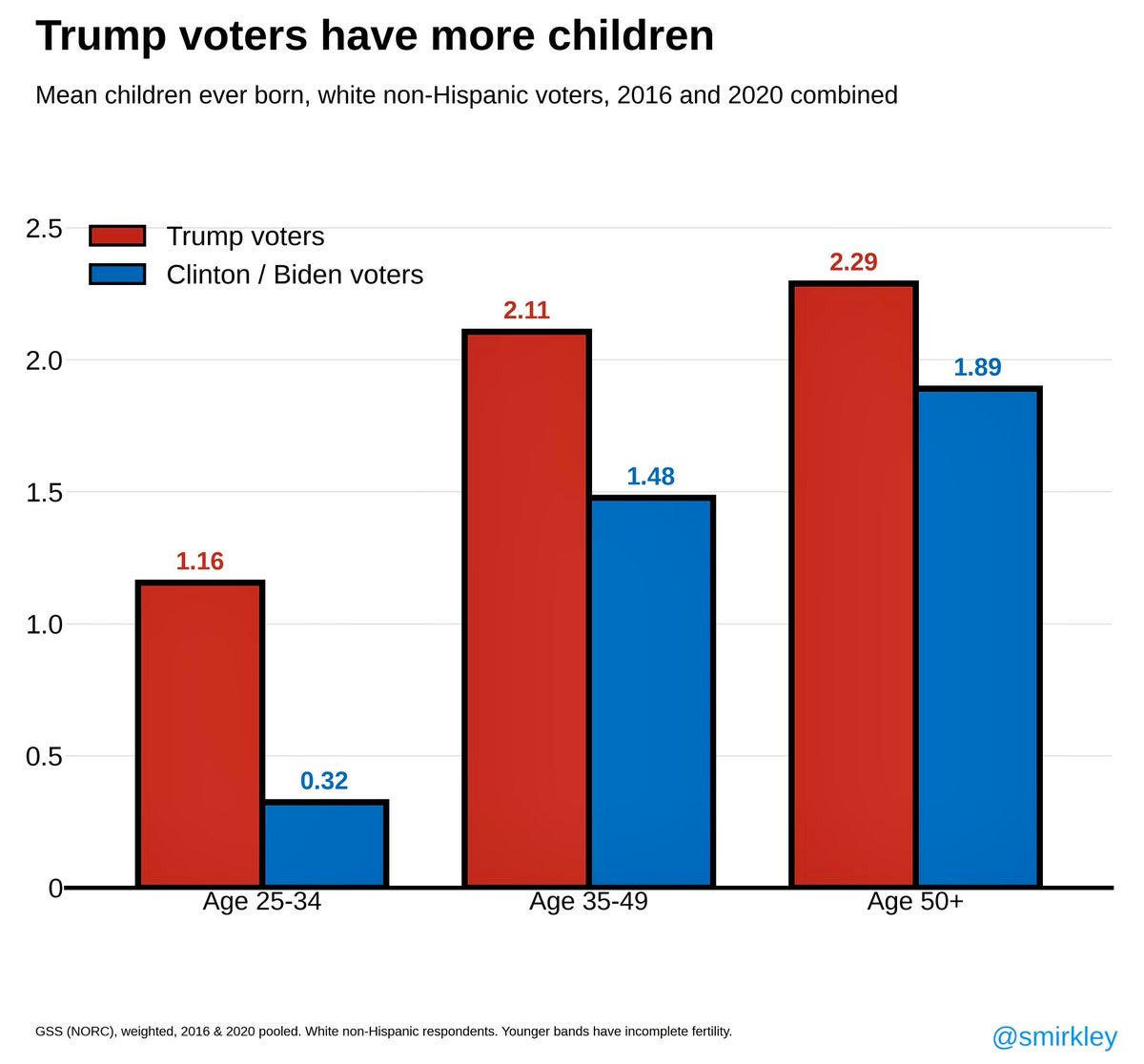
X user @smirkley posted a graph suggesting that Trump voters will inherit the earth because they are having more kids, and the gap is widest among the youngest voters.
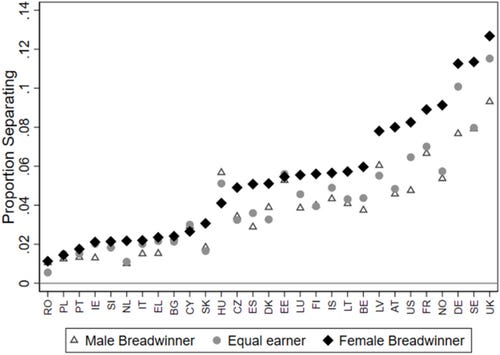
An interesting new academic study looks at divorce in households where the woman out-earns the man. Among their findings is a very consistent international trend in which female breadwinner couples are more likely to separate than male breadwinner couples.
Institute for Family Studies: America Was Built on Taking Risks. Today’s Teens No Longer Do
Ryan Burge: The Purists Are Losing: How American Catholics Are Rewriting the Rules - American Catholics increasingly see moral doctrine as a matter of individual conscience rather than church teaching.
The Gospel Coalition: The Little White Church Is Empty - on the struggles facing rural churches.
Jake Meador: Is the era of mere Christianity over?
New Content and Media Mentions
In addition to the New Trustees discussion, I also got a mention in Commonplace.
New this week:
The Public Intellectuals America Needs - Americans no longer trust institutions. They trust individuals. That makes a certain kind of thinker a critical national resource
My podcast this week was with NYU professor Arpit Gupta on whether AI can save cities from the “urban doom loop.”
And my podcast for Members only is about the new vibe shift - where I see culture and politics going next.
Subscribe to my podcast on Apple Podcasts, Youtube, or Spotify.
Cover image: John Delano/Wikimedia, CC BY
I’m 34, living at home. It feels like the country is finally recognizing the aftershocks of 2007. The year of the iPhone, we moved into a house in a suburb similar to Carmel, Ind.
When I graduated high school, I knew very few people who planned to commute to college, like myself. “The college experience” of entering adulthood by living on a large campus seemed the normative experience. For many years, I felt like a weirdo.
This was not weird to my parents. Generation after generation established homeownership by living with parents, and even building new homes to accommodate multiple generations under the same roof. In the South, inter-generational partnership, education, work ethic, and—most importantly—obedience to Baptist godliness, were the only hope for staying out of the harsh poverty most Black people suffered from birth.
“Helicopter parenting” is a logical response to perceived dangers for many Black parents. The changes brought about since 2007–financial and technological—have significantly altered the matrix for decision making, making more people like my anxious Black Boomer parents. This newer matrix more heavily weights the negatives: college costs, housing costs, debt, social isolation, cyber bullying, bad roommate experiences, hazing, being away from home. Most of our Boomer neighbors are White 60/70-something couples living in a house with many bedrooms that go unoccupied. Most of our Gen-X neighbors have 1 to 3 children who live at home. Some of their kids are in college living at home, some are working full-time remote from home, some are doing grad/law school living at home. The growing share of Millennials in the neighborhood seems to be what Drunk Wisconsin calls “The State School Upper Middle Class”—the type of people who look like they own (and actually use) a Peloton.
Canvassing for local election candidates, I’ve noticed there seems to be a much greater prevalence of living at home for anyone who was in school or college in 2020, anyone who did online school, anyone who joined Facebook before adulthood, anyone who grew up with the online world being the primary navigable waters of life.
As someone who did remote schooling before it was cool, I see social atomization, suburbanization, extended adolescence, delayed marriage, and the retreat into the home to interface with the Brave New World where we Amuse Ourselves to Death, as a very long, knotted up thread called “anomie.”
Nonetheless, there are some profound joys and insights in observing and knowing the same parents everyday for three-plus decades.
Our oldest son, 37, still lives with us. Partly because he took so long, ten years, to finish community college and then his bachelors (while working 30+ hours per week), the arrangement was already sort of established. By the time he graduated at 28, many of his siblings had moved out and we had more space.
Looking for a full-time job, he got a lot of advice to move to Austin or California, to max out his career prospects, but I thought it was more important for him to only change one thing at a time, and to focus on making sure he did well at that first job in his profession. He's a programmer, and is somewhat nerdy and limited in people skills, though hardly antisocial like some these days. I ran across the term "20% autistic" a while back, and though he's not actually autistic, he doesn't do well juggling too many changes at once.
I guess someone could argue, "He needs the experience of living with others (i.e., roommates)." But as the oldest son in a big homeschooling family, he really doesn't. Plus, he's something of a neat freak, and I doubt he would love living in a rowdy and messy apartment with a bunch of guys.
Being able to focus on his programming job, while still living at home, has allowed him to excel at that, while saving a lot of money. Still, we're all hoping he'll find someone to marry soon, and move out, even though he's a big help here and pays his share of the housing expenses, which also helps.
In an earlier time, Americans were a very practical people. Nowadays, it seems like so many are prisoners of expectations that aren't always in line with reality. Someone just out of college, for instance, can't expect to have the same standard of living as their parents. I don't recommend all adult kids living at home, but when it makes sense, it can be fine.