


French writer Emmanuel Todd argued that it was the Protestant emphasis on mass literacy, rather than the specifics of Calvinist theology, that created the capitalist revolution. In a post-Protestant America, we should potentially expect to see a decline in a culture of literacy, which indeed we do. College students, for example, struggle to read books.
In The Defeat of the West, Todd writes:
Max Weber established a link between Protestantism and Europe’s economic rise, even if he likely went astray in seeking the reasons for this takeoff within subtle theological nuances. The fundamental factor is simpler: Protestantism, as a matter of principle, imparts literacy to the populations under its control, because all believers must have direct access to the Holy Scriptures. Now, a literate population is capable of technological and economic development.
Indeed, the Protestant regions of Europe achieved high levels of literacy earlier than Catholic ones did. We can see that from this viral map from the influencer Redeemed Zoomer
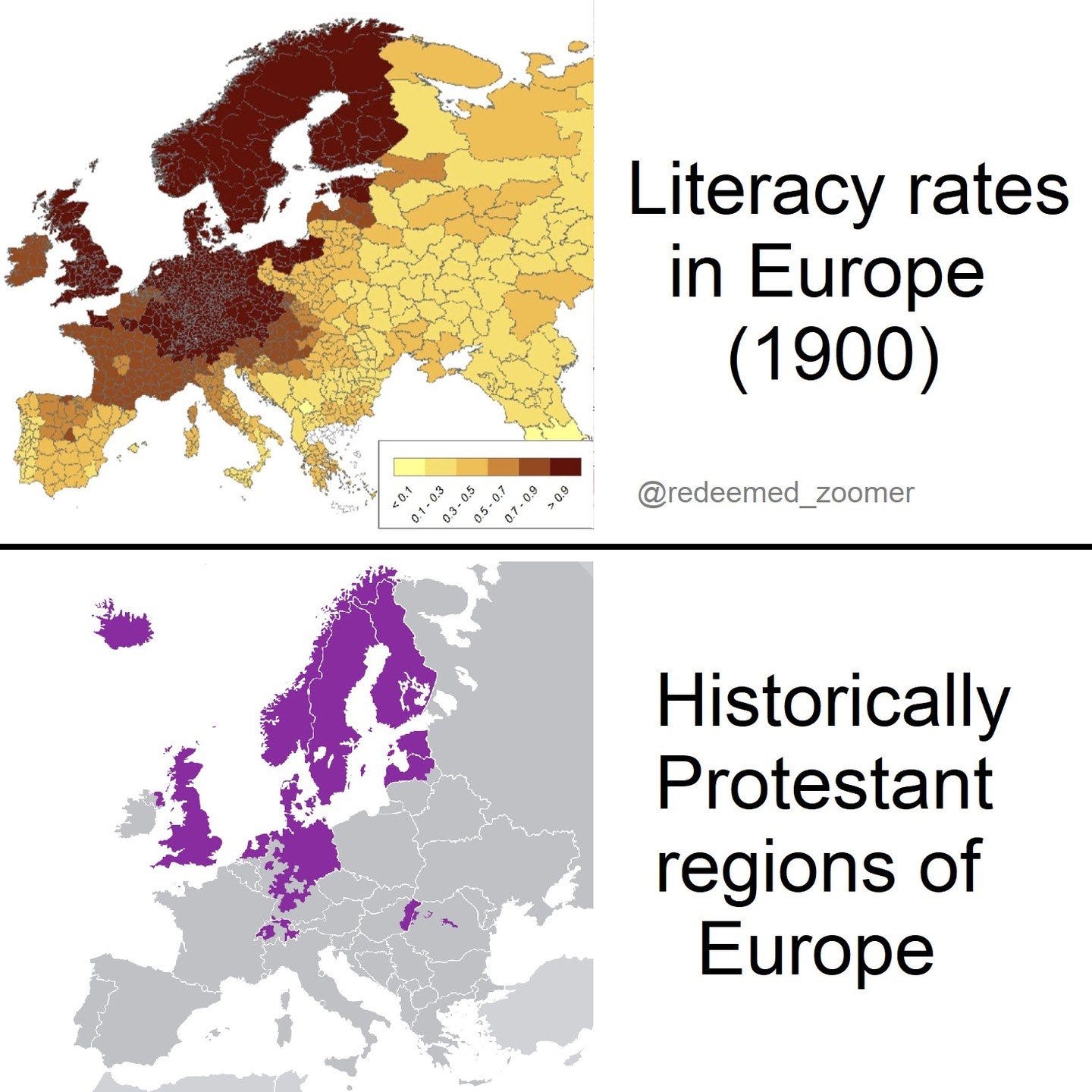
We certainly saw this in America, such as with the famous “Old Deluder Satan Act” of 1647 in Massachusetts that started the creation of a public school system.
Protestantism in general has had an ethos of moral reform and human capital development, of which literacy is one example. This is in part related to how the Reformation rejected the two-tier Christianity of Roman Catholicism.
The Catholic philosopher Charles Taylor talks about what he calls the dilemma of renunciation. Living a fully Christian life in every respect is extraordinarily demanding. For the Catholic church, with its idea of the counsels of perfection - poverty, chastity, and obedience - it’s beyond what ordinary people can achieve. How do you resolve this?
The Roman Catholic Church resolved it through a two-tiered system. There are what are in effect super-Christians - monks and priests - who live by an extremely high standard. But that’s at the price of everyone else living by a much lower one.
This in practice produced an extremely literate, sophisticated, disciplined elite, combined with a largely degraded peasantry.
Protestants rejected the two-tier system. But this created the problem of how much you can demand of the ordinary person. As Taylor put it in A Secular Age:
Radical Protestantism utterly rejects the multi-speed system, and in the name of this abolishes the supposedly higher, renunciative vocations; but also builds renunciation into ordinary life. It avoids the second horn, but comes close to the first danger above, loading ordinary flourishing with a burden of renunciation it cannot carry. It in fact fills out the picture of what the properly sanctified life would be with a severe set of moral demands. This seems to be unavoidable in the logic of rejecting complementarity, because if we really much hold that all vocations are equally demanding, and don’t want this to be a leveling down, then all must be at the most exigent pitch.
Trying to set the bar too high leads to Calvin’s Geneva or Puritan Massachusetts, creating what were arguably repressive societies that contained their own injustices.
Inevitably then, there’s some leveling down from the very top that had to occur to set the bar to the level at which most people could realistically clear it without creating more problems than you solve.
But this approach of having a single tier system, and trying to set as a high a bar as reasonably possible for everyone, ultimately raised up the masses. Protestantism became an engine of human capital development. That’s part of what has been underneath its recurring various moral reform efforts. Education and development of children was a big part of this, with the heavily Protestant Progressive movement bringing compulsory schooling, the high school movement, the playground movement, etc. Recurrent bouts of vice suppression also figure here. As does a focus on a healthy domestic life, sexual continence, thrift, hard work, personal and public order, civility, cleanliness, humility, avoidance of ostentation, future orientation, etc.
Weber pointed to Benjamin Franklin’s Autobiography as encapsulating the habits and values of Protestantism, or what some conservatives call “bourgeois values.” America figured out for much of its history how to set the bar within a healthy range that produced this uplift of our people and the propulsive force that sent the nation outward and upward.
From Reading to Watching
As Christianity, and thus the Protestant ethos of the nation, has declined, we should expect to see the decline of the habits associated with it. Indeed, that was one of the key points from Todd’s book, in which he argued that the death of Protestantism is in some respects the death of the West.

One of these habits in decline is the culture of literacy and the written word.
The Catholic writer Julia Yost wrote an interesting column (gift link) in the Washington Post recently where she sees the shift to a post-literate culture as one reason for a newfound appeal in Catholicism.
The age of Instagram and TikTok favors Catholicism. An earlier era of the internet, that of the blogosphere, was congenial to Protestantism, with its biblical and exegetical basis. The result was the Young, Restless and Reformed movement — mostly male Protestants reading one another’s blogs and finding their way from seeker-sensitive evangelicalism to high-proof Calvinism. Today’s internet, by contrast, is image-forward and postliterate. This helps to explain why today’s online Christians tend to be Young, Restless and Roman.
Protestantism, which began as a revolution against idolatry — the whitewashing of church interiors, the stripping of altars — has image-aversion in its DNA. The visual language of American Protestantism is accordingly limited. White steeples, Puritan clothing, snake handling: not much for an influencer to work with. Catholicism has icons and incense; rosaries, chapel veils and ashes; priestly black, cardinal red and papal white. “Catholic drip” content, downstream of “Conclave” (the 2024 film about a papal election, praised for its costume and production design), enjoys intense engagement. An old stereotype has it that Protestantism is for people who read books, and Catholicism is for people who want spectacle. Say hello to Gen Z.
Yost gets at something real here, even if I’d qualify it in a number of ways.
I think it’s true that the aesthetics of Catholicism (and Eastern Orthodoxy) are one of its draws for new, younger converts. You see this in the appeal of the Latin mass, performed in a language the attendees can’t understand.
On the other hand, Catholicism’s draw to the young seems to be primarily among people like highly educated aspiring conservative elites. As I noted above, Catholicism at the elite level has always had a strong tradition of literacy. Catholic monks literally preserved countless historical works by repeatedly transcribing them. People like Thomas Aquinas are paragons of a literate rather than aesthetic sensibility.
Ultimately, there’s no conflict between having a literate culture and being elite in the Catholic world. You can have both the aesthetics and the literacy, at least at the elite level.
At the non-elite level, I’d note that the aesthetics of the typical American Catholic parish aren’t actually that great. I’ve been to many Catholic masses and every time it seems like the priest is just mailing it in. This foots to things Catholics themselves say, complaining about parishes that are “sacrament factories.” (The limited Orthodox services I’ve attended, by contrast, were the real deal liturgically. The aesthetically best Western liturgies I’ve seen have actually been in the Episcopal church).
Also, I’d say that Yost’s description of Protestant aesthetics is also incomplete. Yes, traditional Protestantism was more aesthetically austere than Catholicism. But modern evangelicalism is very often “spectacle forward” - rock concert grade music, laser lights, designer clothing (skinny jeans, sneakers), emotional and sentimental affect, etc. It may not be “smells and bells” but these churches are very much putting on a show, in which the aesthetic and performance components - cringe though they may seem to some - play a key role in drawing people in. The megachurch, though prominently featuring a sermon, is not just a literary phenomenon.
Yost also rightly notes the role of a changing media ecology in the shift from words to images. There’s definitely something to the shift from blogs to Tik Tok. But the shift to a post-literate culture began well before then, with the advent of television, as documented by Neil Postman in his famous book Amusing Ourselves to Death.
But I think there’s also a deeper factor at work. Namely, the decline of Protestantism in America has undermined the basis of a literate culture.
As Emmanuel Todd noted, the decline of religion is a gradual process that goes through stages. After the active state of religion comes the phase of what he calls the “zombie state,” in which belief has faded but the habits and values remain. Following that comes the zero state, in which even the habits and values have dissipated.
While he doesn’t give precise dates for these in America, it would appear from his work that roughly the zombie state began around the turn of the 20th century, the transition to a zero state began around 1965, and the arrival at a zero state in 2015. This largely foots to my three worlds model, in which the Positive and Neutral Worlds were the transition phase, and the Negative World is the zero state for Protestantism.
In our current religious state, the habits and values of Protestantism are in severe decline. A literate, word-oriented culture is one. But it’s hardly the only such example. We see also the rise of the culture of consumption, credit card debt, obesity, out of wedlock births and single parent households, the metastasization of vice (gambling, drugs, porn), the decline in male labor force participation and the general “lost boys” phenomenon.
America’s human capital has been significantly degraded in many respects as the country’s Protestant cultural foundations have dissolved. Religious decline is certainly not the only cause. Daniel Bell wrote decades ago about the cultural contradictions of capitalism, for example, and economic changes like deindustrialization have had a big negative impact on people and communities. But this can’t all be chalked up to the economy either. During the worst years of the Great Depression, for example, out of wedlock births actually declined. There was no drop off in a literate culture; books sales declined as people had less money but library use surged, and newspapers and magazines held their own.
In this cultural-religious environment, Catholicism might indeed grow in its appeal because of its aesthetic-experiential rather than textual way of relating to its base of followers. But a mass Catholic revival in America would not solve many of our substantive problems because Catholicism is not an engine of broad-based human capital development, certainly relative to Protestantism. People have talked about the “Brazilification” of America - extremely diverse, with a glittering, ostentatious elite, a hollowed out middle class, a large underclass, mass corruption, civic dysfunction, etc. A Catholic America would be very compatible with a Brazilified future.
Evangelicalism is also largely failing in this regard. While it’s held to the gospel as its center,rather than the high bar approach, it has essentially leveled down, setting the bar much lower than in the past. I’ve noted before that the culture of evangelicalism is very different from that of the historic Calvinist Protestant culture of America.
Still, it deserves respect for continuing to focus on the moral reform of people’s lives. As Pentecostal Christianity sweeps Latin America, for example, we read about how men in the church stop getting drunk, stop beating their wives, start working hard, etc. This is what makes many evangelicals good at things like prison ministries, addiction recovery, etc. These evangelical groups are still able to raise people up from the very bottom.
As a general matter of emphasis, Catholic groups are more focused on and better at poverty relief and meeting material needs. Whereas evangelicals more emphasize personal transformation, often through personal and small group relationships. (Note that Alcoholics Anonymous, for example, had essentially Protestant origins).
To be clear, there’s a lot of overlap. Catholics aren’t exclusively about relieving material needs (see Catholic schools, for example), and evangelicals not exclusively about personal transformation. These are matters of emphasis rather than complete differences. But I think we can still see that Protestantism is a better human capital developer for the masses than Catholicism is.
However, American evangelicalism is highly assimilated to today’s post-Protestant culture. Thus, while it can help ameliorate some of the downsides of today’s culture, it is not likely to be capable of regenerating a culture based around literacy vs. spectacle.
Combine Protestant religious decline with modern media ecologies, and it’s a recipe for a continued post-literate America. Not that Americans physically can’t read, but that they increasingly don’t want to.
Capitalism began in the cities of Renaissance Italy and the still-Catholic towns of the Low Countries. Apart from loosening the Church's ban on interest (which was already becoming honored mainly in the breach even in Catholic Europe) the Reformation had nothing to do with it.
Re: This in practice produced an extremely literate, sophisticated, disciplined elite, combined with a largely degraded peasantry.
Well, before printing books were very expensive and most people would never hold one in their hands. Printing enabled people to become literate, at least those living in towns and cities who had sufficient leisure for reading.
Re: There’s definitely something to the shift from blogs to Tik Tok.
Also, blogs to podcasts, which are still verbal of course, but do not involve reading.
I wonder if Jewish culture can be used as a comparison here. Jewish communities in Europe usually had considerably higher male literary rates than their neighbors, and this high literacy made Jews particularly adapted for modernity, even though modernity itself is largely a Protestant invention.