


Coming next week: A look at the state of America’s big cities, based on my recent visits, and a Christian venture capitalist’s view of the AI future.
State School Upper Middle Class
A writer who goes by the name “Drunk Wisconsin” wrote a viral essay back in February around what he called the “State School Upper Middle Class.” or “runner-up elites.” Don’t let his nom de plume or other saucier essays turn you off, there’s some great insight in here. People like this are all over suburban Indianapolis (and the suburbs of most other cities).
For a full decade now, American society has been discussing either the Ivy League elites who have lost touch with salt-of-the-earth Americans or the hoi polloi themselves; those denizens of Rust Belt towns slowly collapsing under the weight of globalization and shifting demographics. We’ve talked about how the Ivory Tower has descended into navel-gazing wokeism. We’ve talked about the sense of spiteful anger that fuels the lower classes to revolt against the elites in a populist backlash. But we haven’t talked a lot about a very large, influential, and important segment of American society: the state school upper middle class.
As the middle class disintegrates, it recombobulates in two new segments of society: a downwardly-mobile lower middle class that has more in common with “the poor” and an upper middle class, which can be viewed as either upwardly mobile or as static in their relative socio-economic position. It’s clear that the former make up a large segment of the Trump/MAGA political movement, but who are the latter group? What do their lifestyles look like? What are their political leanings? This post is intended to reflect on this new group, who I call the state school upper middle class, in an attempt to start asking questions I don’t see getting answered.
You know these people. His name is Tyler or Ryan or something, her name is Lauren or Megan, but maybe it’s spelled a little stupid. They met in college—University of Michigan, unless I’m remembering it wrong, maybe it was Minnesota….They gave the city life a good try after graduation—living in an apartment, going out all the time, living the life of a twenty-nothing. But they’re sensible people and they instinctively follow the success sequence, which means they had a weird nagging feeling pushing them to get engaged, get married, buy a house, get a dog, and have kids. That’s exactly what they did, in exactly that order. He proposed on vacation somewhere abroad—Italy or Ireland or Iceland—and their wedding was as large as it needed to be to accommodate her mother’s preferred guest list. The dog is a doodle, his name is Huxley. They now live in the suburbs of a large metropolitan area somewhere in the US. Hard to tell exactly where, the parking lots all look the same. They have two of the 2.5 children they will have, on average.
You know these people. State schools across the country are pumping them out by the thousands annually. They are the descendants of the middle class from the 1950s—not only in the sense that many of them have ancestry in the American middle class from seventy years ago, but also in the spiritual sense. There is no longer a true middle class. Instead, the middle has split into lower and upper sections that are increasingly foreign to one another. The separation is powered in large part by the fact that the UMC goes to college to obtain a four year degree, a mechanism that shaves a portion of society off and isolates them within a bubble of people from similar backgrounds, similar tastes, and similar IQ levels.
Like the middle class from the ’50s, they are content. They have a house and two cars and their lives are generally fairly stable. Their 401k is funded and their kids have a 529 account the grandparent throw some money in every Christmas. Their student loans, car payments, and mortgage are not a burden that will cause them bankruptcy. They’re prudent, so they pay off their debts and only use credit cards as intended—for cash back rewards. Unlike the lower middle class, they’re going to be fine and they feel it deep in their bones. That sense of doing okay is why they are the spiritual descendants of the old middle class, and it’s why the have-nots that happened to end up in the other category cause a disproportionate amount of concern in the pundit class.
The state school upper middle class are not rich in the traditional sense. They haven’t inherited large sums from their parents, they had to take out some student loans to pay for college, and they can’t afford to live a life outside of their means. Instead, their within-the-means lifestyle is perfectly mediocre: shopping at Trader Joe’s and buying a new Toyota. Compared to the old middle class from the last century, they’re undeniably more wealthy; their houses are bigger, their TVs are flatter, and they can afford to throw away the plastic toys their kids get from the grandparents so that the kids aren’t tempted to stop playing with those expensive wooden Lovevery toys their pseudo-crunchy millennial mother bought them. In inflation-adjusted terms, this cohort earns slightly more on a per-household level than their socio-cultural ancestors. With that money, they can afford to live a life that’s similarly slightly better in relative terms.
That sense of doing okay is an important component of analyzing this group of people because it informs their worldview. Their reality meets expectations; the life they expect to have is the life they do have. Even if the actual individuals that make up the millions of people who inhabit this zone are from immigrant backgrounds like myself, or moved up from being born in a trailer park, they are the inheritors of the American dream, the torch has been passed to them. Through hard work, good decisions, and a heavy dose of sheer luck, they managed to find themselves working an email job that pays them enough to go on vacation twice a year. As a result, they have none of the grievance their lesser halves hold. They don’t feel an intrinsic need to revolt against the powers that be. Why would they? They’ve got it good.
The writer correctly describes their socio-political outlook as “left of center, right of woke.” They are the heirs of the suburban Reagan Republicans, but today they are essentially moderately center-left. Because they live in functional communities, are doing well personally, and still basically have middle-class ideas about decorum, they are revolted by Donald Trump’s style and the general affect of today’s GOP. Trump and state GOPs are not the underlying cause, but are an accelerant of this group of people moving left.
The Great Realignment that American society has undergone has upended our old definitions, and we’ve struggled to find new labels that appropriately describe what people currently believe. As part of that split, small-C conservatism is now found more often among politically blue-leaning Americans. (See LastBlueDog for more on this line of thinking.) These people don’t want massive disruptions, they don’t want revolution. They want stability, consistency, and competence. Moreover, the ideas that the state school upper middle class exhibit in their lived experience—marriage, children, stable employment, education—that used to be associated with red-leaning voters are now likely to be found among reluctant, unenthusiastic Kamala Harris voters.
This UMC is moving to the suburbs and buying real estate with 30-year mortgages with the school district in mind. As such, many suburbs are turning purple or blue-ish like the WOW counties of suburban Milwaukee in my home state of Wisconsin. I know some of these people personally. As a matter of fact, I am them, which is why I find this group of people interesting to think about. What I see among my peers is a generally moderate disposition that, according to the current balance of the political scales, means that they prefer to vote for Democrats, regardless of any admitted excesses on the left. In my opinion, this is largely cultural. As I’ve written elsewhere, if you drive a truck and think Applebee’s is the pinnacle of cuisine, you’re Team Red. If you wear a Patagonia vest and dress sneakers to the office, you probably know what (actually good) restaurant to book a reservation at for Valentine’s dinner, and you’re probably Team Blue.
This shift has profound implications for politics. Although neither Republicans nor Democrats are governing well at present - except perhaps in places like these state school upper middle class suburbs - the Republicans have a bigger problem in that the leftward shift in educated voters leaves them without the human capital needed to govern or run institutions. Even if they decided they wanted to govern, they don’t have the horses to do it.
Also, it’s undeniable that more educated and affluent people are better able to mobilize politically to get what they want. So the concerns of this increasingly left-leaning group will have significantly more influence in society than the Republican working class, even if it is smaller.
This is why in his famous 1994 essay, Edward Luttwak believed fascism was likely to come to America because of a white collar rather than blue collar squeeze. His prediction of that squeeze was early, but with the potential for large AI disruption to white collar employment, the conditions for radical politics of many stripes in the US may end up being much greater than anyone imagines. In our day, this is manifesting in various forms of neo-socialism, which has of yet not come to these suburbs, but might if the state school upper middle class really starts getting hit hard.
Drunk Wisconsin goes on to say:
The state school upper middle class shops at Costco and is concerned about their exposure to microplastics. They drive a normal gas-powered car and try to minimize screentime for their kids. That time they spent at college was the entry point for receiving the trickle-down cultural preferences that are held in more extreme versions by coastal elites. They haven’t gone full Erewhon, but they certainly avoid Walmart. My guess is that a large part of Instagram’s ad revenues come from the woman in the state school upper middle class family clicking on algorithm-fed ads for Montessori toys, merino wool clothes, and guides on how to correctly discipline their kids without causing long-term trauma. The purchasing and consumption habits of this cohort reflect their moderate, slightly-left-of-center politics.
…
These people are the reason so many cleaning products are now “natural.” They are the reason children’s toys are now pastel-beige-colored. They are the number one source of Peloton’s monthly memberships. What I’m trying to say is that, while the state school upper middle class may not be the elites who set trends and determine morals, they are the ones who make up a large share of home purchases across the country, they are the ones to whom corporations pander, they are the ones who can break the tie in an off-season election. In short, these people are important, and I get the sense that, due to their relatively silent existence, they are being underdiscussed in the intellectual space.
The state school upper middle class is a significant portion of the top 10% of the households in our K-shaped economy that now control half of all consumer spending. Think a dual career couple in Carmel, Indiana where the husband works for Eli Lilly and the wife works for Roche.
Click over to read the whole thing. It’s an important piece.
The Young Angry Women
The UK magazine New Statesman had a cover story on Britain’s rising new radical feminism. One of the authors of the paywalled piece shared some of their key points on X.
Young women are 26 pts less favourable to capitalism than young men, and feel much more positively towards communism than capitalism.
Women u25 dislike capitalism so much, they view it as (un)favourably as fascism.
UK should pay slavery reparations by a 2-1 margin
They think 43%-40% ‘it is unfair some people have more than others and we should redistribute wealth’ over ‘people deserve to keep what is theirs, even if it means others have less’
More negative than young men about their careers, earning potential and property
6 in 10 (58%) say they would find it difficult to date someone who disagreed on Gaza
3 in 4 (74%) say the say the same about views of Donald Trump, with even more saying they wouldn’t date someone who disagreed about social justice
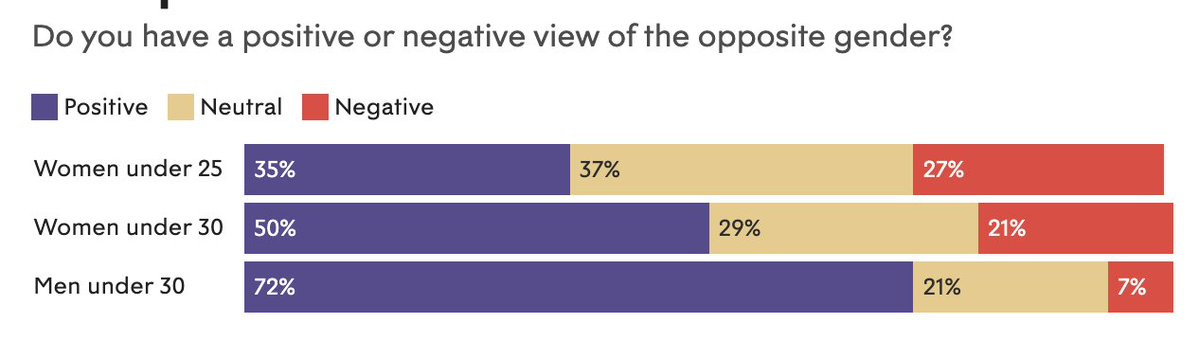
And this one: “Under 30 women are 3x as likely to hold a negative view of young men than the other way around.” Check out this graph.
The Savannah Enlightenment
I have said that someone needs to write a Plutarch’s Lives type book about American Protestant elites, because today’s American Protestants, especially evangelicals, have no idea what one looks like.
First Things magazine supplied a chapter in that book this month, with an article in their new print edition about James Oglethorpe called “The Savannah Enlightenment.” Oglethorp was principally an Englishman, but he’s very notable in America as well as the founder of Georgia and Savannah.
Oglethorpe’s greatest legacy, however, would be far from England. On November 16, 1732, he sailed from Henry VIII’s old docks at Deptford with a group of 114 men and women of various trades and stations in life. They were beginning what history has called “the Georgia Experiment.” To Parliament, Oglethorpe had proposed a new colony to serve as a military buffer state between wealthy Carolina and Spanish Florida. To subscribers, he spoke of planting a colony on the principle of philanthropy, led by “a noble Tenderness for the Miseries of others.” Oglethorpe had led an unsuccessful penal reform effort in England, after a close friend of his, a publisher whose books had failed to sell, was thrown in debtor’s prison. It is said that, while visiting the jails, Oglethorpe saw his fellow Englishmen, “chained neck to neck and hand to hand,” being led off to servitude in the American colonies. Scholars estimate that more than half of the white immigration to the American colonies before independence—270,000 out of 500,000—occurred in the form of indentured servitude. Oglethorpe decided he would lead England to a better way. There would be no slavery in Georgia. There would be no aristocratic class either, and to prevent its arising, no amassing or sale of property: All shareholders would hold equal-sized plots of land, which they were powerless to alienate. They would bring seed plants for a whole new economy based on the warm climate: wine, mulberries (for silk), olives, citrus.
…
[Benjamin] Franklin’s criticisms were very nearly inevitable. His personality was at odds with Oglethorpe’s. They were the two most remarkable men then active in British North America. Franklin worshiped hard work, industry, success, virtue; Oglethorpe wished for kindness, benevolence, philanthropy, redemption. Oglethorpe was a soldier, Franklin a burgher. Franklin was cunning, practical, and conscientious; he counseled great leaders but never quite counted as one himself. Oglethorpe was idealistic, impulsive, given to the grand gesture; he attained positions of leadership again and again, and men followed him.
Franklin’s prudence might have made the Georgia Experiment a success. Franklin’s thought began with the task, and considered which means might help him achieve it; Oglethorpe started with people, and sought for them a purpose. Franklin observed the world in order to discern where a profit might be had; Oglethorpe sought a wrong to redress. Both believed in progress: Franklin pursued it by rewarding success, Oglethorpe by salvaging failure. Franklin adapted to the times; Oglethorpe clung to ideals. Franklin believed that actions could be assessed in dollars and that seeking financial gain was the wisest course most of the time. He did not personally approve of slavery, but he bought, owned, sold, and employed slaves, since doing so was legal and profitable. He could suspend moral judgments, which made his occasional moralistic interventions in American history—for independence and against slavery—all the more effective. (Pennsylvania prohibited the importation of slaves in 1780, and Franklin became the president of its Abolition Society.) Oglethorpe did not know how to yield. Nor did he know how to follow the dollar for an hour, and await a better season for his ideals.
…
Then came war. The War of Jenkins’ Ear pitted Spain against Great Britain starting in 1739. Georgia became a front, and Oglethorpe’s presence was supremely opportune. He barely visited Savannah, where the malcontents prevailed, and instead lived mostly at Fort Frederica, a now abandoned frontier fort. For three years he crisscrossed the coastline, capturing Spanish outposts and fortifying Georgian ones. His excellent relations with the Creek confederacy secured them as allies for the English. Oglethorpe twice led an army against St. Augustine, but failed to take the great stone fort there. He proved his worth, however, at the Battle of the Bloody Marsh, where the Georgians massacred nearly to a man a small Spanish detachment, inflicting ten casualties for every one they suffered.
…
Practical men are no greater than their successes; idealists, however, may leave behind treasures for future generations, however contemporaries undervalue them. Georgia would have to recover Oglethorpe’s moral wisdom about slavery later and at great cost. Oglethorpe left another legacy, written into the very landscape of Savannah: its urban plan. Simple yet surprisingly subtle, it has in this age of mass tourism and urban preservation made Savannah one of the most visited and beloved places in America. Three decades ago, the town attracted five million visitors a year; that number has tripled since. Forrest Gump rode the beauty of Georgia, and Savannah in particular, to the Oscars. John Berendt turned Savannah’s unique blend of Southern culture into Midnight in the Garden of Good and Evil, a nonfiction work that reads like a novel. The book became a publishing sensation for a quinquennium and remains the best introduction to the city. Aging Boomers flocked to the Georgia coast. But the main allure is the Oglethorpe Plan itself.
…
But the real genius of Oglethorpe emerges when you take to your feet. For every forty-four lots he made a square, so that as you walk north to south, you arrive in a square every four blocks. The effect is magical. It is as if you were in the city when suddenly your path diverges in a wood, and now you must go right or left under a canopy of trees. Live oaks fill the sky; hints of buildings glint through the boughs. The squares are a repeating element in the grid, but they function as a counter to its normal effects. In places like Oklahoma City or Omaha, grid lines lead monotonously off into the distance. In Savannah, you leave leafy Chippewa Square and walk four blocks north past houses, churches, apartments, and shops to Wright Square, where you exit the streets and enter a park. You may turn right or left or keep straight, as at any grid intersection, but you may also go diagonally, or sit under a tree, or lie on the grass. If you are driving a car, you have to take a detour around the square. The square interrupts the grid’s monotony without compromising its geometry.
…
He lived to see the American Revolution, and history records that he met with John Adams while the latter served as ambassador to Great Britain. In their meeting it is said that Oglethorpe spoke admiringly of the Revolution, suggesting that Parliament was given over to the love of money, and gave his blessing to the new nation. He died shortly afterward. Inscribed on a tablet near his burial site were words we do not find often boasted of: “He was the friend of the oppressed Negro.”
Click over to read the whole thing.
This is a very good article, but strangely underplays Oglethorp’s Anglican Christianity. Oglethorp seems to have had Christian motives for much of what he did, and was connected with John Wesley, who briefly served as rector of a church in Savannah.
Author John Byron Kuhner chose instead to talk about Oglethorp as a freemason, which to a modern ear would make him sound like he was not Christian. This would not have been the case in that era in England, however.
Best of the Web
The New Yorker: Saving a Lost Generation of Men With Chop Saws - The College of St. Joseph the Worker, which combines the trades with a liberal-arts education, is trying to restore its students’ sense of their own competence, and to revive the city of Steubenville, Ohio, along the way
Veronica Clarke/First Things: A Whole New World of Disney Adults
Ryan Burge: This is Not Simple Generational Replacement - Can Millennials or Gen Z Save the American Church? The Data Says No.
James Wood/First Things: In Defense of Cultural Christianity
New Content and Media Mentions
New this week:
Post-Protestant, Post-Literate - The collapse of Protestant culture is degrading American human capital — and literacy is just the beginning.
My podcast this week was with Margarita Mooney Clayton on art, beauty, and human creativity.
Subscribe to my podcast on Apple Podcasts, Youtube, or Spotify.
Maybe I'm beating a dead horse here, but -
If a survey showed that 21% of men under 30 had a negative view of women, vs. only 7% of women the same age, it would be reported as a national crisis: "Explosion of misogyny!" "How can women and girls even feel safe leaving their homes with all the seething hatred out there!" When the numbers are reversed, it's reported in a very matter-of-fact way, with no hint of alarm, and often with a subtle undertone of "Good, men are finally getting the hatred they deserve!" And this seems to be true whether the author of the article is male or female.
When I read the quotes from the State School Upper Middle Class post, I was trying to figure out why the young adults in the UMC group are left of center and dislike the republican party. Yes, they were exposed to leftists in college and the culture has turned liberal, but the UMC group is living what is arguably the conservative, middle-class dream. So why the shift in politics? The members of my family who are 60+, and most of our friends, belong to the UMC group, and we are red, not blue. We are mostly conservative and religious. (This is probably not the norm nationwide for the UMC since I live in a small town. Our 60+ counterparts in large suburbs are almost certainly more liberal, probably light blue.) Yet, I do notice that our children and the children of our friends are more liberal than we are, and as mentioned in the post, are at least somewhat put off by republicans. Some vote split ticket, something I rarely do, and most vote for democrats. This younger UMC group can hardly claim that the republican party has become radical. If anything, it has drifted slowly to the left. It is the democrats who propose untenable, crazy, and often immoral positions.
It may be that this younger UMC group really thinks that the republicans are radical since they don't have any historical perspective, but one thing that stands out to me is their sensitivity to personality. They prefer soft, banal people who may not be effectual in office but at least don't disturb the peace. Trump, with his non-stop offensive comments, is beyond the pale for them. How a politician acts seems more important to them than his positions, or least as important. Personally, I wouldn't mind if a president sucked lemons and spit seeds at people so long as he pushed the right buttons in office. But not so with the younger UMCs. I believe this represents the influence of women, especially feminists, in our culture. Women are very sensitive to personality and typically are more liberal than men. Most of the women in this UMC group exert significant influence on the viewpoints of their husbands. The bluish color of the younger UMC group may well be due to the influence of the wives in the group.