


What comes next after the Trump era in American politics? And will it be a durable governing majority, or just another oscillation in a deeply polarized, nearly 50/50 nation?
The durability question is an important one. We are in a period of transition in America. The old arrangements of the 80s and 90s no longer seem fit for purpose to many. We have a long list of challenges to address: demographic transitions, China competition, social atomization and associated dysfunctions, etc. for which the old answers no longer seem as relevant.
Part of how that transition has manifested is in our political instability, and the gradual decline of our old political order. That decline is shown, for example, in the progressive rejection of old political norms and arrangements, such as how the filibuster has been weakened over successive administrations and the growth of party line voting on Senate confirmations for presidential appointments.
One part of moving beyond the transition period is the development of a governing majority that can implement the institutional changes needed to get America fit for the challenges of both today and tomorrow. I would define a durable governing majority as one that is able to hold the presidency for 12 years, have enough support in Congress to pass more than one or two significant pieces of legislation, and in which the minority party accommodates itself to a significant part of the new agenda.
I would define the Reagan-Bush era as a durable governing coalition. It wasn’t Republican hegemony and didn’t get everything it wanted, but it did get things done - and set the tone for another decade or more of similar approaches. The Democratic Leadership Council and Bill Clinton largely kept the economic playbook, and even embraced Reaganesque ideas like welfare reform and tough on crime measures. We haven’t had another period like this in about 35 years. (I should not, however, that various parts of Trumpism like China skepticism are being more broadly absorbed even by people who don’t like him generally).
So what are the possible 2028 outcomes, and are they potentially durable ones? If we use the standard left-right spectrum as one axis, and a populist-institutionalist as the other, this produces a 2x2 matrix of basic outcomes. We will examine each in turn.
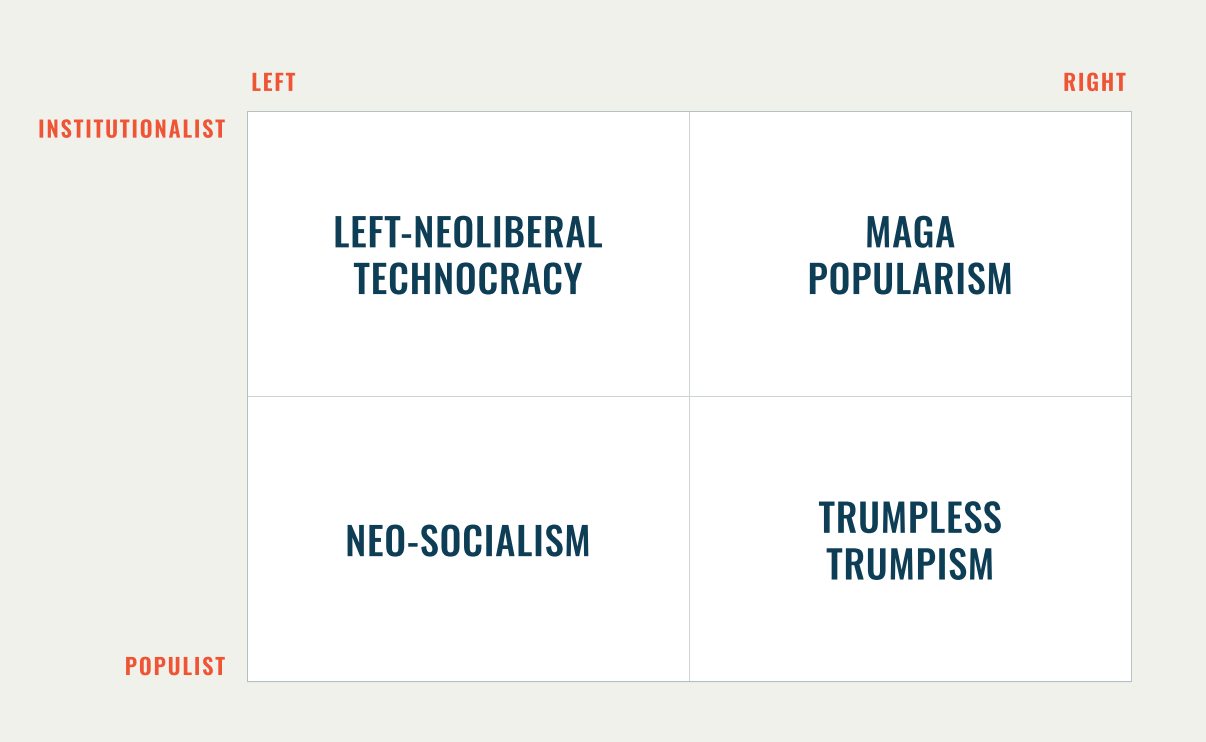
1. Neo-Socialism (left-populist). The first possibility is that a populism on the right is replaced by a populism on the left. This would be the insurgent neo-socialism now coursing through our cities, and also some states.
For 2028, this would involve a charismatic Alexandria Ocasio-Cortez or Zohran Mamdani type winning the Democratic Presidential nomination, then the general election. As Trump demonstrated, the Presidency is a viable path for an insurgent, populist candidate. A lot of “burn it all down” voters who were attracted to Trump may well, still disillusioned, vote for this kind of candidate. As with Trump, the Democratic establishment might not like this person, but I believe they would be much more supportive of a neo-socialist President than the Republican establishment was of Trump.
While this is a possibility in the 2028 presidential election, it would have a difficult road to entrenching itself as a durable governing coalition. Populism always seems to eventually fade. The number of true believers is also demographically narrow. Sociologist Musa al-Gharbi notes that actual membership in the Democratic Socialists of America is 85% white and 80% people with college degrees (among those age 25 or older).
Hard progressivism has also already delivered bad results in some cities like San Francisco, which is already walking it back. Places like Portland and Seattle are not models they can point to in order to win votes nationally. Zohran Mamdani in New York is popular, but has only been in office a short time. While social democracy has demonstrated it can be a viable governing system overseas, I do not believe American neo-socialism is primed to deliver results at the national level.
Possibly there could be some state level traction for neo-socialist policies in places like California, with policies like its proposed wealth tax. We are also seeing some neo-socialists win statewide primary elections in select places, such as Abdul El-Sayed in Michigan and Angie Nixon in Florida. November will give us a read on what the broader public thinks of them. But even if neo-socialism does come next in the 2028 presidential election, I would think it’s just another oscillation rather than a durable political arrangement, again due to its demographic narrowness. Apart from that I also believe its ideas are mostly bad and won’t generate positive results for the country.
2. Left-Neoliberal Technocracy (left-institutionalist). This scenario is that the old Clintonesque Democratic establishment reasserts primacy. I don’t think it’s any surprise that it’s old Clinton hand Rahm Emanuel who is promoting this approach.
This time around, left-neoliberalism would be bolstered by an influx of corporate workers and upscale suburbanites of the type that have traditionally voted Republican, but who have already been abandoning the party as it shifts downscale and alienates this part of its traditional base.
This would be a movement friendlier to big business and tech. It would silently adopt various Trumpist positions like China skepticism, reindustrialization (at some level), and a weak stance on antitrust. It would keep the immigration tap open but do more border enforcement than previous Democratic administrations. It would reject wokeism and limit public moralistic scolding. It would also look to rebuild the old Democratic alliance with Silicon Valley, though there would certainly be a lot bumps and tensions in that project. What makes it a technocracy is that it would adopt a lot of wonky policy ideas from the “abundance liberals” and other such sources. There are a number of people developing ideas that could be adopted by this coalition.
Silicon Valley could adapt itself very much again to this milieu if it seems to be a winner. The urban chamber of commerce type establishments would love it, as they understand, even if they won’t say it, the immense amount of damage the so-called “Woke 1” era did to their cities. They are eager to get back to business and rebuild. In general, left-neoliberals would have a lot of institutional and media support. The “Never Trump” caucus would love it. However, it would have to find a way to defeat or contain the emerging neo-socialism to its left.
Where this group would also struggle would be to avoid the “everything bagel” type effects imposed by what Matthew Yglesias called the “Progressive Establishment.” I would also include “the Groups” (wealthy progressive lobbying organizations) here. These would have to be overcome to make this kind of center-left governance effective, such as in repairing the alliance with Silicon Valley and actually building things.
What would make this durable is if the realignment of business class people and interests from the GOP to the Democrats turns out to be large. Again, the trend has already been going this direction. This realignment would leave the Republicans as a structurally minority party mostly made up of the MAGA hard core - an ornery populist group that’s always with us in America - and remnant bourgeois elements, by which I mean people who personally own small and medium sized businesses like car dealers, road construction firms, manufacturing concerns, funeral homes, farms, cell phone store franchises, nursing home chains, etc. They have very personal stakes in policy with regards to their businesses and will reject the managerialism of this political arrangement. This Republican Party would receive support, as it does today, from segments of industries like finance that need it to check Democrat tax and regulatory efforts. But this wouldn’t be a party that could muster a consistent majority, particularly as the heavily white Baby Boomer generation passes on.
To be durable, the left-neoliberal technocratic governing class would of course also need to produce at least decent results for the country.
3. MAGA Popularism (right-institutionalist). This is the center-right version of left-neoliberal technocracy. A post-Trump candidate like Marco Rubio would take the legacy GOP program and update it with the parts of Trumpism that are actually popular. The people in this movement would moderate their previous support of mass immigration but reject mass deportations. They’d be basically pro-business and pro-trade, but far less dogmatic about it than the old GOP. They’d be less enthusiastic about muscular foreign policy interventions (though, like Trump himself, might find themselves doing them anyway). They’d reject Trump’s crass style in favor of a more dignified demeanor. They would be anti-woke, but also implicitly reject traditional social conservatism. For example, they’d oppose transgender participation in women’s sports but support gay marriage since both positions are popular. Compared to left-neoliberal technocracy, they’d be much more explicitly patriotic and pro-America.
This was in essence what Ron DeSantis did as governor of Florida during Covid. It was extremely successful and made him very popular, despite being elected initially by a razor-thin margin. DeSantis pivoted right when he decided to run for President, which did not serve him well. And he ran directly into the Trump buzzsaw. But the template is there.
I use Rubio as the example here because this is how he has positioned himself. I note that he has prepared the ground for distancing himself from unpopular Trump policies by pointing out that his job is to carry out the President’s policies (i.e., not necessarily what he would prefer himself). Still, as Secretary of State, he’s still tied to Trump.
This option becomes especially viable to the extent that neo-socialism and other forms of hard progressivism gain traction in the Democratic party. Left-neoliberal technocratic types would be willing to play ball with a moderate Republican in this mold. Many of them would silently approve of some resulting policies, such as a more anti-woke stance than any Democrat could probably openly implement. Again, the principle here would be the same: let’s get back to business.
It’s a lot harder to envision this as a durable coalition unless there’s some significant minority shift toward the GOP, in at least some segments, because Republicans are still very dependent on white votes - a demographically declining segment. While there was a shift towards Trump by minorities, basically all sizable minority groups still vote Democrat by a significant margin.
I don’t think minority attraction is a hopeless project. In particular, there are a lot of affinities between middle and working class Hispanics and whites, such as the desire for a “big-ass truck” pointed out by Josh Barro. But it’s speculative as to whether the GOP can actually pull this off. You don’t have to believe in the hard “emerging Democratic majority” thesis to recognize that demographics are a challenge for the GOP.
4. Trumpless Trumpism (right-populist). I am on record as believing that the right populist moment in America is nearing its end. However, I could be wrong, or right populism could continue for another political cycle or two. This would be the proverbial Trumpism without Trump. This is how JD Vance is positioning himself, as the heir to Donald Trump and his populist-nationalist movement.
In this scenario, a President Vance would likely restore a greater level of presidential dignity, end the corruption, and generally avoid some of Trump’s more erratic policies (such as the “Liberation Day” tariffs). It would remain very tough on immigration and trade, very hostile to the government bureaucracy and media, as well as continuing a general “America First” approach on foreign policy. How much Vance could accomplish would depend on the composition of Congress, as well as his level of desire to legislate.
The durability of this would depend on the ability of Vance and others to successfully replicate the personal bond Trump has with his supporters. I think this will be difficult to accomplish because so much of the Trump phenomenon is personalized. Also, right populism has already had a 12 year run as a political force if not as a governing majority (non-consecutive terms for Trump, a reliance on executive action and reconciliation bills, etc), and it is the nature of such things to decay. I’ve already written in more detail why I think the populist moment is heading towards its conclusion. But as I said, I could be wrong.
Three things cut across these four scenarios.
First, all of these scenarios assume a certain continuity in conditions. There’s always the unexpected shock that could scramble the game board. We saw this with 9/11, and to some extent with Covid. These events can’t always be anticipated, but something like a genuine fiscal crisis or some kind of major AI disruption are certainly conceivable.
Second, the left options have a bit more inherent durability because they have the potential to make some hardball moves to entrench their majority if they gain a trifecta of the presidency and both houses of Congress. Abolishing the filibuster and admitting multiple new states to “gerrymander” the Senate could be on the agenda. They could also mandate universal mail-in voting and ballot harvesting, and prohibit voter id laws at the state level. They could amnesty every illegal immigrant. They would also have the nuclear option of packing the Supreme Court.
Republicans have a trifecta now and could abolish the filibuster. But they haven’t done it yet, so likely won’t. And their repertoire of potential actions is much more limited, basically consisting of mandating voter id nationally. They have no plan for states to admit. They have no equivalent to amnesty. They already have a majority on the Supreme Court. At the state level they have also already mostly done mid-decade redistricting, so there’s not much opportunity there either. They are also much more internally divided.
Third, there’s the specter of what I call “American Liquidationism.” This is a policy resulting from Boomer political capture, in which pandering to seniors becomes the policy core of whatever group ends up winning.
In this scenario, no benefits for seniors can ever be touched. In fact, more benefits might be added. And there would be additional policy choices to explicitly privilege seniors, such as property tax elimination, funded in part by disinvestment in the future (like cutting education spending). Nothing would be done to rein in our ballooning debt unless a true financial crisis occurs.
In essence, America would slowly liquidate its future in order to maintain present consumption by Boomers, who would be exempted from any shared sacrifice needed to address national problems. This is a path we’ve already been on to some extent. Our national debt has grown from $4 trillion when the first Boomer became president to almost $40 trillion today, with continuing deficits of almost $2 trillion per year. Trump said he would not touch senior benefit programs. And we see across the country increasing calls to abolish property taxes, often explicitly targeting seniors. This is especially the case on the Republican side but Democrats are getting in on it too.
This approach could also be somewhat incorporated into any of my four scenarios as, unfortunately, it actually seems to be pretty popular. It would make a productive transition to a prosperous future much harder to pull off, in part because of the dire financial condition in which it would leave the country.
Which option actually wins in 2028 is of course unpredictable. If I could predict the future I wouldn’t be writing here, I’d be running a hedge fund. But in terms of durability, the scenario that looks to me to be the most likely candidate to be a durable governing coalition is left-neoliberal technocracy. This is because it has the highest potential of creating a realignment in which traditional Republican constituencies like suburbanites continue shifting left. It also has the most intellectual firepower devoted to developing implementable policy ideas. And it would have the backing of media and most institutions.
This political alignment would give it the opportunity to address America’s structural challenges like the debt, falling fertility rates, our defense-industrial complex, competition with China, social atomization and a lack of civic cohesion, navigating the AI future, and various inequalities in our society (e.g., geographic inequality). Doing this would require that it overcome the Progressive Establishment and the Groups, reject American Liquidationism, and avoid excessive catering to business lobbies. Then there will always be the possibilities of unexpected or unwelcome shocks that would have to be successfully addressed. And of course, they’d also have to make good decisions themselves, which is far from guaranteed.
These are all easier said than done. But it is making the difficult and uncertain institutional changes needed to put the country on a sound footing for broad prosperity in the coming decades that will be the true measure of our success in navigating the American transition. We should hope that whichever political faction does in fact win, they are successful in starting to address this task.