

The End of the Moral Majority
The pro-life movement is one of the first casualties of a political architecture built for a country that no longer exists

Roe vs. Wade has been repealed, and Republicans in Washington haven’t banned abortion yet. The pro-life movement is not pleased, and they’ve found a culprit to blame: President Trump.
Marjorie Dannenfelser, president of Susan B. Anthony Pro-Life America, told the Wall Street Journal, “Trump is the problem. The president is the problem.” Pro-lifers like her are upset he has appointed abortion supporters like Robert F. Kennedy to key positions in his administration, is allowing mail order abortion pills, and is leaving abortion policy to the states.
Dannenfelser says Trump’s approach means “the movement as we know it is finished.” She’s right that it’s finished. But it’s not Trump who ended it. It’s the American public. The movement to ban abortion stalled not because of him, but because abortion bans have been shown to be a loser at the ballot box. We now know that a majority of Americans want abortion to be legal.
Abortion has been on the ballot several times since the repeal of Roe vs. Wade, and the pro-abortion position has dominated in terms of results. I can only identify two cases in which the anti-abortion position won a majority of the votes, in South Dakota and Nebraska.
There’s also a wide belief among analysts - even among opponents of abortion themselves - that abortion was the reason Democrats significantly over-performed in the 2022 midterms. This was a shock result in an election that should have otherwise been a “red wave.”
In this voting climate, Republicans are not going to line up to support social policies that are proven political losers. The pro-life movement is not prepared for this reality, and their reaction makes it clear.
An Obsolete Architecture
The pro-life movement is not a one-off exception. It’s just one early example of a much larger institutional challenge facing social conservative movements and organizations in coming years. They were largely created during a period from the 1970s through the 2000s on two founding assumptions that are no longer true: that traditional morality was still held to by a majority of Americans, and that the way to ensure their triumph was through Republican politics.
I call this combination moralistic-majoritarian politics. It’s moralistic in that it believes its positions are moral absolutes, so compromise is impermissible. In abortion, this means abortion is murder and thus must be stopped at almost any cost. It’s majoritarian in that it is structured around winning political victories in electoral politics, which comes with the implicit assumption that its beliefs are broadly popular in society.
With abortion, moralistic-majoritarian politics works, in theory, like this:
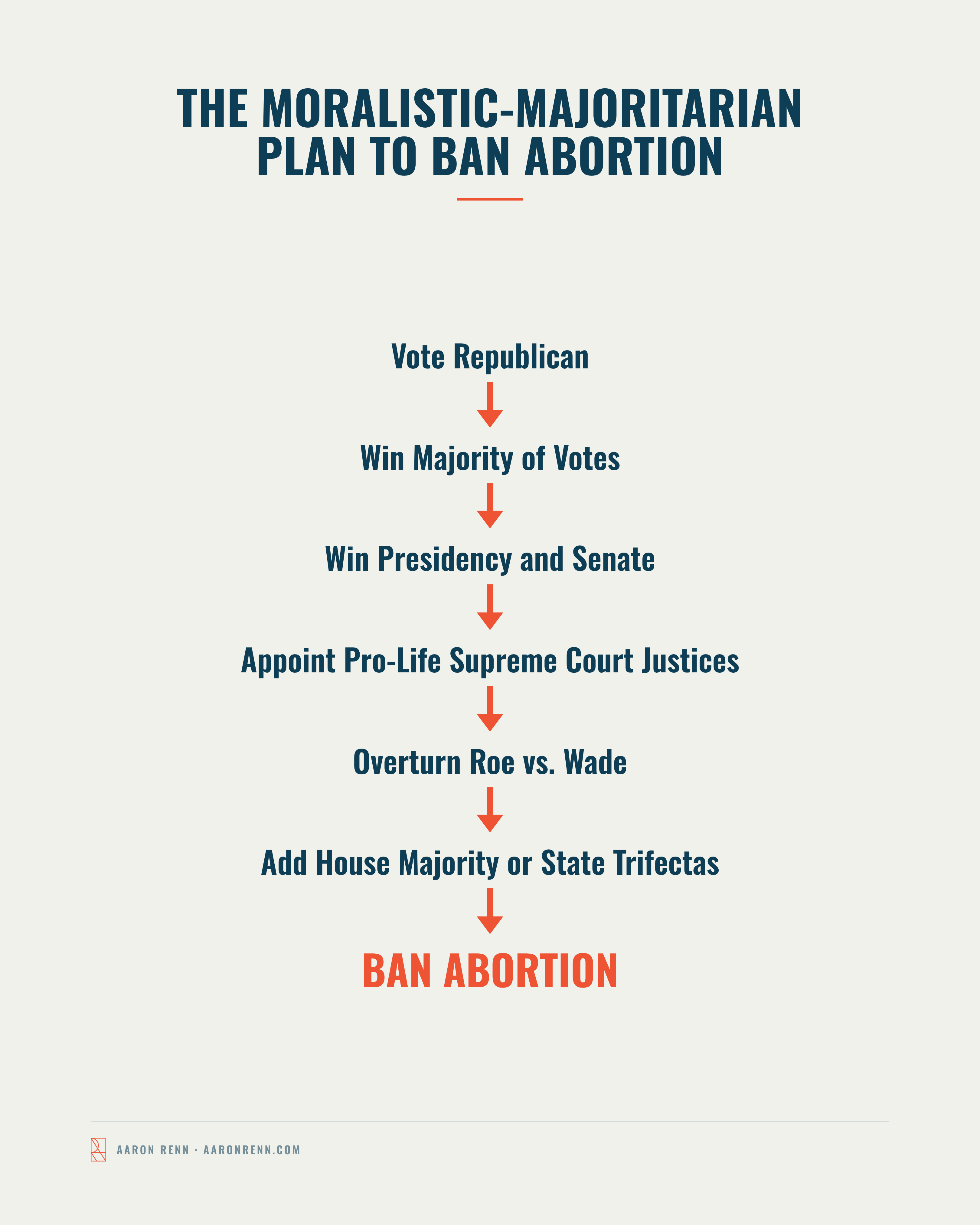
It’s no surprise that moralistic-majoritarian sounds like Jerry Falwell’s flagship social conservative organization Moral Majority. In my “three worlds” framework, this is a relic of the Positive World, in which Christianity is in decline but still viewed positively by society. In this era it was plausible - if not necessarily accurate - to claim that social conservatives still spoke for the American mainstream. The theory was that the secular left had been getting its way through institutional capture and procedural manipulation, but that their ideas weren’t actually held by most people.
Fast forward and America is now in a Negative World, where traditional morality and social norms are now expressly repudiated on a range of issues extending far beyond sexuality matters like abortion. This shift in the religious culture of America is one of the most important parts of the American transition now under way.
In this new, Negative World America, moralistic-majoritarian politics fails because social conservative positions are not actually supported by a majority of the people. Hence efforts to ban abortion lost momentum quickly after the repeal of Roe vs. Wade as this became clearly evident at the ballot box.
This is particularly hitting the pro-life movement because it has an audacious goal, and abortion is a particularly polarizing issue that has been subjected to repeated direct ballot box tests. But similar reckonings are coming for churches and denominations, Christian colleges, and other such groups and movements.
Despite what you are reading about a vibe shift, packed Catholic masses, or a Gen-Z religious revival, generational turnover is only going to accentuate this trend, eroding the demographic base of support for banning abortion. As Ryan Burge has noted, each generation is less religious than the last, and with the large and very religious Boomer generation set to pass on, this will produce a steep decline in the number of religious conservatives who are the base of movements like opposition to abortion. There’s no prospect of moralistic-majoritarian politics succeeding anytime soon, except on marginal or popular matters, or on a very temporary basis.
Political Coalition Implications
Moralistic-majoritarian politics on abortion - or other social issues - is a problematic fit for today’s Republican Party. Social conservatism was never that popular with the dominant libertarian/classical liberal and foreign policy legs of conservatism’s proverbial three-legged stool. Populist or MAGA conservatives are more interested in cultural conservative policies like immigration than social conservative ones like abortion. Add to these abortion bans being a proven electoral loser, and GOP politicians are going to pivot away from the issue.
The pro-life movement has done itself no favors within the Republican coalition by attacking Trump, and even opposing him during parts of the 2024 campaign, as prominent pro-life activist Lila Rose did. Politicians are never going to be fully comfortable with people who view themselves as on a holy crusade, and these behaviors are only going to further marginalize the movement.
Some pro-life people in one state I know complained to me that pro-life groups had been marginalized during their state’s process of developing abortion restriction legislation. I used to be puzzled by this, but after seeing how people like Marjorie Dannenfelser and Lila Rose conduct themselves, it now makes sense to me.
Pro-life groups have also lost credibility through many years of claiming polls showed that the public was on their side or was trending their way. This turned out to be completely wrong. Yet these organizations continue to publish what they claim are favorable polls. Susan B. Anthony Pro-Life America still maintains a polling dashboard. Live Action recently touted that a “new Pew poll shows gains in pro-life sentiment.” People are going to treat claims coming out of these groups with increasing skepticism - as well they should.
New Politics for a New Age
The travails of the pro-life movement augur for a new kind of politics for religious conservatives: prudentialist-minority.
It is minority politics in that it recognizes that their moral vision is not presently accepted by the majority of the public. It is prudentialist in that rather than taking an all-or-nothing stand on moral absolutes, it accepts that in a fallen world, politics will always fall short of a perfect moral standard. It asks what the most reasonable and realistic approach to improving the general welfare is right now in light of the present culture, public opinion, institutional and political realities, etc.
A prudentialist-minority approach recognizes that change is a long-term, probably multi-generational game, and that trends are running against the preferences of religious conservatives. Thus the first imperative is to sustain moral integrity within your own community. Then, while achieving what victories are possible within the realm of prudence, working to change hearts and minds in society over time. This project requires a broad-spectrum set of initiatives.
The left did this. The book The Sexual Revolution was published in 1936. The Summer of Love was in 1967 - 59 years ago. Today we are still going through the outworking of ideas and efforts ongoing for nearly a century. And sexual liberation proponents are still aggressively working for cultural, not just legal change. Christianity has pulled off similar changes over time, as with the early church itself and the abolition movement. So it has this tool in its toolbox as well.
The pro-life organizations no doubt feel they were playing the prudential coalition game, but when it came to be their turn to get what they wanted, the GOP pulled the rug out from under them. This is understandable. Still, keep in mind, they did get their biggest ask delivered, the repeal of Roe vs. Wade. But when it came time to then ban abortion, the times and public sentiment had changed. The GOP took big swings at this in some places, but electoral reality intervened. It’s not the Republican Party’s fault that the public was much less supportive of banning abortion than pro-life groups had led it to believe. It’s a different world today post-Dobbs, and post-referendums on abortion.
The Anti-Pornography Example
The religious right has already made this shift from moralistic-majoritarian to prudentialist-minority in at least one important area: anti-pornography activism. Not long ago, religious conservatives wanted to ban porn. Legally and culturally, that turned out to be a loser. No surprise, as Politico put it in 2018, “the GOP gave up on porn.”
In response, anti-porn activism changed its approach. Some organizations rebranded around opposition to sex-trafficking, a more popular cause. Porn itself was rebranded as a personal moral failing that needed to be opposed and disciplined inside the church. Non-religious couples today might happily be watching porn together at home, but the church was not going to accept porn for its own members.
The ubiquity of minors accessing hard core pornography on their smart phones opened a door to renewed political action. Nobody wants 11 year old boys having access to this material. So state legislatures have passed popular laws requiring age verification for access to porn. This won’t keep the likes of Pornhub out of those states forever, but it does show the kind of policy advances that are possible when there’s broad popular support for them. Prudentialist politics doesn’t necessarily mean you get nothing. And over the long term, who knows what shifts in public beliefs are possible?
I expect that it will take some time before the pro-life movement adjusts to this new reality. The current moralistic-majoritarian approach is deeply rooted in the pro-life ecosystem. The moralistic side of that is not a political ploy, but a deeply held moral conviction, one mostly aligned with historic church teaching. This conviction need not change in order to adopt a new political approach, but in practice it inhibits adopting one. The movement has a lot of older, long-time leaders and funders who are unlikely to change course at this stage of the game. The realities of demographic decline in the church have yet to become fully manifest to them.
But ultimately a new approach will be forced on them, if only to stave off irrelevance. Other religious conservative groups and movements should take note and adjust before they encounter their own crisis.
Cover image: Donald Trump with Marjorie Dannenfelser and others in happier times in 2017.
My friend Marjorie has forgotten a pretty important point. In 2016, Donald Trump was a pretty new convert to the pro-life cause, and took a typically maximalist position: if abortion is murder, then aborting mothers should be punished. This flipped the lids of pro-life leaders, who were TERRIFIED that they'd lose the country over this. So they attacked Trump mercilessly (admittedly in part because nearly all of them, like me, were for Ted Cruz) until he recanted.
Not at all unreasonably confused, Trump wanted to know why this perfectly logical conclusion was unwelcome. And our pro-life leaders told him: all we're asking from you is to overturn Roe. As a matter of principle, this is a state issue, it should not be addressed by the federal government, and we need you to appoint judges who will make that happen.
Trump took them seriously. Roe was overturned, which no one believed possible. And that created two problems for the pro-life movement, both self-inflicted.
First, Trump really did take them seriously. So once he made it possible to overturn Roe, he believed them -- the experts -- that there was no more need for federal action. Yes, he's against Planned Parenthood funding, and yes, I think under the right circumstances he'd prefer to let states ban the abortion pill. But if abortion is purely a state matter, how could he ban it outright? Californians want it, so the FDA needs to allow it, right? Makes perfect sense.
Second, the pro-life leadership circa 2016 didn't just ask for too little from a Trump who was willing to give them more than they wanted. They also had no plan for what would happen once Roe was overturned. Why? Well I've been in more than my share of those rooms, and I can tell you firsthand: hardly any of them believed Roe would ever be overturned.
Oh they said they did. They raised money saying they did. I think they told themselves they did (these are not bad people). But in their hearts, they thought Roe was part of the firmament, a permanent loss that would be undone "someday" but only after God provided a miracle. And they didn't believe Donald Trump was that miracle. Their mindset was like pre-1994 Republicans, who were certain there would never be a Republican House majority in their lifetime. The result was that when Roe was overturned, they were like the dog who caught the car.
They literally had no plan for what came next. They had no plan to convince Americans abortion was wrong. They had no answer when the abolitionists came along. They were caught flat-footed. Because they thought they'd be fighting Roe till the day they died. And suddenly Roe was gone, and they couldn't adjust.
Your points are correct, Aaron: I am certainly not arguing with you. I am, though, adding a bit that I personally witnessed and that I find utterly tragic. Some of us argued that Roe actually could be overturned, and thus that we needed a plan to convince and persuade, not to assume and to lecture. Yet here we are.
I'm very grateful for what Donald Trump has done for us. I'm very much saddened by the fact that it may take another generation for our movement to get its act together and actually win the hearts and minds of this people. And my sense is, that will have to come from churches evangelizing rather than any existing pro-life organizations, however valuable some of them might be or become.
It appears that non-religious coded communication against abortion or vice/social issues has been more effective than religiously coded communication. I think many were surprised when Donald Trump in presidential debates had his Democrat opponents on their heels when talking about abortion. Democrats would run against the make abortion illegal under any circumstance message. Trump, and Vance too, have pinned Democrats on the make abortion legal under any circumstance message. Comments from the former Virginia Governor, Ralph Northam, have added to Democrat problems with this when late-term abortions were brought up in the controversy. Non-religious coded messaging has come off as stronger and put opponents more on the defensive, which can lead to the opponents making a mistake.
Churches have not been effective at messaging against the growth of vice. My Catholic Church has poker, bingo, other forms of gambling at its annual summer festival. The Knights of Columbus sells square games for NFL scores. How are they going to be effective at talking about the downsides of gambling? How will they lobby against an advertising ban on gambling, similar to tobacco, when you see it in the church bulletin?