


The Atlantic’s September issue includes a remarkable story about the cities that decided to say Yes to drugs (gift link). This turned them into, in the words of the Atlantic’s own subtitle, a “zombie apocalypse.”
Late last year, I walked roughly a mile from downtown Seattle to the working-class neighborhood of Little Saigon and came upon a montage of human despair. An open-air drug market stretched along the intersection of 12th and Jackson: about 250 people, many smoking fentanyl or bent over in the thrall of the drug, tilting as if mid-fall. Three women lay passed out on the sidewalk, their chests slowly rising and falling, while fellow addicts stepped over them and dealers made sales. Young boys, schoolbags on their backs, stood on a far corner and watched.
I was in Seattle last month myself, and posted some reflections. The World Cup was in town, so it was vibrant - and perhaps the city cleaned drug addicts out of the some areas. But Pioneer Square and the U District were overrun with very disturbed people.
Under the philosophy known as “harm reduction,” some cities have effectively done much more than legalize drugs. They have allowed public drug dealing and consumption, and in some cases are actually underwriting it with city resources. While some programs like needle exchanges probably have some public health value, the net result is to make these cities extremely unpleasant or even unlivable for ordinary people, and especially families with children.
Drug addicts have taken over parks and playgrounds, making them unsafe for families to use.
I walked around the block to the Hoa Mai playground, named for a Vietnamese flower that signifies rebirth. City workers had installed gates to keep drug users away, but at 4 p.m. on a Wednesday, I counted 27 people smoking drugs and nodding off. No children were in sight.
In some cases, parks and playgrounds are literally closed and fenced off because of the amount of drug-related activity. Drug addicts are also menacing children going to and from school. Here’s a story from Burlington, Vermont:
A Burlington High School student told me that her teachers have instructed students to avoid eye contact with dealers and users. A week earlier, she said, an addict had trailed her home after volleyball practice. She broke into a run, yelling for help, and the person eventually turned away.
It’s a remarkable article, and you should read the whole thing.
This type of progressive politics and governance dysfunction is the result of decades of the hollowing out of leadership and civic life in cities. The loss of leadership capacity deriving from corporate consolidation, the disappearance or significant diminution of old-money families, managerialism, and other factors is one I’ve told many times. The Covid/BLM era dramatically accelerated this.
The result is that there is no longer an ecosystem of powerful civic actors and institutions that provide checks and balances against bad or extreme ideas like these. At best, these people and institutions work behind the scenes to mitigate problems. They rarely speak in open opposition these days outside of a few cities like San Francisco.
At the same time, the hollowing out of civic life among the citizenry has produced an apathetic electorate that barely bothers to vote in many places. The old voluntary associations and such used to represent constituencies cities had to pay attention to. Instead of this old civic fabric we now have NGOs that are top-down directed by politically motivated donors, often on the far left.
So there’s less stopping far-left politicians from getting elected, or standing in their way once they do, than there used to be. Yes, Oregon rolled back drug decriminalization, and San Francisco voted in a new mayor who’s been much tougher on open air drug dealing and consumption. But it took extreme circumstances to generate this correction.
Radical politics are not just a product of the alienation of young people. They are also an effect of the decline of local companies, institutions, leadership, family life, religion, political parties, etc. This decline has tangible consequences in the real world.
I’m not going to claim this is the only factor underlying the challenges facing cities. Economic forces are very large as well, for example. But most urban problems are partially downstream of this.
When Girls Join the Boy Scouts
One of our institutions that’s been in a long-term decline is scouting. Both the Boy Scouts and Girl Scouts have seen membership decline significantly over many years. The Boy Scouts in particular have had internal institutional trouble, with a large-scale abuse scandal and the departure of the LDS Church from participation.
One way the Boy Scouts responded to this decline was by admitting girls. The program was actually renamed Scouts BSA. Many girls seem to be taking advantage of this which is striking given that the Boy Scouts’ glory days are far behind it and it’s already in steep decline - arguably a sinking, scandal-plagued ship.
Erica Song wrote this month in the New York Times that this entry of girls has been a triumph. She writes about her own experience with a son and a daughter in scouting. Her son started in Cub Scouts, and her daughter was in the Girl Scouts. She describes what happens next:
When the Boy Scouts of America voted in 2017 to welcome girls into its core programs, I described Cub Scouts to my Girl Scout troop of 10 girls. Seven of them made the switch and have never looked back.
Song frames this in explicitly feminist terms as a triumph for girls. Richard Reeves of the American Institute for Boys and Men posted that it’s unfair that girls get to participate in boys’ organizations while maintaining their own girls-only ones as well. It’s courageous of someone in his position to say this.
But the debate over girls in scouting misses a critical element. Why are men’s spaces and organizations higher status than women’s in our society? In part, it’s because women themselves believe that those are the superior option. The girls of Song’s Girl Scout troop themselves judged their own organization inferior. No patriarchy made them do it or was stopping women from making the Girl Scouts as awesome as they want it to be. And yet they joined the Boy Scouts anyway. Women desire to be where men are, to do what men are doing, to join in male spaces.
With occupations, once the share of women reaches a certain level, men sometimes exit them. The field then often suffers from a drop in pay and status (which some argue is because employers devalue women’s work). Will something similar happen to the Boy Scouts? The fact that boys were already exiting before the girls showed up makes this future seem possible. Perhaps boys shouldn’t run away when girls join one of their spaces. But if it’s truly the content of the Boy Scouts that’s attractive to the girls, as Song suggests, boys leaving shouldn’t affect the desirability and status accorded to it by the girls. We’ll have to watch what happens.
Marrying Up
Women are performing better than men in some domains like higher education and selected professions. Sociologist Wendy Wang explores in both the data and her own personal experience how this creates challenges for those women in the marriage market.
She starts by talking about how women have tended to want to marry up in terms of status and income, and how her own mother had explicitly given her that advice. With so many women being professionally successful and making more money than men in many cases, this makes it harder for those women to find men who make as much or more money than them.
She cites a 2019 study that used the actual incomes of married couples to create “synthetic husbands” for unmarried women. Wang observes, “The ideal [synthetic] husbands earn about 58% more than the pool of unmarried men who are actually available, and they are also more likely to be employed and hold a college degree.” There’s a gap in the pool of unmarried men even at the base level of just being employed and having a college degree, to say nothing of income.
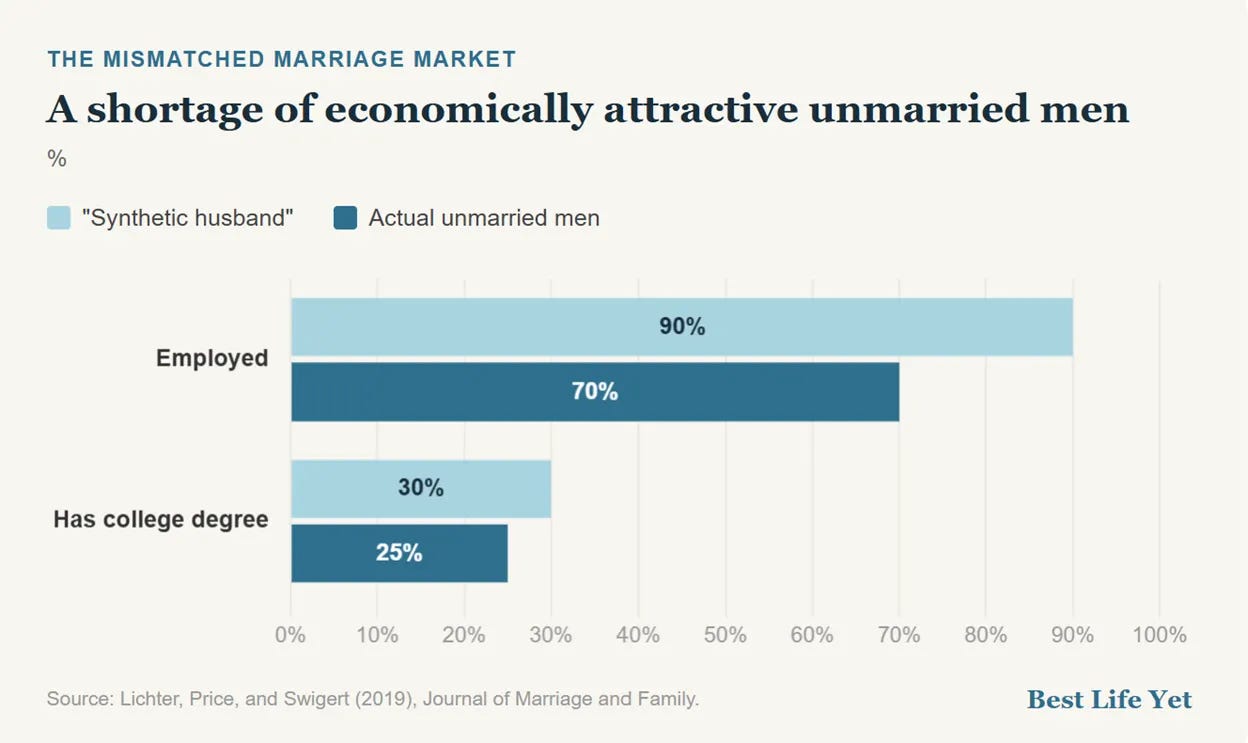
Wang observes, “The mismatch is clear. There simply aren’t enough single men for single women to marry up. If women want to marry, someone has to marry an equal or marry down.” It looks like even under a purely assortative-mating preference - marrying someone equal to yourself - there’s still a deficit.
This is forcing many women to either remain single or marry down. However, marriages where the woman earns more than the man are significantly more likely to end in divorce.
The Cut, New York magazine’s women’s publication, has an interesting article exploring some of the frustrations Gen Z women who date down have with boyfriends who are unemployed or underemployed.
Since the dawn of paychecks, women have made less than men. But while the overall wage gap persists, some Gen-Z women are living through a more hopeful reality….A few years ago, a Pew study found that in a handful of cities, like New York, Los Angeles, and Washington, D.C., young women are actually earning more than their male peers. With that extra money they are also buying almost twice as many homes as young men and saving for retirement at higher rates. Women of this generation are more likely than any other time in history to date a man who makes less than them — or who makes nothing at all.
Young men, I assumed, must be humiliated by this state of affairs, their masculinity in tatters. But for the most part, they seem comfortable with being pampered and paid for — maybe a little too comfortable.
The article provides numerous examples of these relationships, such as Naomi’s:
Naomi’s worst fear was turning into her boyfriend’s mother. But in truth, the 24-year-old paid for everything, helped him with his résumé, and made sure he was looking for jobs. He reassured her that he’d make some changes, like going to therapy and showing up on time when they hung out. Instead, things got worse. While she cobbled together a six-figure income working two retail jobs, he talked about applying to law school while lying in bed at her apartment on the Upper East Side, watching Reels on his phone.
It’s not hard to imagine that these kinds of dynamics are part of what’s behind falling rates of family formation and fertility. As with institutional decline, this is already starting to have real, tangible effects in the economy and elsewhere.
Best of the Web
Joel Kotkin: Scientists Who Believe in God Are Challenging the Expert Atheist Establishment - There is a growing view that a creator may be behind major discoveries being made in science
Ryan Burge: America is undergoing a vibes revival (WaPo gift link).
The statistical measures of American religiosity don’t actually point toward a significant uptick in religious belief and practice. Instead, a number of data points seem to support the notion that what the U.S. is experiencing is a vibes revival. The public’s sense that religion is roaring back is completely disconnected from what’s actually happening in America’s pews.
WSJ: America’s Big Cities Are Rapidly Losing Kids - The number of children is falling across the U.S., but the decline is especially pronounced in big metros
The Urban Institute, which, as the name implies, is a think tank focused on cities, just put out a study called “The Case and Means for Family-Friendly Core Cities.”
NYT: Even in Utah, Land of ‘Big Love,’ Families Are Getting Smaller (gift link) - Forget tradwives. When it comes to plummeting fertility rates, Utah is leading the country.
American Institute for Boys and Men: From awareness to action: Boys and men in U.S. policy - A good roundup of action in the states when it comes to policies designed to help boys and men.
New Content and Media Mentions
I got a link this week from Tim Challies.
New this week:
Why the Left’s Own Thinkers Predict New York Mayor Zohran Mamdani Will Fail - The modern American city is structured to attract capital, not to defy it.
The Reckoning Is Here - A Thanksgiving sermon in 1868, a demographic reckoning decades in the making, and the civic role the mainline church used to play
Where Is Politics Going Next? - The recording of this month’s Zoom discussion, exclusively for Members.
Subscribe to my podcast on Apple Podcasts, Youtube, or Spotify.
"With occupations, once the share of women reaches a certain level, men sometimes exit them. The field then often suffers from a drop in pay and status (which some argue is because employers devalue women’s work)."
Leftists are going to have to pick one (or neither, but definitely not both): Are employers greedy SOBs who want to pay the least they can and make the most money possible? Or do they want to overpay men just because they are sexist SOBs? Both can't be true.
From other articles I've seen about "marrying up" it seems that women with well paying jobs will marry men without college degrees but who also make good incomes (>100K). These guys are usually "high Proles", owners of profitable HVAC companies, roofing firms, auto repair shops, etc. Of course this tends to poach these men out of the working class marriage pool leaving those women with the less successful men.