

College on a Cattle Ranch
Forming young adults, phones and fertility, and more in this week's digest.

The challenge in forming young people into healthy, capable, successful adults is one of the most important any society faces. Well, here’s some good news on that front. The New York Times recently profiled Deep Springs College (gift link), a school that’s part of an active ranch, and how they are doing this successfully.
First, author Michal Leibowitz describes the problem our higher education institutions have had:
The last few years have not been kind to American higher education. There are the academic problems: widespread artificial-intelligence-enabled cheating; digitally castrated attention spans; rampant grade inflation. There are the political tensions: the collapse of public trust; the protests, encampments and counterprotests that were so mishandled on college campuses after Oct. 7; now the Trump administration’s research funding cuts and threats. And there’s the demographic cliff, finally here…These challenges have, rightly, occasioned some soul-searching for American higher education.
…
These reflections are a start, but they ignore a core problem at the root of so many campus and social issues. It is not just that we lack civility and the capacity to respectfully disagree, but that many of us live as collections of strangers, each pursuing our own ends, and that our college education does almost nothing to develop the sense that what we do in our day-to-day lives resonates with people beyond ourselves.
Oh, our schools claim to foster community. They advertise residential communities and student clubs and intellectual fellowship. But, in reality, many are opaque bureaucratized customer-service institutions that offer students little stake in a common life.
She then goes on to talk about Deep Springs College, and how it’s different:
“We all, technically, legally own the place,” Will Xu told me last year. We were sitting at a picnic table on the campus of Deep Springs College, a tiny, experimental school in the California desert where he is a student. The White and Inyo Mountains were ringed around us.
The college was founded in 1917 by a hydroelectric tycoon, L.L. Nunn. Today, Deep Springs educates about 26 students each year, offering them a free, two-year liberal arts education on a working cattle ranch. Many go on to elite colleges like the University of Chicago. After Mr. Xu graduates in June, he plans to work in tech policy.
The students of Deep Springs are the sole beneficiaries of the Deep Springs trust. This college is theirs to look after and to safeguard.
This isn’t a symbolic position. Of course, millions of American students work part or full time while trying to get an education. But the students at Deep Springs have an unusual kind of responsibility for their collective lives: They work as cowboys and butchers, they mow the lawns, and they serve on the board of trustees, the curriculum committee and the communications committee. They staff a team of volunteer firefighters, responding to accidents on the twisting roads beyond the school. They help make the food that feeds everyone here — students, faculty, staff members and their families.
And they care for the animals that share the ranch with them — the chickens, cattle, pigs and horses. Rebecca McMillin-Hastings, who graduated last year, described the process of cleaning an infected wound on the flank of a dairy cow named Euclid: “You just kind of have to get your soap in your water and, just like, push on the wound. And it really hurts her.” She described throwing her entire body weight against the animal, knowing that she was hurting her, feeling that she was hurting her, but also knowing that it had to be done.
Students aren’t just mixing manual labor with intellectual studies. They are intimately involved in running the college, learning how to steward an institution.
David Neidorf has filled just about every role there is at Deep Springs College over his many years at the school: lecturer, professor, dean, vice president of operations, president and interim dean again. He told me that most students come here to live up to some kind of demanding ideal. “They wanted more responsibility than they’re going to get — for their individual lives, for their communal lives — elsewhere,” he said.
The students must choose not only which classes to take but also which ones will be offered to the college at large. They help to pick the professors and to run the admissions process, and are involved in ever bigger decisions about the future direction of the college, like whether to hire someone for fund-raising.
There’s a lot more in this great piece, including a briefer look at Berea College. Be sure to read the whole thing.
Is It All About the Phones?
Birth rates have declined substantially, not just in America, but around the world. This suggests that falling fertility can’t be related to simply US domestic factors, since the same thing is happening in a wide range of countries, with a diversity of cultural and religious backgrounds, in every region of the world.
John Burn-Murdoch at the Financial Times took a look at this, and suggests that the advent of the smart phone played a big role. First, he notes the global nature of fertility trends:
In more than two-thirds of the world’s 195 countries, the average number of children born to each woman has fallen below the “replacement rate” of 2.1 that keeps populations stable without immigration. In 66 countries, the average is now closer to one than to two. In some, the most common number of children born to each woman is zero.
He then hits a point I’ve referenced before, namely that a decline in marriage/partnering rates at least partly underlie this, not merely an across the board fertility decline.
In previous decades, the world’s fertility rate went down because couples had fewer children. Now the main reason is that there are fewer couples. Had US rates of marriage and cohabitation remained constant over the past decade, the country’s total fertility rate would be higher today than it was 10 years ago.
A pioneering study by demographer Stephen Shaw shows that in the US and most high-income countries, the number of children that mothers give birth to is stable or even rising. But the proportion of women who have any children at all has fallen steeply in the past 15 years.
The decline in partnering among young people is really incredible, as his chart shows.
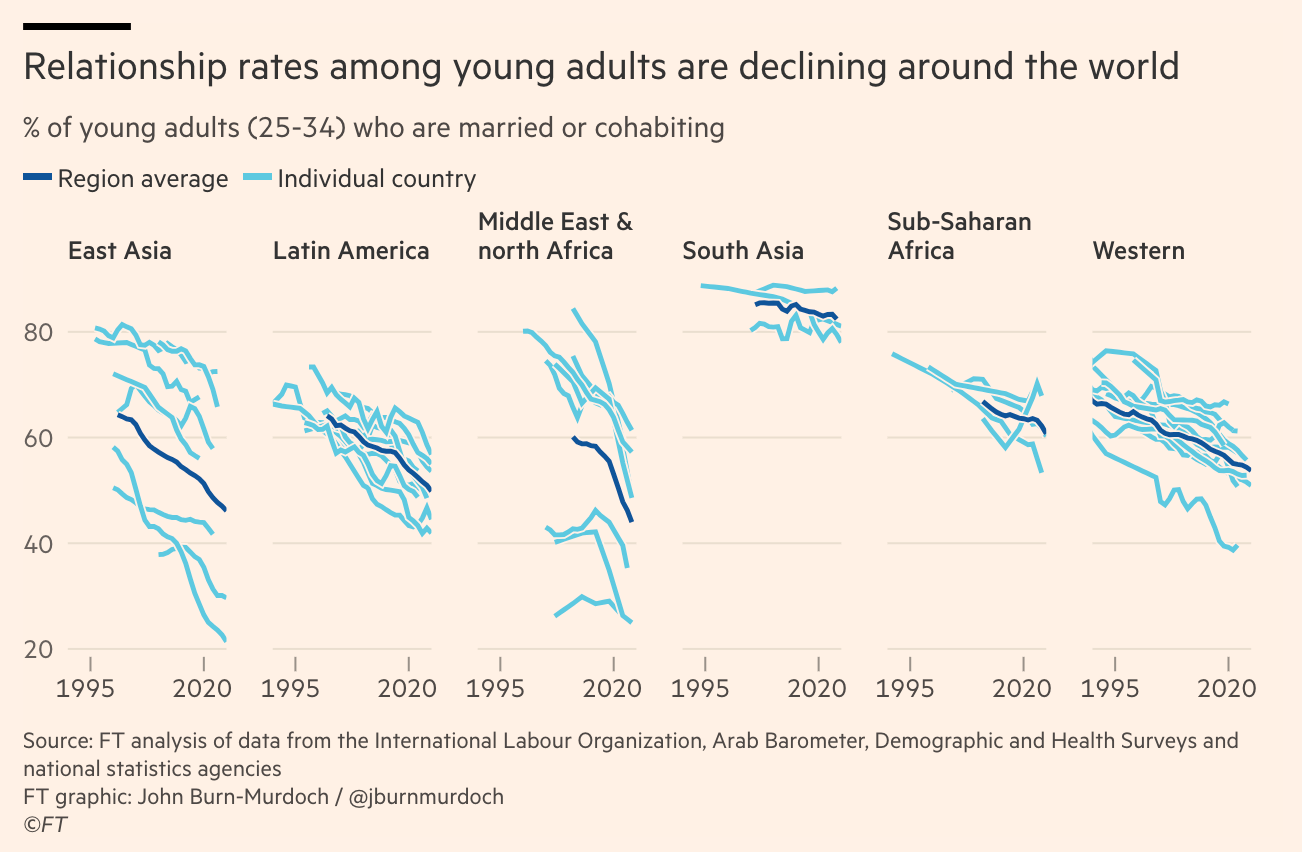
He goes through various explanations ranging from economic stresses to rising female accomplishment before dialing in on the key factor of the smart phone:
Dissatisfied with purely economic explanations, researchers are beginning to point the finger at a new culprit — the digital devices and platforms that play an outsized role in young people’s lives across the world.
Nathan Hudson and Hernan Moscoso-Boedo of the University of Cincinnati published a paper last month looking at birth rates through the lens of the rollout of 4G mobile networks in the US and UK.
The number of births fell first and fastest in the areas that received high-speed mobile connectivity earliest. The authors argue that smartphones have transformed how young people spend time with one another, sharply reducing in-person socialising and leading to the collapse in their fertility.
For example, US, British and Australian birth rates for teens and young adults were broadly flat during the early 2000s but began to fall markedly from 2007.
The same slide began in France and Poland around 2009, and in Mexico, Morocco and Indonesia around 2012. What had been steady declines in fertility in Ghana, Nigeria and Senegal became precipitous drops between 2013 and 2015.
All of these inflection points coincided with the mass adoption of smartphones in local markets — as measured by Google searches for mobile apps.
In country after country the birth rate plunged after the introduction of smartphones, no matter what the previous trend was. The younger the age group, the more pronounced the downturn — a mirror image of smartphone usage patterns.
Melissa Kearney, professor of economics at the University of Notre Dame, says it is “quite plausible that the modern digital media environment has had profound effects on society that have led to a decline in romantic coupling”.
This is a longform FT “big read” piece that’s well worth reading in its entirety, if you can get past the paywall.
I can’t help but contrast the intentional and highly physical formation of young people at Deep Springs College with the more purely digital formation shaping most of our young people today - a formation with profound consequences for their lives and our society, as the FT piece shows.
Related in the NYT: They Started I.V.F., Then Split. Now Who Gets Custody of the Embryos? (gift link)
Catholic vs. Protestant Culture
Another interesting data post from scholar Ryan Burge sheds additional light on Protestantism as a superior engine of human capital development.
I’ll start with Burge’s conclusion:
What I take away from all of this is that evangelical identity carries something that can’t be fully explained by how often you show up or how conservative you vote. There’s a theological and cultural foundation to evangelicalism that shapes how adherents think about the body, sexuality, and the family in ways that Catholic identity simply doesn’t replicate — even among the most devout and politically conservative Catholics. The Church may teach the same things on paper, but the people in the pews aren’t internalizing them the same way. And that gap between official teaching and lived belief is, frankly, one of the most interesting stories in American religion right now.
Let me state this a different way: in Protestantism, there’s a high standard for the laity. They are expected to both believe the full teachings of the church, and put them into practice in their own lives. Whereas Catholicism, practically speaking, has much lower expectations of the laity. Culturally, lay Catholics feel free to dissent from the teachings of the church.
If this is true of theological matters, how much more is it true of secondary matters such as the famed “Protestant work ethic”?
Burge illustrates this by looking at social conservative beliefs. He has previously shared data showing that Catholic views on social issues are often not aligned with the teachings of their own church. This drew critiques from Catholics who argued that these results were only because he’s including nominal Catholics or some such. His new post attempts to take that critique seriously.
So let’s test out this idea that Catholics are just as socially conservative as evangelicals by pulling in both things that we’ve learned. I am going to show you three graphs: the entire sample of evangelicals and Catholics, only weekly attenders of those two groups, and finally only weekly attenders who also identify as politically conservative. That way we can control for those differences as much as possible.
There are some very interesting charts in there, but I’ll just share this one. It’s the share of people who believe pre-marital sex is always wrong. I think this is an interesting point to look at because while believing that will make someone look culturally retrograde or strange, it’s not one of those “third rail” issues that can get you cancelled.
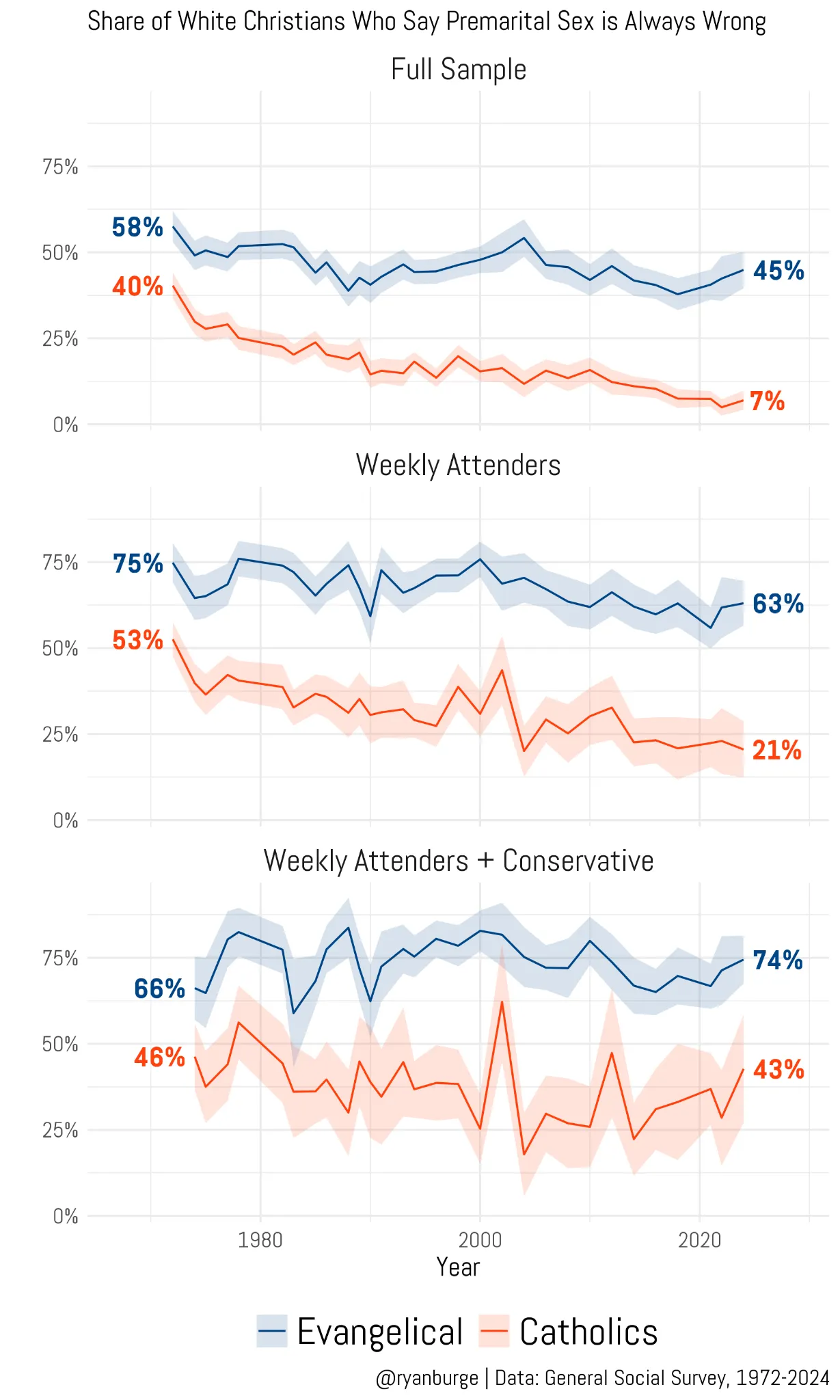
Even when looking at just weekly white attenders who are conservative - and keep in mind, that excludes the larger share of Catholics vs. Protestants who attend weekly but aren’t conservative - still less than half of Catholics believe pre-marital sex is always wrong.
Evangelicals are far from perfect when it comes to believing their church’s nominal teaching, let alone practicing it, yet Catholics score worse. Again, being unable to convince even half of its regular, explicitly conservative attendees to even believe its own teachings, I’d argue Catholicism is much less likely than Protestantism to function as a broader engine of human capital uplift. Protestantism is more transformational of people’s beliefs and practices.
Catholicism has many positive attributes, as I’ve highlighted in my book and elsewhere, but this is an area where Protestantism shines. The decay of Protestant culture is thus very consequential for the country, and its role cannot be plausibly replaced by Catholic culture, even were some great religious transformation to occur.
There’s a lot of great material in Burge’s post, and I’d encourage you to read the whole thing.
I should note that this analysis only looked evangelicalism. Mainline Protestantism may have lost some of this traditional function. It’s a bit harder to say using the same analysis, since many of these churches no longer promote traditional moral teachings, at least not with any vigor.
But mainline Protestantism is a repository for other virtues that are in increasingly short supply in our country. Just look at Burge himself. He’s an archetype of the high-minded mainline Protestant man who is interested in truth, fairness, and getting it right above merely championing his own team or cause. If you read him, you know that his analysis is not sectarian. He may not always be right. He’s not above criticism. But you see all too few people even trying these days. The production of this type of person is another thing Protestantism historically did well in America, and we feel keenly today the loss of that ethos.
What It Takes to Shape Culture
I wrote earlier this week about the meaning of the cancelation of CBS’s Late Show with Stephen Colbert. But there’s another lesson to learn from this. CNN’s Brian Stelter tweeted this picture of the staff of Stephen Colbert’s show gathered on the Late Show stage:


This prompted an outpouring of contempt from conservatives, who mocked what they see as the show’s bloated staff, and how it was losing an estimated $40 million per year on a budget of $100 million.
I’m sure the show could have been produced with fewer staff on a leaner budget. But this is consistent with a longstanding observation that I’ve had that conservatives have no idea the amount of talent and money it takes to produce compelling and impactful media and cultural products. Hence, their efforts are chronically understaffed and underfunded, limiting their broader cultural impact.
Best of the Web
In last week’s digest, I mentioned conservative institutional neglect of libraries. A librarian wrote to me to agree that few conservatives become librarians. But he did want to point me at the Association of Library Professionals, a new association of librarians who want the profession to stay true to its historic mission and avoid the turn towards social activism.
Samuel Abrams/AEI: Civic Knowledge Is Returning. Civic Formation Is Not.
NYT: What to Know About the New Obsession With Testosterone (gift link) - From politics to influencers and beyond, the hormone is being used not just for medical reasons but in pursuit of a new masculine ideal
WSJ: More Dads Are Scaling Back at the Office for Kids and Housework (gift link) - College-educated men lead the way among dads sacrificing hours at work for time at home
The Palme d’Or at the Cannes Film Festival this year, one of the most prestigious awards in film, went to “Fjord.” This film is apparently about an evangelical family from Romania that moves to Norway, where child protective services tries to take their children away from them. It’s very interesting to see a film with this theme win such an award, and I wonder what the political subtext is. (For example, is the real meaning a commentary on how the much larger Muslim immigrant population of the Nordic countries are treated?) But interesting regardless. I hope this film shows near me so I can go see it.
New Content and Media Mentions
I got a mention this week from Fortune magazine and from Tim Challies. I was also a guest on the Immanuel Network Podcast.
New this week:
Stephen Colbert Didn’t Get Cancelled - Mass Culture Did - From 55 million to 6.7 million viewers in 34 years — and what that tells us about the end of America’s shared mass-media, mass-consumer culture
Nihilism with a Business Model - The gig economy didn’t just change how we work. It changed how we imagine ourselves. A guest post by John Seel.
Subscribe to my podcast on Apple Podcasts, Youtube, or Spotify.
For good and ill, Catholicism often has a more forgiving attitude toward sins of the flesh than (especially American) Evangelicalism. Dante puts passionate sins on the outer margins of Hell, and his portrayal of lovers damned for their sexual sin (Paolo and Francesca in one of the early cantos of Inferno) shades more toward tragic sympathy than condemnation.
The ill effect of the is, of course, that expecting little of people results in little virtue. The disposition toward a tragic sensibility about sin can become passivity.
Going to Deep Springs College was my dream in high school and getting rejected there remains one of my biggest disappointments. The article understates or omits three key things about the school.
1) Until 2018 it was, in accordance with the will of its founder, LL Nunn, an all-male college.
2) It’s part of a larger network of Nunnian education that also includes the Telluride Association, which went mega-woke. You can read about it in Compact here: https://www.compactmag.com/article/a-black-professor-trapped-in-anti-racist-hell/
3) It’s super elite. When I applied to college in the fall of 2013, I was accepted into Harvard early action but rejected by Deep Springs. They had a two-round admissions process, and I didn’t even make it to the second round.
On paper there’s no reason why an eccentric Christian philanthropist couldn’t set up a school like this for evangelical Christians. Given the small size of the institution, the usual lack of elite evangelicals problem doesn’t apply. 26 college students and a handful of professors isn’t a big ask. And I imagine evangelicals would be disproportionately interested in this kind of education (all-male, service-oriented, work-college, wilderness environment). Maybe someday soon...